
Home Services & Solutions Translation software Do Modern AI Translation Tools...
CIO Bulletin
,
24 July, 2026
Author:
Sambhrant Das
Advanced translation platforms evolve beyond simple text substitution to deliver context-aware multilingual processing across cloud platforms and global business systems.
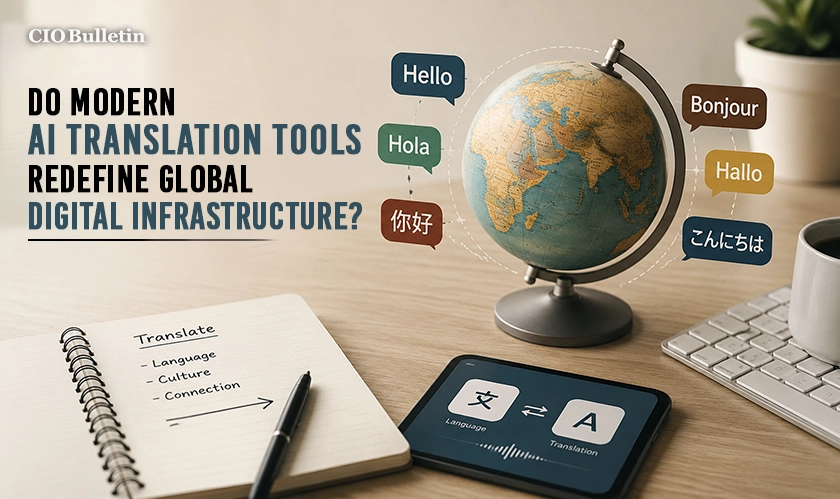
Selecting an enterprise localization engine has shifted dramatically from simple speed metrics toward context-aware intelligence, API flexibility, and structural workflow integration. Modern AI translation tools analyze complete conversational structures rather than isolated phrase fragments, providing accurate semantic preservation across global platforms. As international organizations build products for diverse markets, embedding translation capability directly into underlying cloud architecture has become essential for scaling real-time communications.
Current enterprise translation solutions cater to distinct operational requirements depending on existing technology stacks and accuracy goals. Systems range from broad cloud provider engines to specialized high-accuracy translation models.
Key platform offerings include:
Google Cloud Translation v3: It offers broad coverage across 130+ languages, custom glossary management, and batch document processing in one place
DeepL API: It delivers high precision translations for many major European languages, being the go-to option for nuanced business writing.
Lara Translate & Amazon Translate: These offer context driven communication for everyday enterprise use and they plug into AWS cloud pipelines naturally as well.
Sticking closely to industry glossaries, brand tone, and regional levels of formality is non-negotiable when translating specialized B2B content.
"Modern AI translation systems analyze language patterns more intelligently by processing complete meaning instead of isolated text fragments," experts at The AI Journal noted in their technology assessment.
Handling custom terminology properly ensures technical manuals, legal notices, and financial statements are fully accurate, and it also helps keep their original formatting intact.
Automated engines can move through huge volumes instantly, but sustaining brand trust needs a structured human oversight beyond just casual checks. When machine speed operates alongside expert review, the reliability of customer-facing materials tends to improve significantly. Moreover, embedding real-time translation across customer support touchpoints, documentation repositories, and internal messages allows companies to lower cross-border operational friction, while at the same time broadening their global reach.
If language translation is treated like foundational infrastructure, not just a standalone utility, multinational companies can move with more agility. As multimodal models keep getting better, cross-language processing will, bit by bit, connect speech, visual text, and document repositories in a smoother manner. CIO Bulletin sees this as a strategic shift, where AI-driven language processing becomes a core pillar in today’s enterprise IT planning.
Everything you need to know about this news
Because they deliver contextual understanding, automated glossary guardrails, and real-time integration inside global cloud applications.
DeepL API is widely recognized for delivering superior nuance and fluency across major European language pairs.
It supports 130+ languages, batch document workflows, and custom glossary administration for large-scale rollouts.
Not really. The smartest mix is high-speed AI translation plus human checking; it gives the best tradeoff between efficiency and precision for documents that really matter.
Technology leaders and corporate strategists can follow emerging software trends and policy analysis directly on CIO Bulletin.



















































 consultants ltd.jpg)


Comments