
Home Industry ERP AI ERP Software Upgrade Reinve...
CIO Bulletin
,
18 May, 2026
Author:
Gayathri Sr
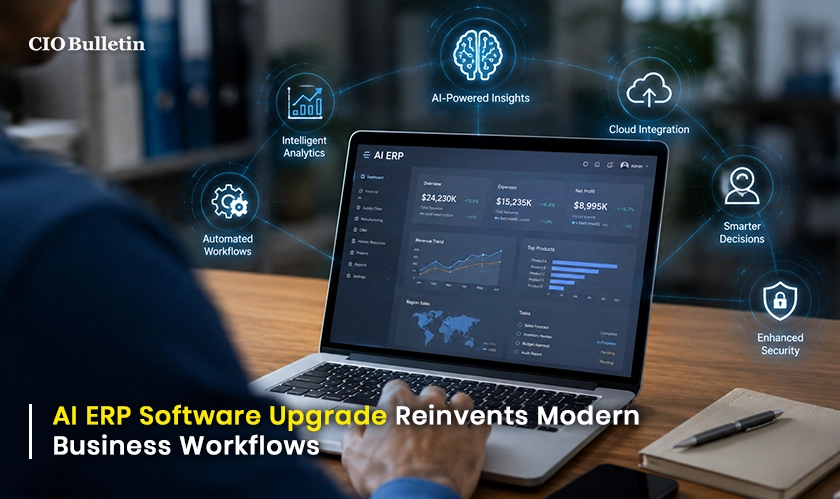
A quiet revolution is brewing in the corporate world, transforming traditional enterprise software from a passive storage vault into an active, thinking collaborator.
Imagine an office where routine paperwork vanishes, financial reconciliations happen in seconds, and inventory shortages are predicted before they even occur. This isn't a futuristic concept; it is the current reality of enterprise resource planning. The global business landscape is witnessing a massive shift as traditional management systems evolve into intelligent ecosystems. Leading this transformation is the integration of advanced AI ERP software, a technology designed to handle heavy operational lifting so human teams can focus on growth.
According to global tech platform CIO Bulletin, the ultimate goal of modern enterprise tech is to eliminate the friction that slows companies down. The latest breakthrough in this space comes from Priority Software’s V26.0 release, which introduces dedicated digital assistants directly into the corporate nervous system.
Rather than forcing employees to navigate complex menus, the latest evolution in AI ERP software allows users to manage operations using simple, everyday language. By embedding an intelligent companion alongside specialized automated agents, the system independently manages tedious tasks across critical departments.
These digital agents are already reshaping three core business pillars:
Finance: Streamlining invoice processing, generating journal entries, and executing rapid bank reconciliations.
Sales & Supply Chain: Automatically creating purchase orders, setting up new vendors, and performing real-time inventory counts.
Predictive Analytics: Assessing market signals to forecast future collections and detect financial anomalies before they impact the bottom line.
"Our focus is outcomes," stated Sagive Greenspan, CEO of Priority Software. "The companion and specialized agents analyze signals, trigger workflows, and execute routine operations inside the ERP, reducing manual effort while elevating decision quality."
This shift toward autonomous operations marks a turning point for the 75,000 customers relying on these tools worldwide. By bridging the gap between human intent and complex data, businesses are experiencing fewer errors and unprecedented operational speed. For organizations looking to stay ahead, the message is clear: the future belongs to companies that let their software do the thinking.

















































 consultants ltd.jpg)


