
Home Technology EV and Concept cars Europe’s Battery Electric Ve...
CIO Bulletin
,
19 June, 2026
Author:
Ravathi Sunil
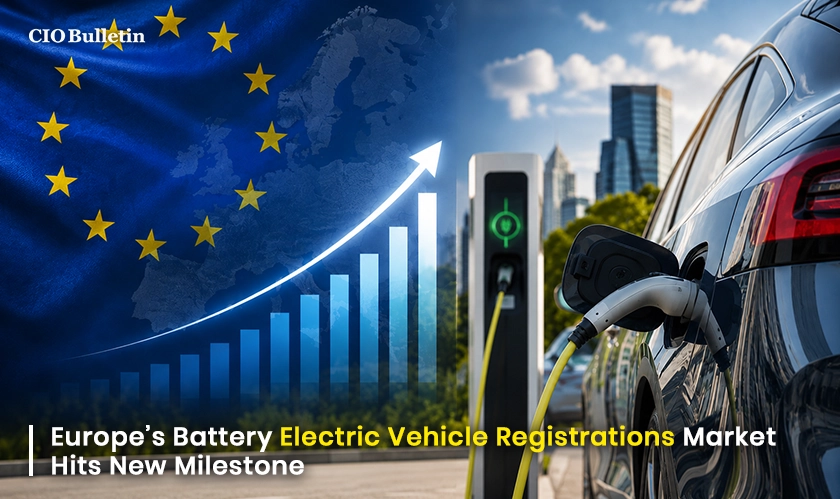
As registrations approach all-time highs, the battery electric vehicle market in Europe reaches a new milestone that reflects the region's fast EV transition and expanding customer adoption.
Registrations of battery electric vehicle registrations in Europe hit a record market share in May, continuing their robust growth as demand was boosted by subsidies, legislative backing, and rising gas prices.
In May alone, 212,387 EVs were sold in 17 major European countries, making up 23.6% of all new cars sold during that time. 962,010 electric vehicles have been sold in these 17 territories so far this year, bringing the total number of EV registrations to close to one million.
“Electric vehicles are one of Europe’s biggest growth stories in 2026.”- Chris Heron, Secretary General of E-Mobility Europe.
With a 29.5 percent BEV share in May, France dominated Europe's major markets because of its security strategy and decreased reliance on oil. With 59,969 registrations and a 41 percent year-to-date rise, Germany hit 25 percent. Italy continues to have the fastest growing market on the continent, with registrations up more than 100% so far this year because of new fresh subsidies.
With a market share of 78.7 percent for Denmark, 41.3 percent for the Netherlands, 49.6 percent for Finland, 36.8 percent for Belgium, and 41.2 percent for Sweden, the Nordics and Benelux continued to lead the way. Slovakia, Romania, Poland, and Spain have all seen year-to-date growth of more than 28%.
More people are beginning to view electric cars as a moving extension of the world's energy transition rather than merely a greener mode of transportation. CIO Bulletin views this as every EV signifies a move away from reliance on fossil fuels and toward electricity, ideally produced by renewable energy sources like solar and wind.
EVs serve as flexible energy assets in addition to lowering tailpipe emissions. They can assist in stabilizing power networks by absorbing extra renewable energy when supply is high and demand is low through smart charging. Vehicle-to-grid technology in sophisticated systems enables EVs to transmit electricity back to the grid during periods of high demand, converting automobiles into distributed energy storage devices.
















































 consultants ltd.jpg)


Comments