
Home Technology IT Services The CIO Field Notebook: A Four...
IT Services

CIO Bulletin,
19 May, 2026
Author:
CIO Bulletin Team
Outsourced IT delivery spend across the Asia-Pacific corridor crossed 215 billion dollars in the most recent fiscal year, according to industry estimates compiled by analyst desks tracking the India, Vietnam, Philippines, and Singapore quadrant. The gap between delivery-partner capacity claims and delivery-partner capacity reality has widened in roughly the same proportion.
This field notebook documents one such audit. Over eighteen days in February the CIO of a mid-market North American enterprise visited nine delivery centres across four APAC countries, completed thirty-one structured interviews with delivery leads and quality managers, and returned with a consolidated scorecard that displaced one incumbent partner, confirmed a second, and put a third on probationary status. The trip cost approximately nineteen thousand dollars, fully loaded, and avoided a renewal decision the audit committee later estimated at six million dollars in downside exposure over the contract term. The savings number is not the point.
A four-country APAC vendor audit is executable in eighteen days when the route is sequenced Bengaluru, Ho Chi Minh City, Manila, Singapore, with each leg booked as a direct flight under five hours.
The right cadence is two delivery-centre visits per non-travel day, one per travel day, and one rest day per eight-day window; deviation from this cadence is the single most common reason a multi-country audit returns with degraded data.
A standardized eight-line scorecard, completed on site at each visit and signed by the accompanying procurement lead, is the instrument that turns a tour into a decision; the worst audits return with twenty anecdotes and zero comparable scores.
Local-carrier coverage in the APAC corridor varies sharply by city block; in industrial parks outside Bengaluru and on the Manila-Cavite expressway, partner-network handoffs degraded often enough during the route to warrant redundant data provisioning.
The most expensive variable in a multi-country APAC audit is the CIO's calendar; the second is the visa-and-entry stack, where Vietnam's e-visa lead time and the Philippines' on-arrival rules each compress the planning window.
The audit was scoped seven weeks before the first flight. The IT procurement function had narrowed the delivery-partner shortlist to twelve candidates across the four countries. The operations committee had asked the CIO to validate the top nine in person before contract negotiations opened in the first quarter. The scope statement fit on one page and named three decision categories: delivery-team retention under sustained demand growth, security-and-compliance posture benchmarked against ISO 27001 and the client's SOC 2 Type II controls, and balance-sheet resilience under a sustained currency or wage shock.
A standardized field instrument was developed before departure. The instrument is an eight-line scorecard, filled in by the CIO at the close of each delivery-centre visit and counter-signed by the accompanying procurement lead. It captures workforce attrition over the trailing twelve months, billable-utilization rate, on-time-with-quality delivery against committed sprints, lead-to-engineer ratio, incident-log integrity, security-control evidence, key-person dependency, and capital-investment trajectory. Each line is scored zero to four. Thirty-one interviews and nine site visits later, the scorecards consolidated into a single nine-row matrix the operations committee approved in a single sitting.
The route was anchored on direct flights. Bengaluru to Ho Chi Minh City, Ho Chi Minh City to Manila, Manila to Singapore, then Singapore back to the home hub. The sequence was not aesthetic. It was arithmetic. Each leg cleared customs inside a working day, with the CIO walking into the first delivery centre on the morning after arrival. Routing through Hong Kong or Tokyo would have added two travel days the calendar did not have.
Days one through five, India. Three delivery centres across Bengaluru's Outer Ring Road and Whitefield corridors. The Indian leg established the calibration baseline because the delivery base remains the APAC reference standard for engineering-talent depth. The Whitefield centre, a tier-one provider with eleven hundred billable engineers on the account, scored a three-point-seven average across the eight lines. That score became the comparator for every subsequent visit. Attrition data was the most contested line item; the centre reported nineteen percent annualized, while the floor walk and exit-interview log suggested a number closer to twenty-three.
Days six through nine, Vietnam. Two delivery centres in Ho Chi Minh City's District 7 and Thu Duc. The Vietnamese leg tested the diversification thesis. Wage inflation in India has driven mid-market enterprises to second-source significant tranches of work into Vietnam, and the audit needed to validate whether the delivery-quality differential had closed. The Thu Duc centre, a five-hundred-engineer operation with a Japanese anchor client on the floor above, scored three-point-four. The District 7 centre scored two-point-nine. The differential was traced to lead-to-engineer ratio, which sat below the audit threshold at the second site.
Days ten through fourteen, the Philippines. Two delivery centres in Bonifacio Global City and one in Cebu, reached by a single short-haul domestic flight. The Manila leg tested the customer-experience and voice-process thesis; the city remains the global reference for English-language service delivery, and one of the candidate partners had proposed a hybrid engineering-plus-support model the procurement function wanted validated on the floor. The Bonifacio Global City centre scored three-point-five. The Cebu centre, with a younger team and a stronger investment trajectory, scored three-point-three but had the highest year-over-year capital-investment line item in the entire portfolio.
Days fifteen through eighteen, Singapore. One delivery centre and two corporate-headquarters meetings at the regional principals of the candidate partners. The Singapore leg was not a delivery-volume play. It was a governance check. The CIO needed to sit across from the regional managing director of each shortlisted partner and stress-test the escalation-and-remediation language in the master services agreement against actual on-the-ground accountability. The conversation in Singapore is what closed the matrix.
The scorecard format that survives a multi-country audit has three properties. It is short enough to complete in the final twenty minutes of a site visit. It is concrete enough that two procurement leads would score the same site within half a point of each other. And it produces a matrix the operations committee can read without a translator. Eight lines, zero to four, signed at the close of the visit. That was the instrument.

The matrix produced by this audit was nine rows long. Four sites scored above three-point-five and were retained. Three sites scored between three-point-zero and three-point-four and were placed on a six-month performance plan. Two sites scored below three-point-zero and were exited at the next renewal window. The committee approved the matrix in a single sitting because the underlying scores were defensible at the line-item level; every row could be traced back to a signed scorecard with a date, a delivery-centre name, and a counter-signature.
The CIO's calendar across the eighteen days carried twenty-four scheduled interviews and seven walk-the-floor sessions; nine of those sessions ran inside delivery rooms where wall-mounted monitors displayed live ticket queues. Those sessions, captured in the audit notes as live-operations walk-throughs, produced the highest information density of any item on the trip. They are the reason the matrix held under board questioning.
Multi-country audits rest on a connectivity assumption the planning deck rarely names. The assumption is that the CIO can receive the security-incident escalation, join the audit-committee bridge, and pull the latest scorecard from a shared drive within minutes of landing in each new jurisdiction. The assumption is wrong more often than not. Local-carrier coverage in the APAC corridor varies sharply between airport, hotel district, and industrial park, and the inter-country handoff window is where most executives lose two to three working hours per leg.
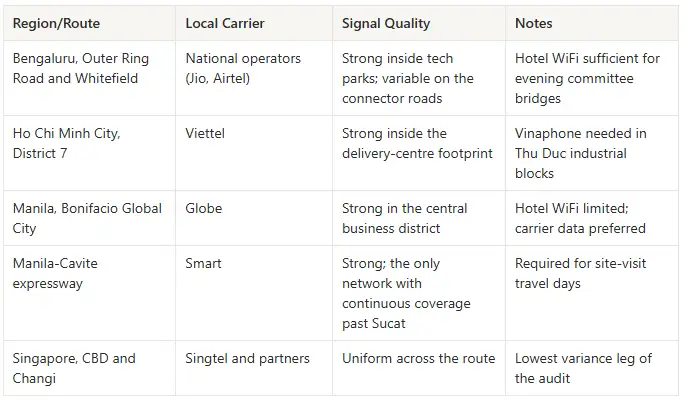
The audit route ran through four distinct mobile-network jurisdictions, each with its own dominant carrier and its own coverage profile inside the delivery-centre districts. In Bengaluru the dominant signal inside the Outer Ring Road tech parks ran on the national carriers, with measurable variance between Whitefield and Electronic City. In Ho Chi Minh City the District 7 corridor ran reliably on Viettel, while the Thu Duc industrial park showed gaps best filled by Vinaphone. In Manila, Globe held the Bonifacio Global City core, while the Cavite expressway segment was where partner-network handoffs degraded. Singapore was uneventful. On the Manila-Cavite segment the CIO ran HelloRoam's day-pass, which connected via Globe on the city core and handed off cleanly to Smart on the expressway, which is the only network with continuous coverage past the Sucat exit.
The coverage table below consolidates the route-level signal experience across the four jurisdictions, drawn from the audit-trip phone log rather than a marketing datasheet.
The provisioning conversation between the CIO and the IT operations team happened in the second week of the planning window. The agreement was that the device fleet would carry one regional data plan with carrier-network fallback across the four jurisdictions, that the corporate VPN profile would be validated against each carrier APN before departure, and that the security-incident playbook would be tested with a simulated escalation from each city. The simulation surfaced one unresolved firewall rule on the Manila gateway, which was fixed before the boarding pass for the second leg was printed.
The audit closed on the return leg. The matrix was consolidated into a one-page summary, the scorecards were filed against the audit-committee folder, and the partner-by-partner negotiation positions were drafted before the wheels touched the home runway. The board sign-off came in the following Tuesday's session. The point that lands with the board, every time, is that the decision rests on signed scorecards from named delivery centres rather than on a Q-and-A with a sales engineer. That distinction is what justifies the eighteen days and the nineteen thousand dollars.
How long should a four-country APAC vendor audit take? Eighteen days is the operating standard for a four-country APAC delivery-centre audit covering nine sites. Compression below fourteen days degrades the scorecard quality; extension beyond twenty-one days erodes the CIO's calendar return on the trip.
What should be on the supplier scorecard for a delivery-centre audit? Eight lines, scored zero to four: workforce attrition, billable utilization, on-time delivery, lead-to-engineer ratio, incident-log integrity, security-control evidence, key-person dependency, and capital-investment trajectory. The scorecard is signed at the close of the visit.
Why visit in person rather than rely on a virtual due-diligence review? A live floor walk surfaces information that a slide deck cannot. Ticket queues, attrition signals, and lead-to-engineer ratios are visible to a trained observer inside twenty minutes; they are invisible on a conference bridge.
How should the CIO stay reachable across India, Vietnam, the Philippines, and Singapore? A regional data plan with carrier-network fallback across the four jurisdictions, a corporate VPN profile validated against each carrier APN before departure, and a simulated security-incident escalation tested from each city. Hotel WiFi is treated as backup, not primary.
What is the right way to sequence the route? Bengaluru, Ho Chi Minh City, Manila, Singapore, with each leg booked as a direct flight under five hours. This sequence respects visa-and-entry timing for Vietnam, conserves the calendar by keeping each transit under a working day, and ends the trip in the jurisdiction where the governance conversations are held.




















 consultants ltd.jpg)


