
Home Technology Database management AWS Launches Graviton Powered ...
CIO Bulletin
,
14 May, 2026
Author:
Gayathri Sr
New integrated engine promises to end unpredictable billing spikes while unifying the modern data lakehouse.
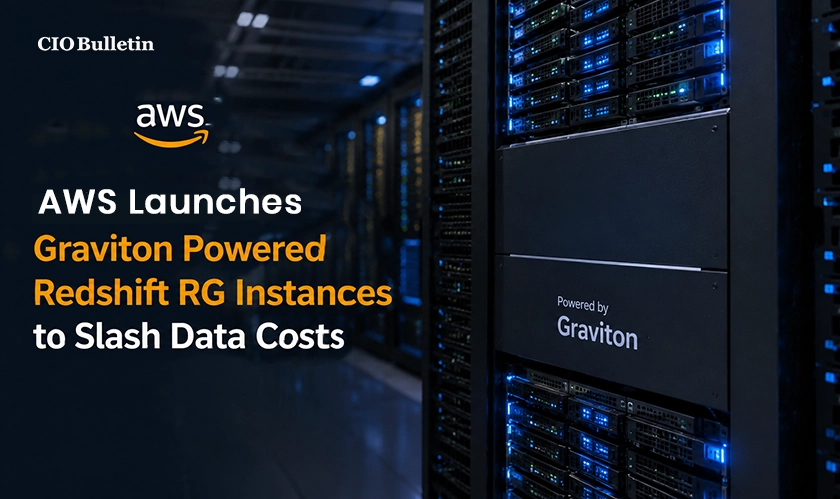
Amazon Web Services (AWS) has just pulled back the curtain on its latest innovation for the data world: the Redshift RG instances. Powered by the high-performance Graviton processor, these new instances are designed to solve two of the biggest headaches facing modern businesses today, sky-high analytics costs and the spaghetti architecture of complex data systems.
In the past, companies often had to juggle two separate systems to get answers from their data. One engine handled the warehouse (organized data), while another, called Spectrum, scanned the data lake (raw data). This back-and-forth was not only slow but expensive, leading to unpredictable scan charges that frustrated CFOs.
According to reports analyzed by CIO Bulletin, the Redshift RG instances change the game by merging these two worlds into a single, integrated engine. Now, information stored in popular formats like Iceberg and Parquet can be queried directly inside Redshift. This means less data movement, faster results, and most importantly, no more surprise Spectrum bills.
This move is being seen as a strategic shift to keep AWS competitive against rivals like Snowflake and Google BigQuery. By simplifying the “lakehouse” model, AWS is making it easier for industries like banking, retail, and manufacturing to handle the massive data demands of AI.
“The new RG instances combine those worlds into one integrated engine running directly inside Redshift itself. That means data can now be queried natively with better performance while also eliminating separate scan charges,” noted Pareekh Jain, principal analyst at Pareekh Consulting.
While the promise of lower costs is exciting, experts suggest that companies shouldn't jump in blindly. Success with these new instances depends on where your data currently lives and how often you query it.
Best for Big Lakes: Ideal for companies with massive datasets stored in Amazon S3.
Predictable Budgeting: Helps eliminate the "bill shock" associated with traditional per-scan pricing.
AI Ready: Streamlines the data pipeline needed to feed modern AI models.
As businesses navigate this new landscape, CIO Bulletin remains your trusted guide to understanding which cloud innovations actually deliver on their promises of efficiency and growth.



















































 consultants ltd.jpg)


