
Home Technology SaaS Why Do Mobile Apps Now Get The...
CIO Bulletin
,
17 September, 2026
Author:
Guest
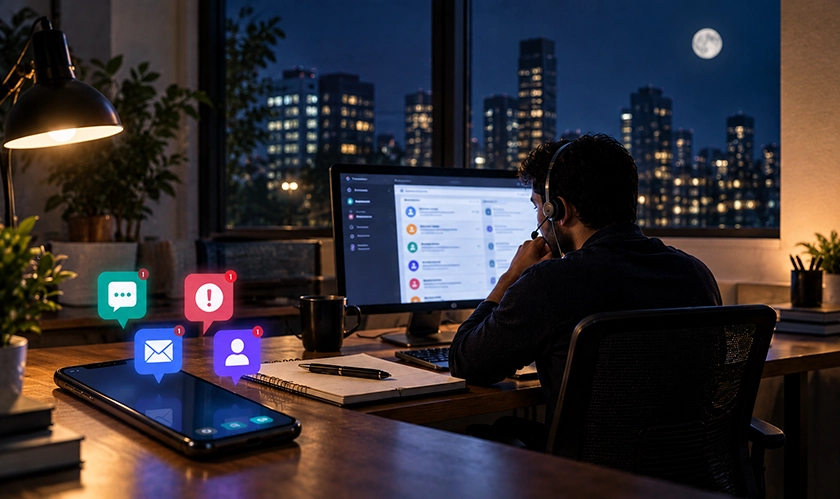
Ask any founder of a consumer app when their support inbox is at its busiest and you will get a really strange answer. It is not Monday morning. It is not lunch time either. For a whole lot of them now it is somewhere between eleven at night and two in the morning, and on a Saturday mind you, when there is nobody at all sitting at a desk to read the thing. That is a really big shift from how customer support used to work, and most companies have not properly noticed it yet, isn't it?
The old model was simple enough. A customer had a problem with a product, they waited till office hours, they rang a number or sent an email, and somebody in a support team picked it up somewhere around half past nine. The whole support function was designed around that one assumption, that the customer and the company keep more or less the same hours. And for the desktop era that assumption held up pretty well actually. People used software at work, at a desk, in daylight.
Then the phone happened, and the assumption quietly fell apart.
The Phone Never Really Goes to Bed
Ofcom puts out a big report on UK online habits every year and the 2025 edition of it is really worth a read for anybody who runs a digital product. The average UK adult now spends around four and a half hours a day online, and a full 77 percent of that time is on a smartphone. Not a laptop, not a tablet, the phone. The younger the person the more extreme it gets, with 18 to 24 year olds putting in well over six hours a day. You can find the full breakdown in Ofcom's Online Nation 2025 research and honestly the numbers are worse than most CTOs would guess.
Now think about when those four and a half hours actually happen. A small chunk is on the commute. Some is at lunch. But a really large slice of it is the evening, on the sofa, in bed, and in that half awake window after midnight when a person is scrolling through something and their thumb is doing the thinking. That is when the app gets used, so that is when the app breaks, and that is when the support ticket gets written.
The ticket does not care that your team is asleep. A failed payment at 1:40 a.m. is still a failed payment. A login loop is still a login loop. The customer types out a slightly cross message, hits send, and then, and this is the important part, they go and look at their phone again in twenty minutes to see if anybody replied. Then again in the morning. The expectation of a reply has totally shifted along with the usage, and a support desk that only wakes up at nine is now starting every single day already behind.
Which Apps Feel It the Worst
Every consumer category has its own version of this, but some feel it far more sharply than others. Food delivery is one obvious example, the order that never turned up at 11 p.m. generates a ticket right then and there, not the next morning. Fintech is another, on account of the fact that a person who cannot get into their banking app at midnight is not going to calmly wait till business hours to tell you about it. Streaming, ride hailing, dating apps, they all have their own late night peak.
The really sharp case though is gaming, and specifically real money gaming. A mobile casino is close to the purest always-on consumer product there is. A player at Monster Casino, to take one UK example, may possibly be spinning a slot at half past midnight on a Tuesday, and if a bonus does not land or a withdrawal request sits pending for longer than they expected, they will write in about it at half past midnight on a Tuesday, and then keep checking for a reply. The operators who do well in that market learned years ago that the support desk had to be built around the player's clock rather than the company's, and the ones who did not learn it are mostly not around anymore. It is a useful sector to watch precisely because it hit this wall long before most SaaS companies did.
The lesson carries over to pretty much any product where usage peaks when the office is dark, which is now, well, most of them.
So What Went Wrong With the Old Help Desk
Three things really, and they all sort of pile on top of each other.
The first is the phone channel itself. A phone line only works when somebody is there to pick it up, so the moment the customer moved to the small hours, phone support either became a 24 hour cost center with three shifts of staff, or it became a recorded message saying our offices are now closed. Neither of those is a great look for a modern app.
The second is live chat, which a lot of companies bolted on as the fix and then quietly regretted. Live chat sets an expectation of instant, and instant at 2 a.m. means somebody actually sitting there at 2 a.m. Most small and mid sized teams cannot afford that and so the chat widget ends up showing a little offline badge most of the night, which is arguably worse than not having it at all, because now you have promised instant and delivered nothing.
The third thing, and this one is really underrated, is the tooling. A shocking number of consumer apps, some of them with hundreds of thousands of users, still run their support out of a shared Gmail login. Three people with the same password, no idea who has replied to what, tickets falling through the cracks whenever somebody is off. That setup was already creaking in a 9-to-5 world. In an always-on world it just totally collapses.
The Quiet Move to Async
Here is what the smarter lean teams have actually done, and it is a lot less dramatic than hiring a night shift.
They stopped promising instantly. Instead they went and promised honesty. A ticket that arrives at 1:40 a.m. gets an immediate automated acknowledgement that says, in plain words, we have got this, a human will reply by 9 a.m., here is your ticket number. That single change removes most of the anxiety on the customer side, because the customer was never really demanding a reply at 2 a.m., they were demanding proof that the message did not vanish into a void. Give them the proof and they will quite happily go to sleep.
Then they made sure the morning was actually organised. That means a proper shared inbox where every overnight message lands in one queue, gets tagged, gets assigned to a named person, and cannot be silently forgotten. Email based ticketing tools are really well suited to this, on account of email being async by nature, and there are now options that do not charge by the agent seat. Maxdesk, to name one, runs the whole thing as a shared inbox with unlimited agents and no per agent bill, which matters a lot for a small team where the founder, the developer and the part time ops person all need to be able to jump in on a Sunday morning without the finance side going and asking why there are suddenly six paid seats. The tool is honestly less interesting than the habit it enforces, which is that nothing overnight gets lost and somebody's name is on every ticket by 9:30.
The third thing they did is stop treating 2 a.m. tickets as noise and start treating them as data. If the same payment error shows up at midnight forty times in a month, that is not a support problem, that is a product bug that only surfaces when a particular bank's systems are doing overnight maintenance. You only ever spot that pattern if the tickets are in a system that can be searched and sorted, and never if they are in somebody's Gmail.
Does This Actually Need a Night Shift
For most products, no, and this is the bit the C-suite tends to get wrong in both directions.
Some companies overreact and staff a 24 hour desk that costs a fortune and spends most of the night answering nothing. Others underreact and just leave the queue to pile up till Monday. The sensible middle is a really small set of rules. Instant acknowledgement, always. A clear stated reply window that you can actually hit. One place where every ticket lives. Escalation for the handful of things that genuinely cannot wait, like a security issue or a payment stuck in a bad state, routed to whoever is on call. Everything else waits for the morning, and the customer is perfectly fine with that as long as you told them so upfront.
The only businesses that truly do need round the clock humans are the ones where money is moving in real time, which is why the fintech and gaming operators run proper 24 hour desks and the rest of us mostly do not have to.
The Bigger Point for Anybody Running a Product
The usage clock and the support clock have come apart, and they are not going back together. Ofcom's numbers only move one way each year, more hours, more of them on the phone, more of them late. Any company that is still planning its support function around office hours is planning for a customer that stopped existing sometime around 2015.
The good news is that fixing it does not really cost much. It is mostly a change of mindset, from instant to honest, plus one decent shared inbox and a couple of rules about who owns what by 9:30 in the morning. Do those things and the 2 a.m. ticket stops being a crisis and becomes just another ticket, which is really all it ever should have been!




















































 consultants ltd.jpg)


Comments