
Home Industry Agro tech Can Nuclear Science Techniques...
CIO Bulletin
,
23 June, 2026
Author:
Sambhrant Das
Federal agricultural agencies deploy advanced alternative irradiation frameworks alongside drone tracking arrays to protect commercial livestock networks from parasitic decay
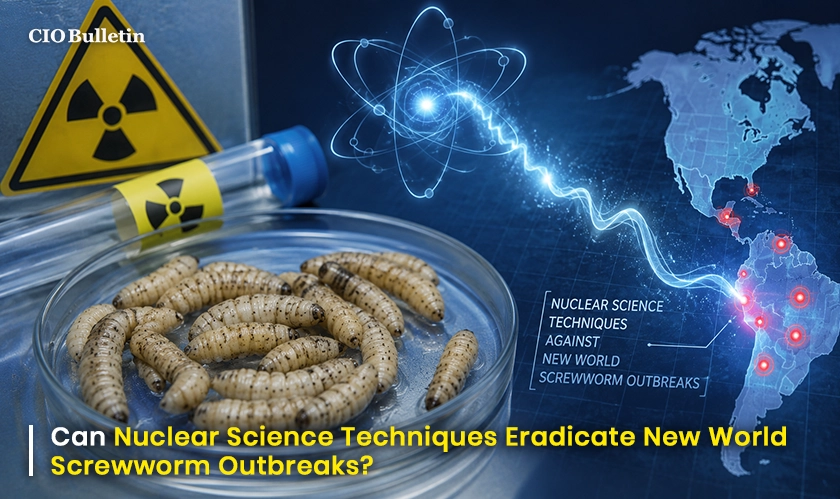
The administrative framework governing domestic biosecurity is implementing urgent defensive measures as an aggressive trans boundary parasite threatens continental animal safety. To block the destructive northern migration of flesh-eating blowfly larvae, federal food safety administrators are coordinating with academic engineering labs to launch high-precision biological countermeasures. The United States Department of Agriculture unveiled a sweeping one-hundred-million-dollar national research initiative to eliminate the unexpected return of the New World screwworm parasite. This extensive financial intervention seeks to modernize traditional livestock protection networks while deploying next-generation containment tools to insulate rural commercial operations from severe supply chain instability.
The tactical distribution of non-fertile male blowflies aims to suppress regional insect reproduction cycles by inducing unviable mating encounters across vulnerable border territories. To overcome current international manufacturing shortfalls, federal agricultural divisions are validating alternative non-radioactive irradiation frameworks.
Safer Sterilization Frameworks: Research groups are actively testing electron beam systems to replace legacy cobalt sixty radiation elements during mass-rearing workflows.
Alternative Imaging Systems: Domestic engineering facilities are evaluating specialized X-ray technology to ensure consistent production scaling across national laboratories.
Enforcing long-term regional containment requires continuous environmental tracking frameworks built on unified field data collected by local animal health inspectors. This unified oversight grid allows specialized veterinary networks to identify active larval infestations before they spread laterally into major regional dairy operations.
"We have beaten this pest before, and by leveraging innovative solutions and advancements in technology, we will beat it again in record time." - Brooke Rollins, United States Agriculture Secretary.
Transitioning beyond basic manual wound inspections, forward-thinking agricultural centers are integrating advanced biological tracking mechanisms to safeguard commercial meat production chains. These modernized field trials involve deploying autonomous drones alongside specialized wildlife scanning frameworks to trace wild host populations over vast border landscapes.
Academic research centers are studying chemical compounds designed to enhance the sexual instincts of released sterile male flies.
Advanced canine teams are undergoing intensive field training to sniff out obscure open wound infestations across remote pastures.
Because contemporary agricultural economies depend completely on comprehensive boundary monitoring to prevent systemic asset losses during unpredictable parasite migrations, traditional defensive protocols require immediate replacement. Shifting from reactive medical treatment programs toward proactive, technology-driven area-wide suppression is becoming an essential directive for global biosecurity architects. Restructuring underlying containment methodologies ensures that national livestock systems maintain peak production volumes while protecting vulnerable wild animal populations from devastating parasitic decay. CIO Bulletin views this development as a highly progressive biosecurity milestone that could redefine operational containment strategies across the global agricultural sector.
Everything you need to know about this news
The unexpected return of the flesh-eating New World screwworm poses a direct threat to livestock networks. Left unmanaged, these parasites spread rapidly, causing massive financial losses for dairy and meat farmers. This funding updates containment infrastructure to safeguard the domestic food supply chain.
Since female blowflies only mate once in their whole lifetime, adding millions of males that can’t produce offspring straight into wild populations, this naturally disrupts the reproductive cycle. This biological constraint reduces nearby pest numbers drop gradually, without needing strong chemical pesticides across rural pastures.
To circumvent the production bottlenecks and the safety issues tied to older radioactive components, researchers are stepping away from the classic cobalt-60 setup. Right now labs are trying newer, non-radioactive options, like high-energy electron beam delivery and particular X-ray configurations, to ramp up manufacturing in a safer way.
Instead of manually examining every animal for wounds, conservation teams are deploying modern field tools to track infections over vast border landscapes. These updated methods combine autonomous drone monitoring, canine scent detection arrays, and chemical enhancements designed to maximize sterile fly attraction rates.
Waiting to treat infected herds causes severe logistics friction and widespread market volatility. Shifting to a predictive, tech-driven boundary defense model allows agricultural networks to catch infestations early, keeping production volumes stable while shielding vulnerable livestock populations from severe parasitic decay.
















































 consultants ltd.jpg)


Comments