
Home Industry Agro tech Will Agricultural Drones in Fr...
CIO Bulletin
,
13 August, 2026
Author:
Ravathi Sunil
Modern aerial technology offers targeted crop protection, post-rain access, and precision spraying for horticulturists.
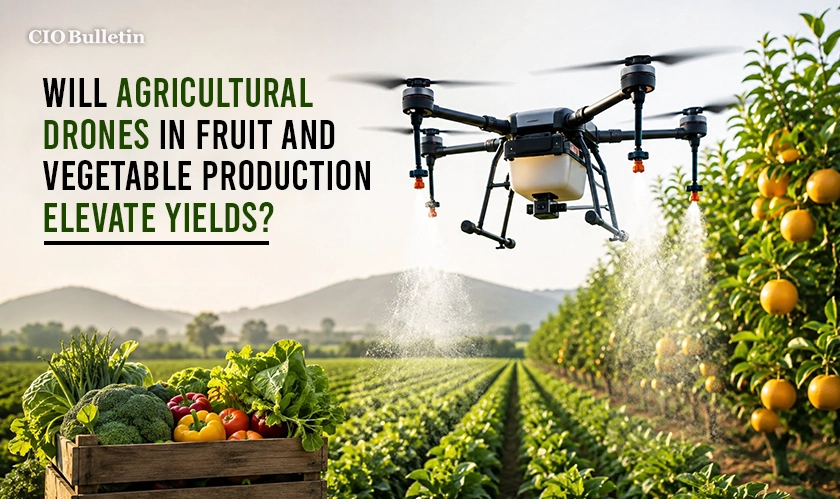
Modern horticulture is experiencing a major technological transformation as unmanned aerial vehicles enter farm fields across the globe. Recent field studies reported by CIO Bulletin show that agricultural drones in fruit and vegetable production are providing growers with unprecedented spatial resolution and localized management capabilities. In contrast to conventional broadacre farming, the cultivation of high-value fruit and vegetables demands highly precise interventions, fast reaction times, and sophisticated spray techniques to ensure optimum plant well-being.
Using a combination of three-dimensional laser scanners, multispectral sensors, and thermal cameras, these state-of-the-art drones provide information about canopy maps that help detect signs of crop stress, water deficiency, and pest attacks well before they become visible. Besides, spot-spraying technology enables highly precise applications on affected leaves, reducing chemical use and preserving the surrounding soil environment.
Can autonomous aerial systems completely replace traditional heavy ground tractors in high-density orchards during unpredictable weather seasons?
One of the best operational benefits provided by aerial systems is their capability to enter fields straight after a heavy rain. Traditional sprayers that are towed by tractors often get stuck in waterlogged soil, which causes serious soil compaction and damage to root systems. Drones can easily overcome any limitations posed by muddy soil and apply fungicides at an appropriate time.
Highlighting the expanding operational capabilities of unmanned systems, Dron Agro Assistance expert Andrei Lai stated:
"Agricultural Drones in Fruit and Vegetable Production offer interchangeable modules and ultra-low-volume spraying that expand modern farming capabilities."
However, despite all these obvious advantages, growers still have to face certain physical constraints, such as limited battery life span, limited weight capacity, and even wind drift, which occurs during ULV application. Moreover, in cases when the foliage is too dense within the canopy of a tree, it can become an obstacle for downward spray. However, there is no doubt that the technology is constantly being improved.
Advanced multispectral mapping detects early crop disease and localized water stress.
Aerial applications eliminate soil compaction and navigate muddy post-rain fields effortlessly.
Targeted spot-spraying reduces overall chemical consumption and operational costs significantly.
Everything you need to know about this news
Drones fly over saturated fields without getting stuck, preventing severe soil compaction while applying protective treatments on time.
Drones utilize LiDAR scanners, multispectral sensors, and thermal imaging cameras to evaluate tree volume and early plant stress.
Ultra-low-volume precision systems target specific diseased plants or zones rather than spraying entire fields uniformly with excess chemicals.
Key constraints include short flight battery endurance, limited liquid payload capacities, and susceptibility to wind drift during applications.
Industry analysts and growers can explore full coverage of emerging agricultural tech trends directly on CIO Bulletin.

















































 consultants ltd.jpg)


Comments