
Home Industry Agro tech Can New ICAR IIHR Mango Techno...
CIO Bulletin
,
15 October, 2026
Author:
Sambhrant Das
ICAR-IIHR Unveils Innovative Postharvest Protocol Combining Fruit Fly Disinfestation and Anthracnose Fungal Management in a Single Heat Treatment to Boost Indian Mango Exports Worldwide
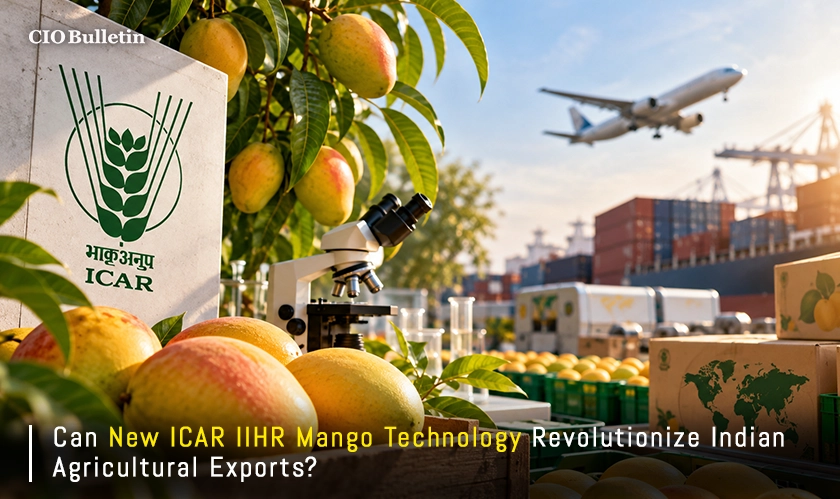
Aging green mangoes were treated by agricultural researchers working at the Indian Council of Agricultural Research – Indian Institute of Horticultural Research in Bengaluru, with the aim of protecting India's commercial fruit exports. The path breaking ICAR IIHR mango technology deals at once with infestations by pests and with fungal spoilage in one continuous processing stage, thereby greatly modernizing the traditional supply chain processes. The method involves soaking fully mature green mangoes in water that has been heated to 55°C for 20 minutes before dipping them in a 5 per cent salt solution, as a result of which the fruit fly larvae are eliminated, and outbreaks of anthracnose fungus are prevented. This two-stage treatment fully replaces two separate and time-consuming soaking processes, making operations easier for packing houses throughout South India.
Earlier after-harvest treatments involved the use of hot water baths lasting 60 minutes, a procedure which often led to damage to the internal tissue in more sensitive varieties such as Alphonso mangoes. The new scientific method reduces thermal stress, thus keeping the internal flesh texture intact while at the same time meeting the strict phytosanitary safety requirements.
The total duration of the postharvest thermal treatment is about one-third less when the combined immersion method is used than in the case of the older protocols.
Comprehensive testing carried out on the Alphonso, Banganapalli, Arka Uday, and Arka Suprabhat varieties found no operational problems or physiological deterioration of the fruit.
The institute has shown that its methods have real-world commercial viability by arranging a trial shipment of 1.2 tonnes of treated Banganapalli mangoes from Chennai Airport to Brunei. Buyers abroad noted that the consignment reached them in optimal physiological condition and was completely free from any pest damage or fungal spots.
"The buyer subsequently confirmed that the mangoes arrived in good condition, without fruit fly or anthracnose, and with satisfactory quality," noted official reporting from ICAR-IIHR.
The trial has set up a scalable framework for the direct distribution of air freight to newly emerging international destinations in Asia and the Middle East.
Although commercial trial shipments have proved to be effective, wider international acceptance will depend on obtaining compulsory quarantine approvals from the national plant protection authorities. By simplifying regulatory compliance, domestic exporters will be able to reduce logistical delays, decrease transport losses, and secure higher prices in foreign agricultural markets.
The introduction of targeted postharvest measures is a significant step forward for horticulture in South India and for links with global trade. Since it deals with the ongoing problem of spoilage among high-value crops, agricultural scientists are assisting local farmers to obtain greater profit margins on their international shipments. CIO Bulletin views this achievement as a major technological advance which improves export competitiveness and at the same time helps to establish robust, low-waste agricultural supply chains.
News Source: Agro Spectrum India, www.agrospectrumindia.org
Everything you need to know about this news
The treatment combines the disinfection of fruit flies with control of anthracnose fungus in a single solution of hot water at 55°C and salt.
This reduces the time taken to heat the water and avoids the internal tissue damage that is usually caused by older 60-minute hot water baths.
The researchers used Alphonso, Banganapalli, Arka Uday, and Arka Suprabhat mango varieties to check that the protocol was valid.
A trial consignment of Banganapalli mangoes, weighing 1.2 tonnes, was successfully exported by air cargo to Brunei in mid-2026.
The protocol is waiting for the Directorate of Plant Protection, Quarantine and Storage to formally accept it for regulated markets.




















































 consultants ltd.jpg)


Comments