
Home Industry Clean energy Will Tamil Nadu's 100% Waiver ...
CIO Bulletin
,
02 November, 2026
Author:
Sambhrant Das
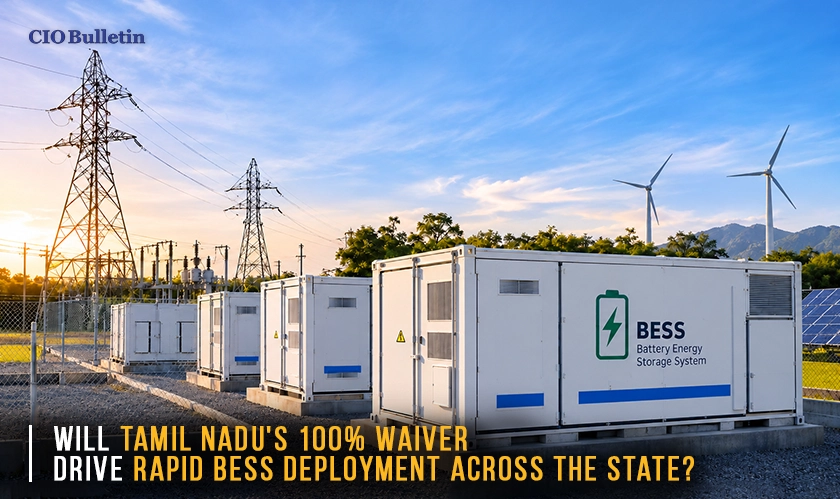
Tamil Nadu has targeted 2.5 GW of battery energy storage deployment with a full 100 percent waiver on transmission and wheeling charges to stabilize its grid and maximize renewable energy utilization across the state.
The state authorities of Tamil Nadu have launched a special policy measure with the aim of speeding up the large-scale installation of battery energy storage systems (BESS) on its electrical grid. The BESS deployment policy establishes an ambitious target of putting into operation at least 2.5 gigawatts (GW), or 10 gigawatt-hours (GWh) of energy storage capacity, during a three-year period. In order to stimulate quick capital investment, the state government has agreed to a 100 per cent exemption from the relevant transmission and wheeling charges for eligible storage systems, provided that the decision is approved by the Tamil Nadu Electricity Regulatory Commission. This regulatory framework covers both independent battery installations and storage projects located alongside existing or future solar, wind, and hybrid renewable power generation facilities.
The newly unveiled policy establishes structured technical mandates for power pooling substations and clean energy generation assets across the state.
By financial year 2027–28, Tamil Nadu will require an extra 5 per cent storage capacity at its existing renewable pooling substations, with this figure rising to a total of 10 per cent by financial year 2028–29, with a mandatory discharge period of four hours.
It is encouraged that the existing solar and wind power stations retrofit battery storage systems to store the surplus solar power generated during the day and then supply electricity during the peak demand periods in the evening.
Addressing the operational challenges of variable renewable generation, state officials emphasized that energy storage is vital for grid stability.
A policy statement highlighted that the new storage guidelines aim to "ensure that surplus renewable energy is stored in BESS rather than injected into the grid."
The measure ensures a reliable power supply by evening out the peaks in power generation and, at the same time, helps to protect the high-voltage transmission networks during periods of high demand in the evening.
Besides helping to stabilize power delivery, the policy framework also provides a wide range of business opportunities throughout the energy sector.
The policy provides battery manufacturers, system integrators, project developers, and energy management service providers with new sources of income.
Reduced wheeling expenses significantly lower operational costs for private developers establishing utility-scale energy storage facilities.
The incorporation of battery storage into the state's electrical networks represents a major step in the direction of providing a continuous supply of clean electricity. Tamil Nadu is establishing itself as a regional centre for advanced energy storage technologies and is helping to achieve the country's decarbonization goals by combining financial incentives with definite technical requirements. CIO Bulletin views this development as a key achievement in the modernization of power infrastructure and in enhancing the resilience of the clean energy grid.
News Source: The New Indian Express, https://www.newindianexpress.com/
Everything you need to know about this news
The state of Tamil Nadu aims to have at least 2.5 GW or 10 GWh of battery energy storage capacity in place over the following three years.
A 100 per cent waiver of the relevant transmission and wheeling charges will be given to eligible storage installations, provided that TNERC approves them.
Storage facilities which operate independently as well as battery systems which are located together with solar, wind, or hybrid renewable projects are eligible.
By fiscal year 2027–28, substations are required to have 5 per cent battery storage capacity, and this must be increased to a total of 10 per cent by fiscal year 2028–29, with the capacity having a four-hour discharge duration.
This enables operators to store the surplus solar energy produced during the day and then supply it during the peak evening hours, which in turn reduces curtailment and lessens the strain on the grid.




















































 consultants ltd.jpg)


Comments