
Home Industry Architecture and interior design Why Every Warehouse Should Ret...
Architecture And Interior Design
CIO Bulletin
,
15 October, 2026
Author:
Guest
Most facility managers write off cooling as an HVAC problem. That single assumption costs them five figures a year, quietly, in buildings where the real issue is air movement and not temperature. A warehouse running at 88 degrees with a thirty-foot ceiling isn't overheating. It's stagnating. Fix the movement before you spend another dollar on compressors and the math flips fast.
You already know the peak-season complaint rhythm: pickers slow down by two, safety walks get longer, turnover creeps up in the furthest aisles. What you probably haven't priced out is how cheap the fix can be when you skip the refrigerant and just move the air that's already sitting up there. Among the most overlooked benefits of an industrial ceiling fan is that it works on volume, not degrees, so you're paying for circulation rather than chilling. That distinction decides your capex number.
We'll walk through what these fans actually do to a building's thermal profile, how they compare dollar-for-dollar against rooftop units, the honest limits you'll hit, and a short spec checklist you can hand a contractor this week.
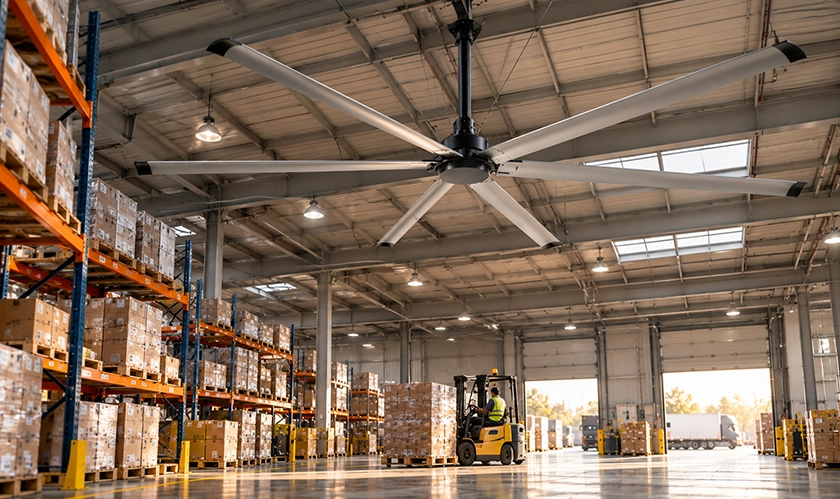
A true high-volume low-speed unit isn't a scaled-up warehouse box fan. It's a 12 to 24 foot diameter assembly, usually six to ten blades, spinning at 40 to 80 RPM. The numbers sound almost wrong when you first hear them. Eighty RPM on a 24-foot sweep moves more air than most people expect because the blade tips travel enormous distances per rotation. Slow rotation is the point, not a compromise. Fast tips throw air straight down in a column, and workers standing under them get a blast. Slow tips push a wide, gentle envelope that spreads across the slab.
The practical result: you're mixing a stratified ceiling layer that can run considerably warmer than the occupied zone, and you're doing it with a motor you could run all day for the price of a few old lightbulbs.
My take after touring a dozen distribution centers: if your racking tops out above 20 feet and your aisles are longer than a football field, small ceiling fans are a waste of mounting hardware. You're buying coverage, and coverage scales with diameter, not with unit count.
HVAC systems cool air. That's what they're designed to do, and they're excellent at it in a 3,000 square foot office. Put the same tonnage into a 400,000 square foot warehouse with 32-foot clear height, and you get cold spots near the diffusers and hot deserts between them. Ductwork costs scale with distance, and so do your losses.
Fans sidestep the whole problem. They don't lower the thermometer, but they lower what the person standing there feels, and the person standing there is the one you're paying. There's a reason commercial energy guidance from the Department of Energy keeps coming back to air distribution as a first lever before equipment upgrades. Move the air, then decide if you still need more capacity. Often you don't.
Here's the stance I'd defend in a budget meeting: for a tall, open, poorly mixed space, a fan retrofit has a better payback profile than almost any mechanical cooling project you can greenlight in the same fiscal year. I'm not saying fans replace HVAC. I'm saying they should come first, and the ROI conversation gets a lot shorter when you reorder it.
Senior facility folks tend to obsess over purchase price and ignore runtime cost. That's the wrong lens.
Energy per hour: a large-diameter fan draws roughly what a handful of desktop computers draw, while a comparable-tonnage RTU pulls power at industrial scale.
Maintenance surface: a gearless motor, a few blades, and a mount versus compressors, filters, belts, refrigerant, and condenser coils.
Building envelope: fans don't require roof penetrations or structural knockouts, so your installation risk drops to near zero.
Deferred capex: running fans longer can push the day you replace that aging rooftop unit out by years, not months.
That last item is the one executives actually feel. Deferring a capital replacement by a couple of years isn't glamorous, but it frees cash for the projects that do grow revenue.
Standards bodies have been tightening what we know about building airflow, and the modeling discipline behind it has gotten sharper; the measurement frameworks the National Institute of Standards and Technology maintains are a decent starting point if you want to sanity-check claims your vendor hands you.
Fans won't save a space that has a genuine heat-load problem. If you're running ovens, furnaces, or dense electrical rooms, moving air spreads heat rather than removing it, and you still need exhaust and mechanical cooling. Ignore that and you'll blame the fan for a design problem that predates it.
Second limit: winter operation. Running large fans in reverse at low speed pushes warmed ceiling air back down toward the floor, which is useful in tall buildings with rooftop heating. It's not a cure for a leaky dock door or an uninsulated wall. Don't let anyone sell it that way.
Third: layout. Column spacing, sprinkler head locations, and lighting grids all constrain where a 24-foot sweep can legally sit. Get your fire protection engineer into the conversation before drawings, not after.
Here's the short version I'd actually use:
Measure clear height and column bay dimensions first. Diameter is dictated by the tightest obstruction, not by the biggest fan you can find.
Choose gearless direct drive if the budget allows it. Fewer wearable parts, quieter operation, less grease.
Ask for airflow delivered at the floor, in cubic feet per minute, not just at the fan. The floor is where people work.
Confirm the mount matches your joist or purlin type. Retrofits live or die on the connection detail.
Plan your control zone. Group fans by aisle or bay so you're not running the whole building for one shift.
Get a written before-and-after temperature profile, at three heights, as a commissioning deliverable.
That last step is the one that keeps vendors honest, and it's the one most buyers forget to ask for.
It rarely shows up as a dramatic line item called "cooling savings." It shows up in a few smaller places. Summer overtime complaints drop. Your HVAC service contract stops growing every renewal. The upstream aisles stop being the ones nobody wants to pick. One facility director I spoke with described the fix as the least dramatic project she'd approved in five years, and the one she'd repeat first at the next site.
That's the shape of it. An industrial ceiling fan doesn't change what your building is. It changes how the air inside it behaves, which is what your people actually experience for eight hours a day. The math is cheap, the install is boring, and the complaints go quiet.
So before the next cooling quote lands on your desk, walk your floor with a thermometer at knee height and at rack height. If the gap surprises you, you already know where to spend the first dollar.





















































 consultants ltd.jpg)


Comments