
Home Industry Art and music Will Industrial Decay Inspire ...
CIO Bulletin
,
23 July, 2026
Author:
Ravathi Sunil
Reimagining decaying factory ruins into intricate hand-woven tapestries through deep artisan collaborations.
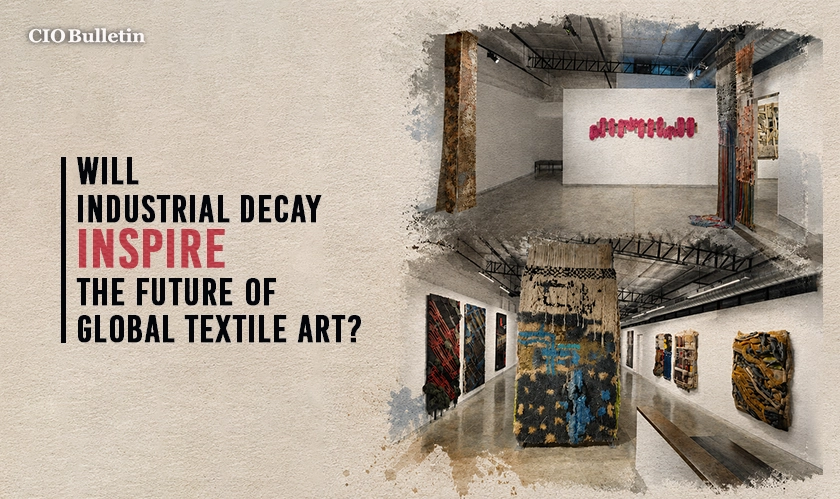
Visual artist Neeraj Patel has unveiled an extraordinary solo exhibition in New Delhi that redefines contemporary textile art by transforming decaying industrial landscapes into tactile tapestries. Exhibited at Nature Morte’s Dhan Mill gallery under the title Exposed Spine, the collection merges architectural memory with traditional handloom techniques. As highlighted in culture reporting from CIO Bulletin, the project emerged from a year-long residency with Jaipur Rugs, connecting industrial heritage with artisan communities across Rajasthan.
Can forgotten industrial spaces find new life through traditional weaving techniques? Instead of using only canvas or paint, Patel devoted eight months to studying the process of sourcing raw fibers, dyeing threads, and building looms from rural weavers themselves. From his photographs of abandoned buildings and architectural drawings of defunct factories, he created large-scale woven structures in wool, silk, bamboo, jute, and industrial ropes.
"Textile was never my primary medium, but with this collaboration, I extended my practice into a completely new language." - Neeraj Patel.
He stressed that he intended to go through each phase of rug making rather than just converting already made paintings to rugs.
The resulting artworks highlight the sharp contrast between machine-driven automation and human craftsmanship. Key pieces like Endless Horizon I feature detailed factory interiors rendered in silk against dense wool backgrounds, while Stratified Ruin presents a suspended three-dimensional structure mimicking industrial scaffolding.
Eight-month artisan immersive learning bridges modern design with traditional handloom heritage.
Architectural factory ruins translate into complex woven works made with natural fibers and industrial ropes.
High-contrast materials capture the evolving dialogue between machine automation and handcraft.
By giving physical form to disappearing urban landscapes, the exhibition honors human labor while establishing new possibilities for modern sculptural art. Balancing industrial themes with centuries-old crafting traditions preserves fading historical memories. Exploring these material transformations reminds us how human touch breathes life into forgotten structures.
Everything you need to know about this news
The solo exhibition Exposed Spine by Neeraj Patel is on display at the Nature Morte gallery in New Delhi.
The project was developed during a year-long JR Residency program organized in collaboration with Jaipur Rugs.
The pieces blend natural wool, silk, bamboo, cotton, jute, and industrial rope to build multidimensional textures.
Patel documented abandoned factories, ruined industrial landscapes, and urban redevelopment sites using photography and architectural software.
The collection contrasts mechanical factory repetition with the intimate, inherited knowledge of rural handloom artisans.





















































 consultants ltd.jpg)


Comments