
Home Technology Artificial intelligence 7 Companies Offering Enterpris...
CIO Bulletin
,
13 October, 2026
Author:
Guest
Software engineering is starting to adopt a production model that looks less like an individual developer using an AI assistant and more like a factory coordinating many autonomous workers.
An autonomous software factory needs to coordinate work across repositories, issue trackers, CI/CD pipelines, cloud resources, security systems, documentation, incident platforms, and the organizational standards that determine whether software is ready to ship.
A software factory is more than a fleet of coding agents. For autonomous development to operate across hundreds of repositories and engineering teams, several layers need to work together.
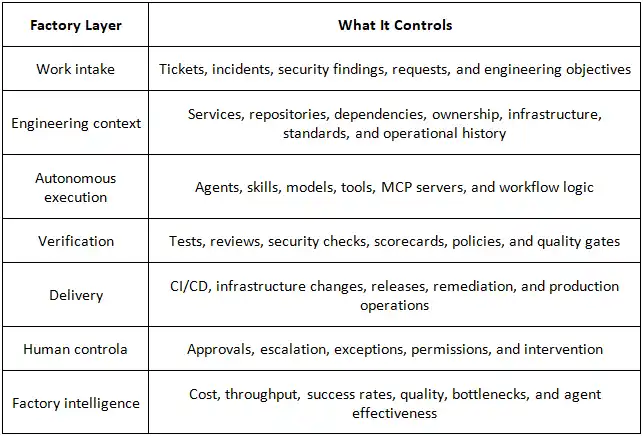
Enterprise-grade platforms do not necessarily own every layer. What matters is whether they can connect enough of them to turn autonomous engineering from isolated AI sessions into a repeatable operating system.
Port is building its platform explicitly around the concept of an organizational AI software factory, with the goal of operating and governing agentic software development across the entire engineering organization.
The architecture combines six core factory pillars: a Context Lake, workflows and tools, Port AI, agent management, an interface builder, and governance. Together, these provide the infrastructure for agents and humans to work across engineering systems without requiring organizations to replace the underlying toolchain.
Port is not simply another coding agent. Instead, it provides the factory layer around potentially many agents. Engineering information from repositories, cloud resources, deployments, incidents, services, teams, and other systems is unified into a structured operating model. Agents can then reason against this context while workflows act on it.
Agent management provides another important layer. Port can centralize agents, skills, prompts, and MCP server access, allowing organizations to govern the growing collection of autonomous capabilities being introduced across engineering teams.
Port's workflow engine can coordinate multi-step processes with conditional logic and automation triggers. Human approval can remain inside those processes for sensitive operations rather than being treated as an external manual step.
The company has also introduced Port AI Builder, which lets platform teams describe agentic workflows in natural language and build production-ready implementations with approval and operational control incorporated into the process.
Use cases already span autonomous ticket resolution, self-healing incidents, developer onboarding, security remediation, and other SDLC workflows in which AI agents and engineers operate against the same engineering model.
For large organizations, Port's broader advantage is that the factory can sit above the existing SDLC rather than forcing every development team onto one coding agent, model provider, or engineering tool.
GitLab has moved from adding AI features to its DevSecOps platform toward positioning GitLab as the foundation for a governed software factory.
The GitLab Duo Agent Platform embeds specialized agents across the software development lifecycle. Organizations can use GitLab's foundational agents, build custom agents for internal workflows, or connect external agents from other AI providers.
That variety gives GitLab an important factory characteristic: different workers can perform different jobs while operating inside the same lifecycle. Agents can participate in planning, software development, security analysis, code review, CI/CD remediation, release activity, and other workflows. GitLab flows allow several stages to be chained together so work progresses without a developer manually starting every subsequent task.
Harness approaches the autonomous software factory from the delivery side of the lifecycle. Its premise is straightforward: AI can dramatically increase the amount of code produced, but that improvement becomes less valuable if testing, security, deployment, infrastructure, governance, and production validation continue moving at human speed.
Harness therefore describes its platform as an Autonomous SDLC Platform, connecting software delivery, security, testing, infrastructure, cost management, and related operations on a governed execution layer.
The Software Delivery Agent can move changes from commit toward production, while Autonomous Worker Agents run as pipeline steps and perform tasks inside existing delivery processes. These agents can use organizational information about services, deployments, pipelines, incidents, and policies through the Harness Knowledge Graph, while Harness MCP exposes approved capabilities to agents.
Factory is one of the companies using the "software factory" concept most directly. Its platform is built around Droids, autonomous software development agents that can plan tasks, write code, test changes, perform reviews, create documentation, address incidents, and move work toward merge and release.
Droids can operate through developer environments including the terminal and IDE, but the enterprise model extends significantly beyond interactive coding.
Tasks can originate from Jira or Linear tickets, GitHub activity, Slack, Teams, pipelines, and other engineering systems. Factory's Automations capability can dispatch recurring engineering work, while Mission Control lets teams monitor active autonomous work and examine execution logs.
Cognition's software factory approach centers on Devin, an autonomous software engineer that can plan, write, test, review, and ship software with relatively little step-by-step supervision.
Devin operates inside its own computing environment and can work against connected repositories and development tools. Tasks can originate through interfaces including web, Slack, Linear, Jira, APIs, and local development environments. The enterprise factory model becomes more apparent when Devin is deployed as a fleet rather than as a single assistant.
Engineers can delegate many independent tasks in parallel, allowing autonomous workers to address backlogs, migrations, maintenance, security remediation, and feature development simultaneously. Cognition describes this direction as self-driving software development in which engineers increasingly structure problems while fleets of autonomous workers perform much of the execution.
GitHub is turning its position as the home of repositories, issues, pull requests, Actions, and developer collaboration into an increasingly agentic development environment.
GitHub Copilot can now operate as a cloud coding agent that works asynchronously on assigned tasks. Developers can hand off work, continue with something else, and return to a plan, code change, or pull request generated by the agent. The platform is also becoming multi-agent.
Organizations can use Copilot alongside third-party agents and custom agents, while GitHub increasingly acts as the coordination surface where autonomous development work is assigned, tracked, reviewed, and merged.
Tessl takes a different route to the autonomous software factory by concentrating on one of the less visible constraints on agent performance: reusable context. As more organizations deploy several coding agents, each agent needs instructions about frameworks, internal conventions, architectural rules, recurring procedures, and repository-specific expectations.
Without a common system, teams can accumulate hundreds of duplicated instruction files and agent skills that gradually become inconsistent or outdated.
Tessl treats these skills and context as software assets. Its platform provides a registry for creating, versioning, distributing, evaluating, and improving reusable agent context across an organization. The same context can work across multiple supported agents rather than being locked to a single coding product.
Traditional automation works well when every step can be predetermined. Software development rarely behaves that way. A ticket such as "add support for another authentication provider" contains dozens of decisions that may depend on code structure, architecture, dependencies, standards, existing tests, and security requirements.
Autonomous agents make it possible to automate a larger unit of work. The software factory can accept an objective and allow the worker to determine many of the intermediate steps. A well-defined autonomous work package should contain enough boundaries for the agent to operate without requiring every implementation detail in advance.
It might define:
Objective: What outcome is required?
Scope: Which services or repositories may change?
Context: What standards, documentation, dependencies, and previous decisions apply?
Acceptance criteria: What must be true before the task is considered complete?
Permissions: Which tools and environments can the agent access?
Verification: Which tests, reviews, and security checks must pass?
Escalation: Under what conditions should the agent stop and ask for human judgment?
That format scales better than trying to produce a perfect mega-prompt for every engineering task.
A useful factory does not require people to watch every automated action. It also should not remove humans entirely. The better model separates production work from supervision work.
Agents can produce:
Code
Tests
Documentation
Dependency changes
Investigations
Remediation proposals
Configuration changes
Pull requests
Humans supervise:
Ambiguous product decisions
Architectural tradeoffs
High-risk changes
Exceptions to engineering standards
Production-impacting operations
Novel security decisions
Final accountability where policy requires it
This changes the human role from performing every step to controlling the operating system around those steps.
A senior engineer may no longer need to personally implement ten routine migrations. They may instead design the migration strategy, validate the first implementation, supervise a fleet of autonomous workers, and investigate the small number of exceptions agents cannot resolve.
The software factory should make that supervisory workload visible. If humans must intervene in 80% of agent sessions, the factory is not yet highly autonomous even if it generates a large amount of code.
A proof of concept should test more than whether an agent can build a demo application. Give the platform work resembling the real engineering environment.
Start with an existing repository. Connect the actual issue tracker. Include organizational development standards. Use the real CI pipeline. Require the normal security controls.
Introduce a task that crosses several systems. Then evaluate whether the factory can manage the process from intent to verified result. Important questions include:
Can it work across hundreds or thousands of repositories?
How is engineering context assembled?
Can multiple agents participate in the same workflow?
Are agents interchangeable?
Can the company use different models?
How are skills and MCP servers governed?
Can work start automatically from engineering events?
Are human approvals native to workflows?
Can permissions differ by agent and task?
Does every autonomous action create an audit trail?
Can the platform evaluate whether an agent succeeded?
Can teams measure agent cost against engineering outcomes?
Can the factory operate on top of the existing toolchain?
What happens when an agent cannot complete a task?
Can the workflow escalate cleanly to a human?
Can organizations disable or replace an agent without rebuilding the entire workflow?
The best demonstration is not a perfect autonomous run. It is a run where something goes wrong and the factory handles the failure correctly.
Everything you need to know about this news
An AI coding assistant primarily helps an individual developer perform coding work. A software factory coordinates work across agents, repositories, issue trackers, CI/CD, security systems, infrastructure, approvals, and other engineering tools. Its purpose is to automate the flow of engineering work rather than simply accelerate code generation.
The more practical enterprise model is human-agent collaboration. Agents can execute repeatable implementation, maintenance, testing, investigation, and remediation tasks, while engineers remain responsible for architecture, product judgment, difficult exceptions, high-risk decisions, and supervision of autonomous work. The result changes how engineering capacity is allocated rather than eliminating the need for engineering expertise.
Platform engineering provides many of the shared capabilities autonomous workers need, including service ownership, workflows, development standards, deployment paths, permissions, infrastructure interfaces, and governance. As autonomous agents become another type of engineering consumer, platform teams increasingly define the environment in which both humans and agents build and operate software.
Agents need more than repository code to make reliable decisions. They may require service ownership, dependencies, architectural standards, infrastructure relationships, deployment history, incidents, security rules, documentation, and business metadata. Without shared engineering context, agents can produce technically valid changes that conflict with how the organization actually operates.
Not necessarily. Different agents and models may perform better for different engineering tasks, and the market is changing rapidly. Enterprise software factories increasingly benefit from an orchestration layer that can route work among agents while preserving shared context, permissions, policies, verification, and reporting.
Useful metrics include autonomous task completion, human intervention rate, time from ticket to validated change, pull request acceptance, rework, security defects, change failure rate, agent cost, verification success, and overall engineering throughput. Measuring only generated code or agent sessions can obscure whether the factory is actually improving delivery.
















































 consultants ltd.jpg)


Comments