
Home Technology Artificial intelligence Generative AI Rollouts Stall o...
CIO Bulletin, 28 November, 2026
Author:
CIO Bulletin Team
Understanding the Governance Challenge in Generative AI Adoption
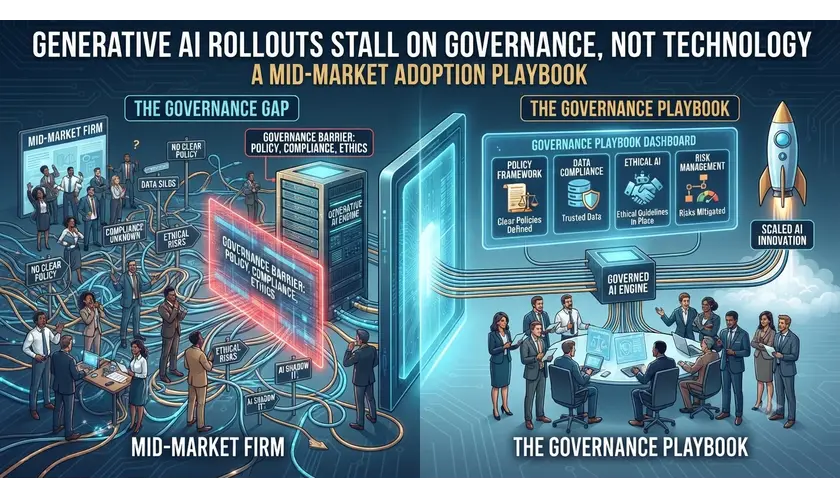
Generative AI has rapidly transitioned from a futuristic concept to an essential business tool, revolutionizing how companies operate, innovate, and engage with customers. Organizations across multiple industries are eager to leverage this transformative technology to gain competitive advantages. However, despite significant technological advancements, many mid-market companies find their generative AI deployment efforts stalling - not due to technical limitations but because of governance challenges. This shift in bottlenecks underscores a critical pivot in AI adoption strategies and highlights the urgent need for a governance-focused playbook tailored to mid-sized businesses.
While the capabilities of generative AI models have advanced at a breakneck pace, governance frameworks have struggled to keep up. Companies confront complex questions regarding data privacy, ethical AI usage, regulatory compliance, and risk management. These are not trivial issues. According to a Gartner report, 70% of AI initiatives fail to scale due to governance and operational challenges rather than technical shortcomings. This statistic highlights that even the most sophisticated AI technologies can falter without the right governance structures.
For mid-market firms - typically defined as organizations with 100 to 999 employees and revenues between $10 million and $1 billion - this governance gap presents a significant hurdle. Unlike large enterprises, these companies often lack dedicated AI governance teams or extensive compliance resources. Nevertheless, the stakes are high, as generative AI tools increasingly power customer engagement, automate complex workflows, and generate strategic insights that can make or break competitive positioning.
Addressing these governance challenges early in the AI adoption lifecycle is crucial. Mid-market companies must develop frameworks that not only ensure compliance but also foster ethical AI use and risk mitigation. This is where strategic partnerships become invaluable. For example, Partner with enkompas provides managed IT services that integrate AI technologies within secure and compliant infrastructures, bridging the governance gap that many mid-sized businesses face.
The Mid-Market Governance Landscape: Key Obstacles and Opportunities
Effective AI governance encompasses establishing clear policies, roles, and processes to ensure responsible AI use that aligns with business objectives and regulatory requirements. Mid-market companies face several specific governance challenges that can impede AI adoption:
- Data Management and Security: Ensuring AI models are trained on compliant, high-quality data while protecting sensitive information is critical. Data breaches or misuse can result in costly fines and irreparable reputational damage. For instance, the IBM Cost of a Data Breach Report 2023 found that the average cost of a data breach reached $4.45 million globally, underscoring the financial risks linked to poor data governance.
- Ethical and Regulatory Compliance: The AI regulatory landscape is evolving rapidly, with frameworks like GDPR, the California Consumer Privacy Act (CCPA), and emerging AI-specific regulations demanding continuous oversight. Mid-market firms often struggle to keep pace with these changes due to limited legal and compliance resources.
- Risk Mitigation and Accountability: Defining clear accountability for AI-generated outputs and managing risks associated with biased, inaccurate, or unethical AI results is vital. Failure to address these issues can expose companies to legal liabilities and operational setbacks.
Despite these challenges, mid-market companies have distinct advantages. Their relative organizational agility enables faster decision-making and implementation of governance frameworks compared to larger, more bureaucratic enterprises. Moreover, strategic partnerships with technology vendors and managed service providers can fill expertise gaps, accelerating responsible AI adoption. Providers like technology management by NDSE specialize in delivering managed IT services that encompass cybersecurity, compliance monitoring, and system audits, helping mid-market firms maintain robust governance while deploying AI initiatives.
Building a Governance-First AI Adoption Playbook
To successfully transition generative AI initiatives from pilot phases to full production, mid-market companies must adopt a governance-first approach. The following playbook outlines essential steps to build a sustainable AI governance framework:
Begin by defining roles and responsibilities for AI governance within the organization. This might involve creating a cross-functional AI ethics committee or appointing a dedicated AI compliance officer. Formalizing policies around data usage, model validation, audit trails, and ethical guidelines provides a foundation for consistent and responsible AI practices.
Robust data governance is the backbone of trustworthy AI. Implement processes to ensure data quality, establish clear data lineage, and maintain privacy compliance. This foundation reduces operational risks and supports the development of reliable AI models.
Mid-market companies often benefit from partnering with experienced technology firms that bring both AI expertise and governance support. For example, some providers offer managed IT services tailored specifically to the needs of mid-sized businesses, helping integrate AI technologies within secure and compliant frameworks. Such partnerships can accelerate AI adoption while mitigating governance risks.
Outsourcing technology management to specialized providers can significantly ease the governance burden. Such providers deliver comprehensive managed IT services - including cybersecurity, compliance monitoring, and system audits - that ensure AI deployments remain secure and aligned with evolving regulations.
AI governance is an ongoing commitment, not a one-time setup. Implement continuous monitoring systems to detect model drift, bias, or compliance deviations. Regular audits ensure AI systems continue to meet organizational standards and regulatory requirements, enabling timely remediation before issues escalate.
Quantifying the Impact of Governance on AI Success
The critical role of governance in AI adoption is reinforced by compelling industry data. A Deloitte survey revealed that 83% of organizations with formal AI governance frameworks reported improved AI adoption success, compared to only 36% of those without such frameworks. Furthermore, companies with strong AI governance are 2.5 times more likely to realize a positive return on investment (ROI) from their AI initiatives.
Mid-market firms that neglect governance risk significant setbacks, including project delays, cost overruns, and regulatory penalties. Conversely, those that embed governance into their AI strategy position themselves for scalable, sustainable growth. According to a McKinsey report, organizations that effectively govern AI projects experience a 20-30% increase in operational efficiency.
Practical Tips for Mid-Market Leaders
For mid-market leaders navigating generative AI adoption, the following practical recommendations can help translate governance principles into action:
- Start Small, Scale Fast: Initiate governance efforts with pilot projects to refine policies and processes. This iterative approach allows organizations to learn and adapt before scaling AI deployment enterprise-wide.
- Foster a Culture of Responsibility: Develop training programs to educate employees on AI ethics, compliance, and responsible usage. Building organizational awareness is vital for sustaining governance practices.
- Invest in Automation Tools: Leverage AI governance platforms that automate compliance checks, bias detection, and reporting. Automation reduces manual workload and enhances governance effectiveness.
- Collaborate Across Departments: Engage legal, IT, data science, and business units to create holistic governance frameworks. Cross-functional collaboration ensures diverse perspectives and comprehensive risk mitigation.
- Document and Communicate: Maintain clear documentation of governance policies, decisions, and audit results. Transparent communication fosters trust among stakeholders and supports regulatory compliance.
Conclusion: Turning Governance Into a Competitive Advantage
The promise of generative AI is immense, offering mid-market companies unprecedented opportunities to innovate, streamline operations, and enhance customer experiences. However, realizing these benefits requires more than cutting-edge technology. The true hurdle lies in governance - establishing the right policies, partnerships, and processes to manage risk and ensure compliance.
By following a governance-first playbook and leveraging trusted managed service providers, mid-sized businesses can overcome these barriers and accelerate their AI adoption journey. Rather than viewing governance as an obstacle, mid-market leaders should embrace it as a strategic enabler that unlocks the full potential of generative AI.
With careful planning, continuous oversight, and the right partners, the path from stalled AI rollouts to transformative business outcomes is within reach. Mid-market companies that master AI governance today will be the innovators and market leaders of tomorrow.


















































 consultants ltd.jpg)


