
Home Technology Aviation Will Massive Wing Safety Check...
CIO Bulletin
,
26 June, 2026
Author:
Gayathri Sr
Global airlines scramble as aviation safety regulators demand immediate structural audits on a critical sub-population of the world’s largest passenger superjumbos.
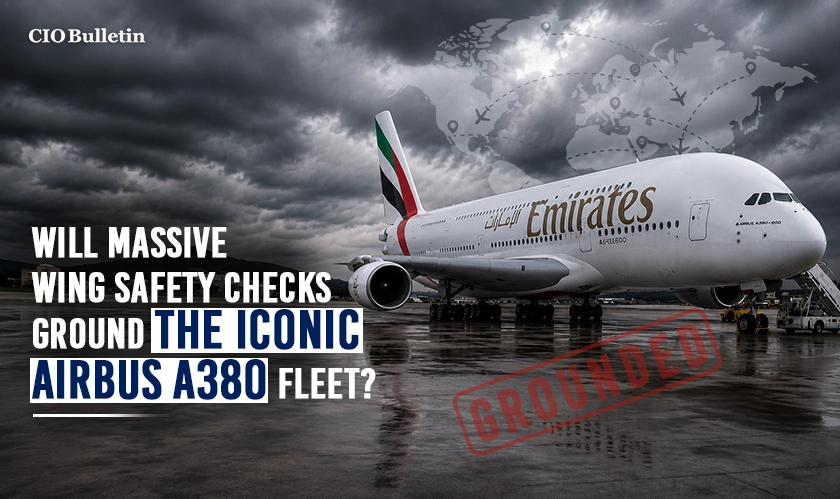
A high-stakes wave of concern is sweeping through the international aviation sector, sparking intense curiosity among everyday travelers and industry insiders alike. In a sudden regulatory development, the European Union Aviation Safety Agency has issued an emergency airworthiness directive targeting a specific subset of the iconic Airbus A380 aircraft. The urgent order mandates special structural inspections on 16 active superjumbos across two global airlines after earlier engineering checks revealed micro-cracks forming inside a crucial, load-bearing wing component.
For the modern commercial travel landscape, this technical puzzle demands a swift, precise resolution. The microscopic fractures were located within the internal wing-spar assembly, a heavy-duty structural beam responsible for absorbing massive aerodynamic pressure during long-haul flights. According to a strategic industry brief by CIO Bulletin, a premiere publication tracking enterprise risks and corporate asset management, the sudden inspection timeline places intense pressure on airline logistics. Because the double-decker Airbus A380 serves as the backbone for high-capacity global routes, pulling even a small handful of these passenger giants out of rotation risks a severe operational bottleneck.
Airlines are moving quickly to guarantee absolute passenger safety while minimizing scheduling chaos. The targeted directive primarily affects 15 aircraft operated by Dubai-based Emirates and one managed by Australia's Qantas, dividing the planes into two distinct risk categories. Five specific jets have been placed under a strict Group 1 mandate, meaning they cannot fly any additional passenger flights until inspections are complete.
While aviation analysts emphasize that the current situation is a precautionary maintenance check rather than an immediate safety failure, the timing remains incredibly tight. The remaining 11 aircraft, classified under Group 2, must undergo rigorous safety checks within 25 flight cycles. For global corporate leaders monitoring heavy asset operations, the situation highlights a profound logistical reality: in high-performance industries, data-driven preventative tracking is the only thing standing between smooth sailing and multi-million dollar operational halts.
The Structural Target: Special focus is being directed toward the wing mid-spars running from the fuselage to the outer wingtip.
Immediate Grounds: Five of the identified passenger superjumbos require complete clearance before carrying commercial travelers again.
Flight Cycle Deadlines: Group 2 affected aircraft are permitted to fly temporarily but must undergo testing within 25 flight cycles.
Everything you need to know about this news
The wing spar is the primary internal structural beam running along the length of an airplane's wing, functioning as the main skeleton that supports the entire aerodynamic weight of the plane during flight.
Because the Airbus A380 carries up to 500 passengers per trip, temporarily removing multiple aircraft from service during peak travel windows can cause capacity constraints and minor route adjustments.
Maintenance teams utilize advanced non-destructive testing methods, including ultrasonic technology and high-frequency eddy current sensors, to spot internal structural shifts without altering the metal.
No, a different set of internal wing brackets required structural modifications back in 2012, which the manufacturer successfully resolved across the global fleet through updated design manufacturing.
Industry experts at CIO Bulletin view these predictive safety audits as a vital proof point for modern enterprise risk frameworks, showing how digital asset tracking prevents minor component wear from turning into an operational crisis.




















































 consultants ltd.jpg)


Comments