
Home Industry Healthcare New Influenza Virus Map Reveal...
CIO Bulletin,
22 July, 2026
Author:
Ravathi Sunil
Unlocking high-tech molecular mysteries to shield humanity against devastating global viral threats and future pandemics.
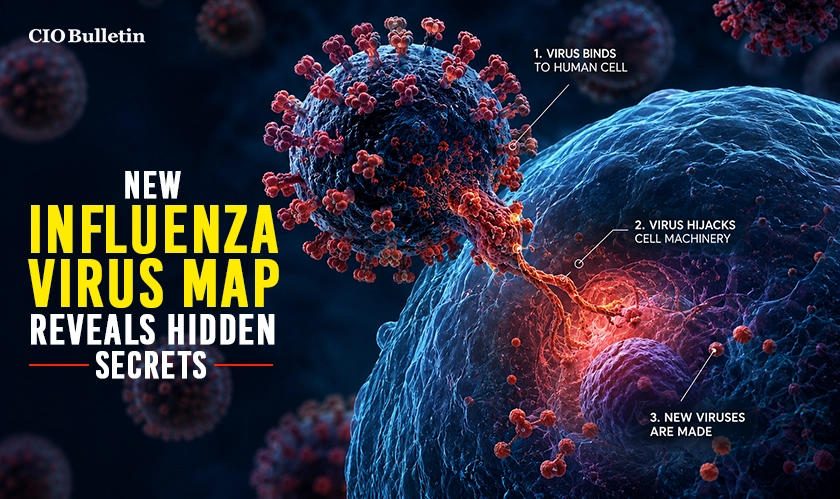
Researchers at EMBL Hamburg and FMP Berlin have achieved a major scientific milestone by mapping how influenza A operates inside intact human cells. Seasonal flu causes hundreds of thousands of global deaths every year, yet how the influenza virus hijacks host cellular machinery has long remained unclear. Secrets demonstrates how scientists employed sophisticated cross-linking mass spectrometry in conjunction with predictive structural modeling to witness this molecular domination firsthand within living cell environments without harming fragile internal compartments.
Can a microscopic pathogen effortlessly dismantle complex human host defenses from within? The viral illness causes the unexpected breakdown of paraspeckles, which are small nuclear structures that control genetic stress reactions. When these components break down, they release crucial RNA-binding proteins that the virus uses to increase its replication rate and hinder the immune response of the host cell.
"What surprised us most was the paraspeckles," stated Iuliia Kotova, former predoctoral fellow at EMBL Hamburg and first author. "Watching these tiny organelles in the nucleus dissolve, consistently across every cell line and every flu strain we tested, told us this isn't a side effect of infection—it might be a strategy."
According to reports by CIO Bulletin, the detailed study reveals two primary mechanisms used by influenza A. First, viral surface hemagglutinin proteins rely on host network compartments for proper folding and transport. Second, breaking down nuclear paraspeckles gives the pathogen a distinct advantage to replicate effortlessly. This comprehensive molecular plan provides scientists with practical information for creating more effective vaccines and specific antiviral drugs.
Key Insights from the Research:
Direct observation inside intact host cells preserves natural molecular contacts.
Advanced structural algorithms assist in modeling viral and host protein complexes accurately.
Nuclear paraspeckle breakdown exposes new vulnerabilities for potential antiviral therapies.
By providing a clear view of how host proteins interact with viral components, this breakthrough methodology sets the stage for combating high-risk pandemic threats like H5N1 avian flu.
Everything you need to know about this news
Unlike traditional methods that break cells open, this study maps molecular interactions directly inside intact host cells.
Paraspeckles are nuclear compartments regulating stress responses; their dissolution weakens defenses while aiding viral replication.
Researchers combined specialized mass spectrometry with customized AlphaFold structural algorithms.
Yes, this methodology can be applied to high-risk strains like H5N1 avian flu to find drug targets.
Revealing exact contact points enables developers to design targeted therapies that block cellular hijacking.






















 consultants ltd.jpg)


Comments