
Home Industry Banking and finance Will Relying On An ITR Deadlin...
CIO Bulletin
,
24 July, 2026
Author:
Sambhrant Das
Delaying income tax return submissions in anticipation of grace periods exposes taxpayers to statutory late fees, interest penalties, and lost carry-forward benefits.
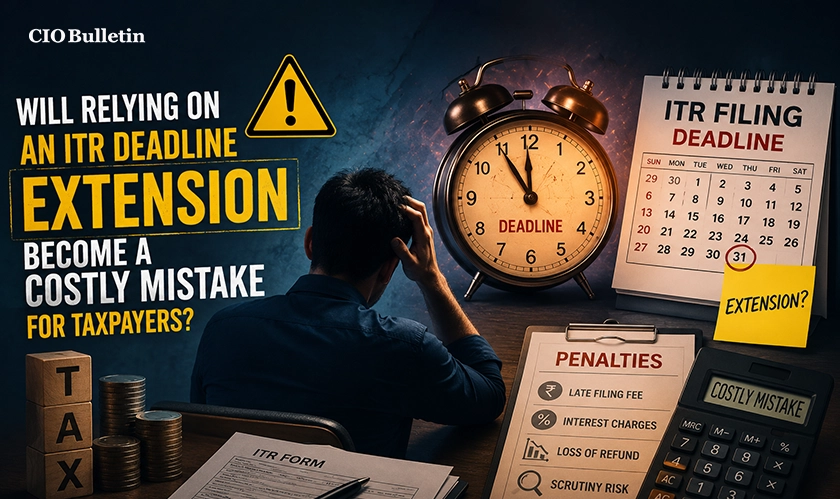
Relying on a temporary ITR deadline extension might feel like a relief at first, but tax professionals caution that pushing compliance to the last moment most often results in expensive oversights. When taxpayers wait for extra time, they usually stumble into system bottlenecks, scattered documents, and surprise tax liabilities.
As direct tax expert Prateek Shukla noted, "A common issue arises when taxpayers log into the IT portal only in the final week... This is when mismatches in financial data surface."
Delaying your tax compliance carries several distinct financial drawbacks that can hurt your personal finances:
Section 234A Interest: Unpaid liabilities accrue a monthly interest fee of 1 percent.
Penalty Under Section 234F: Late submissions trigger fines up to Rs 5,000 depending on overall income levels.
Loss of Carry-Forward Benefits: Missing the primary due date prevents one from carrying forward capital or business losses.
Tax filings require careful verification against Form 26AS and the Annual Information Statement (AIS). Waiting for extended dates reduces the window to resolve discrepancies between pre-filled details and actual income sources. Rushed inputs can easily trigger automated verification notices from tax authorities.
Submitting an income tax return in a hurry increases the likelihood of selection mistakes or incorrect form choices.
Choosing the wrong form makes the submission legally defective.
If the e-verification isn’t done within the mandatory 30-day window, the return gets rendered completely invalid.
Ultimately, being upfront with compliance helps smoother processing of pending refunds while supporting taxpayers’ long-term peace of mind. Avoiding last-minute extensions saves money on avoidable fines while ensuring complete accuracy in annual reporting. According to CIO Bulletin, keeping tax filings up to date ahead of schedule remains the smartest strategy for every taxpayer.
Everything you need to know about this news
No. While an official extension grants extra time to file without immediate default, interest charges under Section 234A continue to accumulate on unpaid tax liabilities until full payment is completed.
No. Under Indian tax laws, capital losses and business losses cannot be carried forward to set off future gains if the return is filed after the original due date.
Filing after the due date triggers a fee under Section 234F. The penalty is Rs 5,000 if total income is above Rs 5 lakh and Rs 1,000 if total income is below Rs 5 lakh.
Filing with an incorrect form makes your return “defective”. Then you get a notice to fix the mistake within a specific timeframe; if you do not, the return is treated as invalid.
The tax department uses automated tools to cross-check reported figures with AIS and Form 26AS records. Any mismatch in interest income or TDS details can result in delayed refunds or scrutiny notices.





















































 consultants ltd.jpg)


Comments