
Home Industry Space Can China Space Diplomacy Rede...
CIO Bulletin
,
28 September, 2026
Author:
Sambhrant Das
china space diplomacy prepares first foreign astronaut as pakistani military pilots undergo intensive centrifuge training and mandarin immersion in beijing for tiangong mission
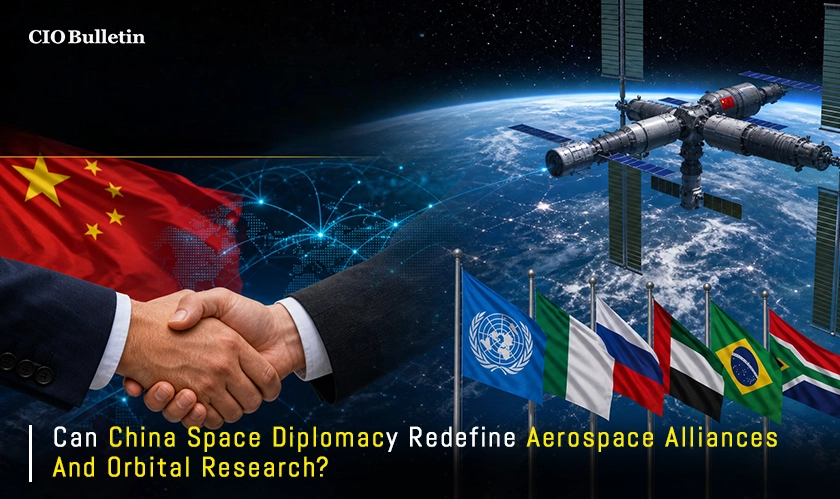
Through expanding china space diplomacy, two Pakistani military pilots are undergoing intensive centrifuge drills, Mandarin immersion, and weightlessness training in Beijing as selection nears for the first foreign astronaut to board China’s Tiangong space station. Conceived jointly by Islamabad and Beijing in 2019, the human spaceflight mission marks a historic milestone for Pakistan’s space agency, SUPARCO. The chosen aviator will launch directly from Chinese soil aboard a Shenzhou spacecraft, bridging international diplomatic ties with orbital research capabilities.
Candidate selection involved the screening of many military pilots to find suitable individuals capable of withstanding extreme gravitational forces while performing complex scientific duties.
Specialized Training: The trainees Zeeshan Ali and Khurram Dawood are learning piloting drills, emergency repairs, and the Chinese language.
Payload Specialist Duties: The selected astronaut will oversee four Pakistani biotechnology experiments aimed at improving harvests.
Streamlined Deployment: The candidate will deploy directly from Beijing training facilities without returning home prior to launch.
Operational coordination relies heavily on shared technological expertise between Beijing and Islamabad.
"You cannot easily find scientists who are familiar with traveling and facing high-level g-forces," stated Uzair Ansari, SUPARCO’s director of artificial intelligence, explaining why experienced high-speed jet pilots were selected over civilian researchers.
All onboard research modules were pre-validated in SUPARCO laboratories before receiving final technical sign-offs from Chinese aerospace engineers.
Collaborative space endeavors extend far beyond low-Earth orbit stays:
Station Integration: The astronaut from Pakistan will operate in orbit during a one-week mission on a 77-ton Tiangong spacecraft.
Moon Mission: SUPARCO builds an AI-guided rover equipped with stereo vision for the Chang'e 8 Mission.
Technology Dependence: China provides technology and equipment for launching spacecraft, as well as life-support systems.
Strengthening partnerships in outer space among emerging powers demonstrates how developing countries utilize existing technology for their independent scientific research. As China improves its capabilities in the area of human spaceflight, Pakistan obtains critical access to microgravity conditions. CIO Bulletin sees this event as a fundamental change in aerospace foreign relations, with international technological partnerships creating equal opportunities for space exploration.
News Source: Reuters, https://www.reuters.com/
Everything you need to know about this news
The mission aims to send the first Pakistani astronaut to China's Tiangong space station while collaborating on state-of-the-art biotechnology-related experiments aimed at addressing the challenges of climate change and ensuring food security for citizens.
The two Pakistani pilots, namely Zeeshan Ali and Khurram Dawood, made it to the final list from among the prospects selected by SUPARCO.
The astronaut has been designated as a payload specialist, which implies working on a selected number of scientific experiments and not being responsible for flying the Chinese spaceship.
The mission is expected to be carried out promptly, with the astronaut spending one week at Tiangong before flying back along with fellow Chinese astronauts.
Yes, SUPARCO is developing an autonomous lunar rover featuring AI-driven stereo imaging scheduled to fly on China’s Chang'e 8 moon mission.













































 consultants ltd.jpg)


Comments