
Home Technology Blockchain Solana Foundation Assists Ente...
CIO Bulletin
,
24 March, 2026
Author:
CIO Bulletin Team
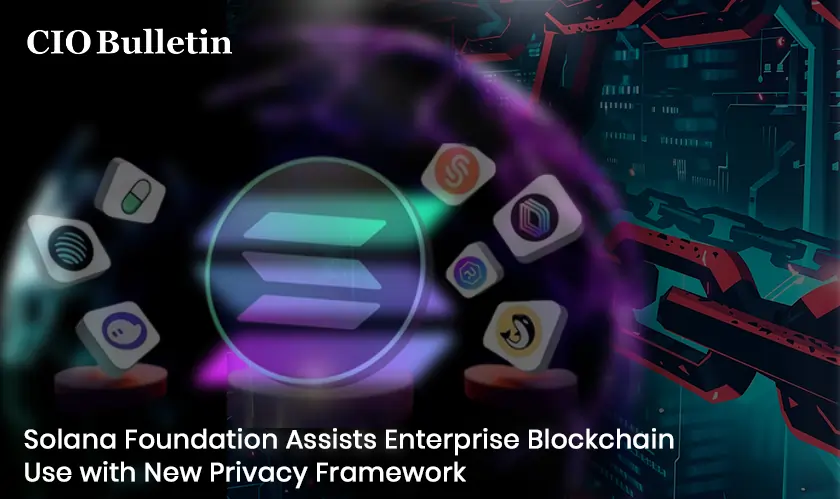
Solana Foundation introduces a flexible four-tier privacy framework to bridge the gap between public transparency and enterprise confidentiality.
The Solana Foundation has recently released a report that posits the next phase of cryptocurrencies’ institutional adoption relies on more than just transparency, with usage to depend upon enterprises’ ability to flexibly control disclosures and recipients. The report defines four privacy modes from pseudonymous to fully private systems while emphasizing Solana’s high throughput and low latency. This enables near-internet speeds operation of privacy technologies such as Zero-Knowledge Proofs (ZK Proof) within a compliant regulatory framework.
Furthermore, the company, in its report, highlighted the shortcomings of traditional public blockchains to highlight the need for its institutional privacy framework. These include the ability to track users with visible wallet addresses, a core component of decentralized finance operations. However, this is a drawback for real-world enterprise applications where financial institutions, companies handling payroll, and organizations executing large trades, among others, need to maintain confidentiality in meeting regulatory and market requirements. Solana Foundation steps in to address this vacuum with its report acknowledging “For enterprises, privacy is a spectrum, not a switch.”
Moreover, the company’s four privacy modes are designed to enable its clients to shift from “Publicly Traceable to Fully Private”. First, the pseudonymous mode keeps the user identity of wallet addresses hidden while placing transaction data in the public domain. Second, confidential mode ensures sensitive data such as balances and transfer amounts are encrypted even while participant identities are public. This is ideal for scenarios requiring transactions to be verified, but amounts to remain private. Third, anonymous mode hides participant identities while making transaction data visible. This is useful in instances where transactions must be verified but identities protected. Fourth, fully private system mode enables the protection of both identities and transaction data through ZK Proof and Multi-Party Computation, meeting the needs of organizations requiring the highest privacy standards to be upheld. According to the company, these tools can be combined depending on its clients’ different business needs.
Also, the report highlights that privacy protection and regulatory compliance are not mutually exclusive, with “audit keys” allowing selective decrypting of transactions by regulators. CIO Bulletin views the introduction of privacy modes as a novel attempt to enable organizations to integrate each mode’s corresponding compliance pathway with their broader ecosystem.





































 consultants ltd.jpg)


