
Home Technology Security Russia Nuclear Weapons Belarus...
Security
CIO Bulletin,
21 May, 2026
Author:
Sambhrant Das
Moscow Dispatches Special Munitions to Field Storage Sites and Initiates Joint Three Day Missile Loading Training to Counter Western Strategic Signals
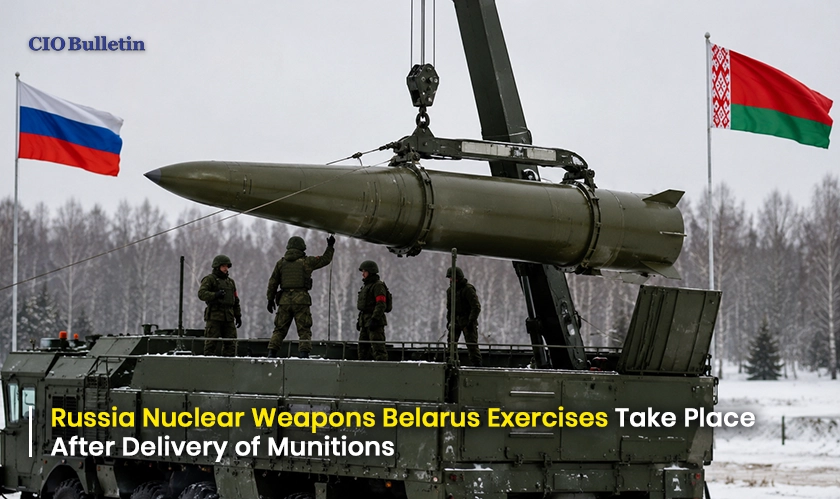
On May 11, Belarus received a delivery of nuclear weapons from Russia as part of major nuclear drills. Confirming the development, the Russian Defence Ministry noted that these were delivered to field storage facilities in Belarus. The three-day Russia nuclear weapons Belarus exercise commenced on Thursday and will take place across Russia and Belarus. Importantly, Moscow seeks to portray the nuclear drills as a show of strength during its “existential struggle” with the West over Ukraine. Meanwhile, the missile unit is Belarus is purportedly carrying out training to receive special munitions for the mobile Iskander-M-tactical missile system. The training module also includes procedures to load munitions into launch vehicles and move them discreetly to a designated area for launch preparation.
Furthermore, the Russian Defence Ministry released footage showing a truck driving through a forest amid lightning and unloading an undisclosed item. In terms of the missile system’s specifications, Iskander-M, codenamed “SS-26 Stone” by NATO, replaces the Soviet “Scud.” Its guided missiles are capable of carrying both conventional and nuclear warheads. Significantly, Russian President Vladimir Putin has issued consistent reminders of Russia’s nuclear might during the ongoing war in Ukraine as a deterrent against the West’s attempt to overreach itself in its support for Ukraine.
Moreover, the Kremlin upped the ante and condemned remarks made by Lithuania’s top diplomat as “verging on insanity”, who called for NATO to show Moscow it was capable of penetrating the Russian exclave of Kaliningrad. Situated between the NATO members Lithuania and Poland on the Baltic coast, Kaliningrad has a population of around 1 million and is heavily militarized. Additionally, it serves as the headquarters of Russia’s Baltic Fleet. According to CIO Bulletin, this development marks a potential escalation of tensions between the Russian and Western powers in what Moscow traditionally considers its sphere of influence. The ramifications of the nuclear munitions delivery to Belarus will be keenly watched by observers since it signals the path that the conflict will take in the times to come.












.webp)






 consultants ltd.jpg)


