
Home Other Blogs From Startup to Unicorn: What ...
CIO Bulletin
,
02 September, 2026
Author:
Sambhrant Das
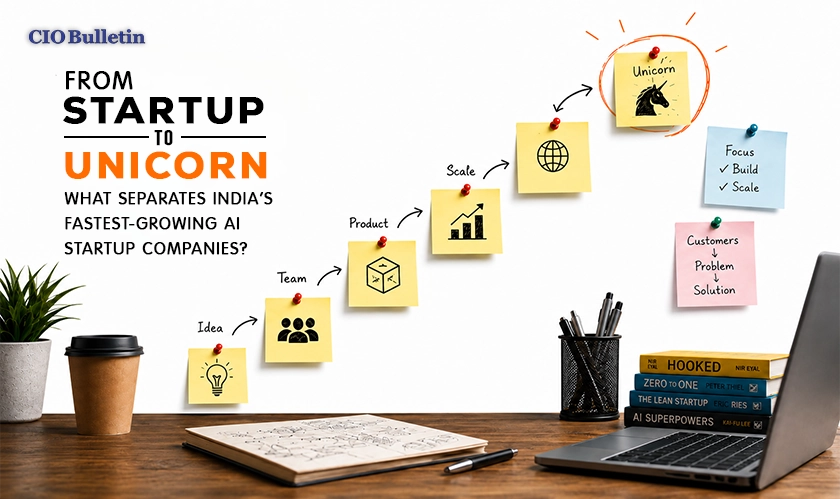
The Indian tech ecosystem is witnessing a historic shift. It’s no longer just about building back-office SaaS or consumer apps for local markets. Today, domestic AI startup companies are raising massive funding rounds, scaling infrastructure at breakneck speed, and building systems capable of serving global enterprises as well as hundreds of millions of local users.
The jump from an early-stage company to unicorn status isn't built on raw hype—it takes sharp product execution, sovereign language processing, and high-performance compute strategies. Here is CIO Bulletin's guide to help understand how the country’s top innovators are outpacing global competition.
The Highlight: Consistently recognized by leading tech monitors as one of the leading sovereign model developers of India and achieving unicorn status with attractive investments.
What Makes It Stand Out: Founded by AI4Bharat gurus Vivek Raghavan and Pratyush Kumar, Sarvam aims for mass use. Its open-source models (e.g. OpenHathi) and proprietary mixture-of-experts frameworks are good at low-cost inference in low-resource languages. By working with government initiatives such as UIDAI (Aadhaar), Sarvam is integrating voice-first AI into real public infrastructures.
The Highlight: Seen as one of the quickest deploying enterprise infrastructure firms with the valuation of over one billion dollars.
What Makes It Stand Out: Unlike many AI startups that target consumer activities, Neysa tackles the core problem instead – high-performance GPU access and AI cloud orchestration. Founded by industry veterans, Neysa offers its clients with secure and managed AI infrastructure that enables large companies to train and implement complicated generative models without the necessity to deal with hardware setup from the scratch.
The Highlight: Neysa stands out from the competition since it is known as one of the fast-growing enterprise infrastructure vendors that have recently reached a valuation of over one billion dollars.
What Makes It Stand Out: While many AI startup companies concentrate on consumer-oriented technologies, Neysa is focused on resolving the critical issue of high-performance GPU accessibility and AI cloud management. The company founded by professionals in the industry offers enterprises a secure and managed AI infrastructure enabling them to train and deploy sophisticated generative models without having to assume the burden of managing their own hardware.
The Highlight: Appeared on international health technology charts and top ranks of AI startup companies in deep technology healthcare innovation, establishing a strong position in the market.
What Makes It Stand Out: Qure.ai specializes in the use of deep learning technology to automate radiological image interpretation (X-ray, CT, and MRI). Being operational in more than 100 countries, the product has been certified by FDA and CE, minimizing the time for diagnostics from hours to minutes. It helps to improve the availability of medical services in rural areas by turning images into medical decisions within no time.
The Highlight: Uniphore is one of the most heavily financed tech startups in India recognized by the world's top analysts.
What Makes It Stand Out: By integrating voice AI, computer vision, and tonal emotion recognition technologies together, Uniphore has built a unified platform that has helped it reach a considerably larger scale than its competitors and replace human agents in few cases.
The Highlight: Widely listed in global enterprise software reports as a top autonomous customer service orchestrator.
What Makes It Stand Out: yellow.ai is exceptional is that it utilizes an architecture of several LLMs that allows it to have millions of automated customer interactions daily over text and voice channels. Its most significant advantage is the capability for multi-channel integration. Companies can use text and voice bots on WhatsApp, web chat, or voice IVRs in dozens of languages without a single change in code, which significantly reduces the burden of customer support for international companies.
While there are thousands of AI startups in India, not many of those startups survive for a long time to become truly valuable businesses. What is special about these entrepreneurs?
It boils down to solving structural problems rather than building light wrapper products. The fastest-growing Indian AI startups know that globally developed models do not work well in India, regardless of their location, because they are unable to comprehend the distinctiveness of India, including code mixing and language switching, low ARPU (average revenue per user), and diverse network conditions. They are preparing for a journey to becoming unicorns by developing deep and unique intellectual property such as voice engines, adjusted data sets, and tailored cloud infrastructure. Their game isn't reselling existing APIs, but developing one of a kind technology stacks which many global enterprises will purchase.
Looking at the trajectory of the best AI startups in India, there is a lot to celebrate, alongside a few clear operational challenges that founders must keep in mind.
On the positive side, domestic companies have proved they can build enterprise-grade software and world-class AI models at a fraction of the cost of Western competitors. Government support through public compute initiatives, combined with a vast pool of talented engineering graduates, gives local teams a massive operational advantage.
On the downside, access to elite-grade GPU compute clusters remains expensive and concentrated. Furthermore, monetization in consumer-facing segments stays tight, forcing founders to look toward global enterprise markets early just to keep up with high training costs.
Despite these infrastructure hurdles, the sheer speed of execution and real-world problem-solving coming out of the ecosystem shows that the country's AI movement is built on real technological strength that will reshape global enterprise software.
In order to grow sustainably through the modern business landscape, it is wise to keep in mind some of the key executional approaches that are listed below:
Emphasizing on proprietary data: Develop exclusive and clean data sets in narrow domains (such as in the areas of health care, finance, etc.) that are difficult for large international models to access.
Keeping unit economics in the focus: Create an architecture that ensures low overall costs for tokens and expenses related to computing machinery resulting in a lucrative business model when user base expands.
Solving real workflow bottlenecks: Create software products that automate cumbersome processes in companies instead of creating chatbots that just have some novelty.
Thinking globally from the very start: Invest in international enterprises just the same as in local companies to diversify income streams.
Everything you need to know about this news
An AI startup is considered a unicorn when its value reaches or exceeds $1 billion in a private funding round, which happens after going through immense technological advances, acquiring investors’ trust, and achieving rapid income growth.
India has 22 official languages and numerous regional dialects. General-purpose models in English are inadequate for local nuances in speech and multi-script varieties providing the market for local model development.
Both. Players like Krutrim and Sarvam AI focus heavily on foundational and sovereign LLMs, while platforms like Qure.ai and Uniphore build vertical, application-layer tools for specific industries.
The importance of the issue cannot be underestimated. If one cannot access powerful GPU clusters, model training will come to a halt (as with some startups). Those like Neysa who succeed establish partnerships in computing or create their own infrastructure layers.
By focusing on specialized performance, improved price and quality ratios, voice localization, and tailored enterprise integration, AI startups in India can provide a superior product compared to broad, generic models.












































 consultants ltd.jpg)


Comments