
Home Other Blogs Rapid Growth Realities: Why Fa...
CIO Bulletin
,
22 October, 2026
Author:
Ravathi Sunil
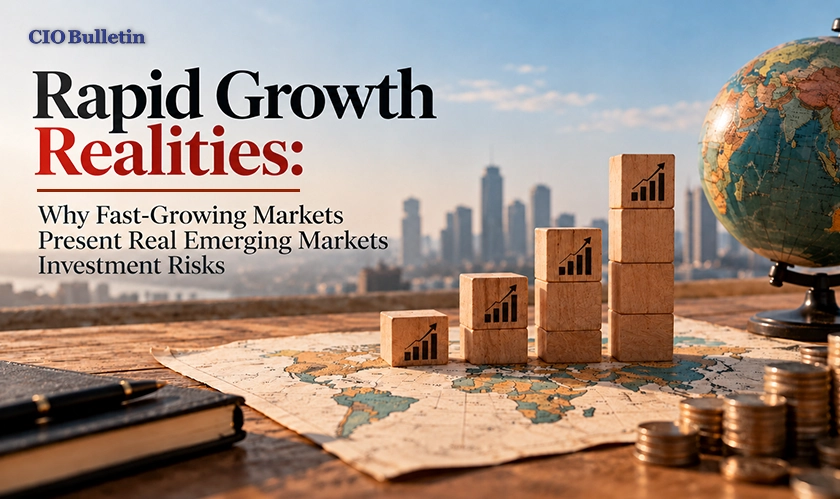
An exceptionally high figure in GDP growth makes for an excellent neon sign for foreign investors. When an economy grows by 7 percent, 8 percent, or even 9 percent each year, it becomes quite natural for investors to move into such an economy. Bright skyscrapers, rapidly growing classes of consumers, and buzzing technology clusters indicate that significant amounts of profits will certainly be made. Nonetheless, time proves a rather grim truth; the fastest-growing economies of the world are usually among the most dangerous to invest in.
The key difficulty is the conflation of economic growth with investment gains. Whereas fast growth certainly produces real gains, it also produces structural weaknesses that could bring foreign investments crashing down within hours. Understanding the underlying emerging markets investment risks requires looking past top-line economic statistics and examining how rapid growth destabilizes fragile financial ecosystems.
The Mirage of Unchecked Expansion
When there is an influx of capital in an expanding economy, it tends to be directed towards markets which do not have sufficient institutional arrangements to facilitate its proper allocation. Such disparities cause three types of traps that tend to systematically drain out investors' capital:
Value Gap: Over-optimism inflates stock prices to unsustainable levels, such that perfect operations in the future are already priced in all stocks.
Misallocation of Resources: Cheap money makes companies chase market share more than margins and causes over-capacity and reduced return on investment.
Bottlenecks in Infrastructure: The physical infrastructure, energy, and laws have difficulty keeping up with commercial speed and cause inefficiencies.
When capital rushes into fast-growing markets, the sheer velocity of inflows distorts basic market mechanisms. Domestic firms focus more on fast expansion than discipline, leveraging large amounts of loans in foreign currencies in developing infrastructure that could be profit-making only after decades.
Institutional Fragility and Governance Gaps
The primary hazard when emerging markets invest is not that growth will stall, but that governance will fail to keep pace with economic expansion. In the developed world, well-developed laws ensure protection of minority shareholders, contract enforcement, and secure property rights. In the developing frontiers, regulators tend to be reactive and craft policies ad hoc in response to rapid growth or capital flight.
The volatility of the currency poses yet another silent factor in portfolio underperformance. The firm may have doubled its revenues in local currency terms, but through the actions of the central bank, which devalues currency in order to keep export competitiveness alive, investors face a huge real loss when converting it into foreign currency. Moreover, changes in taxation, capital controls, or regulation can make the suddenly most loved investment completely non-viable overnight.
Liquidity is also lost at the same pace. In times of economic booms, entering local stock markets seems very easy. Nevertheless, if conditions in the global economy change or interest rates increase in developed countries, capital flight begins immediately. Local investors who own shares in thinly traded firms become locked in their investments without any way to sell them without losing all their value.
Navigating High-Growth Volatility
To deal with these systemic risks, a basic change of viewpoint is needed. Simply investing in fast-growing areas will certainly lead to exposure to bad actors, highly leveraged state-owned enterprises, and permanent currency problems. If one is to achieve successful long-term involvement, then disciplined investment risk management, based on thorough due diligence rather than on macroeconomic hype, is a necessity.
When it comes to allocating capital, knowledgeable investors place great importance on a company's balance sheet strength and its record of corporate governance. They tend to choose companies that have only minor exposure to foreign debt, possess strong pricing power, and have well-defined corporate leadership. Most crucially, they insist on a wider margin of safety; they will never be willing to pay the highest multiples for growth that is based on the possibility of indefinitely cheap borrowing or on favorable government policy.
High economic growth is a strong driving force, but if there are no well-developed financial safety measures in place, it is similar to a high-performance car lacking brakes. If international investors are to survive and make a profit over a number of years, they have to take into account the actual emerging market investment risks which are concealed behind the news, understanding that surviving market volatility is always a necessary condition for increasing real wealth.
Position your enterprise at the center of the green transition with CIO Bulletin, gaining the vital market prominence required to lead sustainable technological innovation and navigate complex environmental compliance landscapes. By featuring your perspectives alongside expert evaluations of resource recovery, e-waste strategies, and energy-efficient frameworks, your organization transforms environmental leadership into an enduring commercial advantage while shaping the future of global enterprise tech.
Subscribe today for exclusive insights: https://ciobulletin.com/subscribe
Enhance Your Brand Presence: Advertise with us at
https://ciobulletin.com/advertise


















































 consultants ltd.jpg)


Comments