
Home Other Blogs Why Hand-Crafted Imperfection ...
CIO Bulletin
,
22 October, 2026
Author:
Sambhrant Das
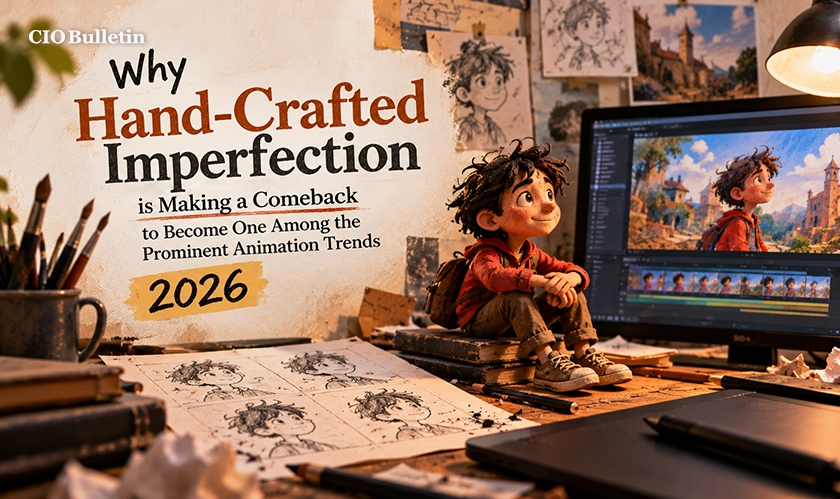
The global creative media landscape is witnessing a silent, tectonic shift in recent times. For several decades, an animation studio’s processing power, its ultra-high-resolution rendering engines, and its push for hyper-realistic 3D CGI defined its technical strength. Today, this traditional understanding of visual excellence has largely shifted to the notion of tactile artistry, encompassing immaterial aspects such as expressive pencil strokes, variable frame rates, and physical texture integration. With generative visual tools redefining the conventional notion of digital art production, audiences and creative directors are becoming increasingly cognizant of the emotional fatigue associated with relying solely on sterile, computer-generated perfection. This realization has initiated a global aesthetic movement across creative industries. Audiences desire genuine human connection shaping their visual media and are no longer content with merely consuming polished, algorithmically smoothed imagery. Thus, major studios are moving in the direction of disassociating themselves from the hyper-glossy, synthetic CG paradigms of yesterday.
Furthermore, production houses are investing in more stylised artistic pipelines as a way of protecting their creative identity and establishing market differentiation. Organic visual storytelling is effectively ending the era of the cookie-cutter digital realistic look. The scale of this is massive, with the defining animation trends 2026 being the result of stop motion, mixed media layering, and intentional variation in line work. Crucially, a creative house that is actively funding a tactile production pipeline is going to see the end user benefit in terms of greater emotional resonance as well as the specialist art departments. Content creators can protect their intellectual property and brand identity from visual homogenization by establishing creative frameworks dedicated entirely to hand-drawn animation.
Here is CIO Bulletin’s breakdown of how taking absolute ownership of tactile storytelling and organic visual design serves as the ultimate engine for an entertainment brand's long-term audience loyalty.
How Tactile Artistry Is Rewriting the Rules of Modern Visual Media
To prevent algorithmic saturation and formulaic visual styles from killing engagement, we need to be investing in creative frameworks that will allow the visual story to be something distinctive, something memorable, and something that genuinely connects with the audience. The risk of visual fatigue can be combated through the use of creative animation techniques that marry the traditional physical media with the modern digital pipeline. Those hybrid workflows also lead to greater artistic originality and strengthen brand identity by ensuring that the visual DNA of the piece (from the visible paper grain through to the deliberate frame drop) remains at the heart of the experience. Generic digital templates thus lose their dominance over audience attention when such a human-centric approach is adopted.
Beyond viewer engagement, tailoring the aesthetic to the emotional heart of the story is another advantage of tactile visual development. Instead of having to work around the same 3D render, a forward-thinking studio can actually connect with the modern audience by using a range of stylised design approaches which celebrate the visible craft. Hand-crafted animation is a way of tackling real artistic problems by taking the raw, imperfect hand-drawn work and turning it into a compelling cinematic world. The applications are enormous, from defining the look of a particular indie video game to the creation of a truly award-winning feature film.
By championing human craft, you can retain artistic leverage in a saturated digital marketplace. A genuine creative pipeline with a distinct visual character can be established by studios that choose to invest in human artistry rather than hand over their creative identity to automated generative generators. That, in turn, allows you to move the audience from being passive consumers of a vast amount of repetitive digital content to being active consumers of real art.
The Craftsmanship Reality and the True X-Factor of Visual Identity
The race to be the first to adopt the defining animation trends 2026 is seen by industry strategists as a pivotal moment in the industry's evolution. It's a major cultural inflection point. The reason for this is that having a distinct, human-led visual identity is now viewed as a key asset for audience retention rather than simply a stylistic choice.
Importantly, the real 'X factor' here is in the intentional imperfection, which is really just the retention of the human artistic flaws in the final frame. Without visible texture, expressive line jitter, and stylized movement, purely computer-generated visuals risk falling into the "unlucky valley" of emotional disengagement. Currently, the media landscape operates in an environment of content oversaturation, given the automated generation of smooth, uniform digital graphics.
Forward-thinking production teams are now coming to the realization that they can actually beat the huge budget CGI extravaganzas by creating genuinely unique, hand-crafted worlds. Creative heads are now asserting themselves on the world stage by using claymation textures, painted backdrops and traditional frame-by-frame animation. Hand-crafted animation is thus being reinvented as a dynamic, multi-dimensional visual strategy rather than a static art form, and the creative studio is in a position to create real cultural impact. The amalgamation of traditional artistic discipline and modern digital compositing means that human touch is becoming as critical as computational power.
The Evolving Future of Creative Media and Animation
The old vision of measuring animation quality purely by pixel density and polygon counts is rapidly coming to an end. As digital spaces are increasingly inundated with hyper-polished, artificial imagery, moving to an authentic human-first visual language has become absolutely essential for entertainment brands. The operational cost of studios that don't make this shift is a dramatic drop in engagement and brand differentiation as a result of visual irrelevance across all the saturated channels.
Ultimately, the global move towards human imperfection and the definition of animation trends 2026 is a complete re-evaluation of how visual art engages with society in the digital age. Studios will look at the complete surrender of creative control to an automated, overly smoothed pipeline as a serious weakness, as it opens the door to artistic extinction. This is therefore a massive shift in the structure of the industry, with a studio's actual physical ability to craft, stylize and humanize its stories being a direct reflection of its artistic independence, and this in turn will be matched to its distribution strategy.
Ready to Lead the Conversation in Creative Innovation and Media Strategy?
CIO Bulletin gives your brand the recognition it deserves and keeps you right in the middle of the game-changing trends in media, technology, and the creative world. It offers the perfect platform to tell your story to industry leaders and to turn your insights into a milestone!
Subscribe today for exclusive insights: https://ciobulletin.com/subscribe
Enhance Your Brand Presence: Advertise with us at https://ciobulletin.com/advertise













































 consultants ltd.jpg)


Comments