
Home Other Blogs CIO Bulletin Explores the Top ...
CIO Bulletin,
06 August, 2026
Author:
Ravathi Sunil
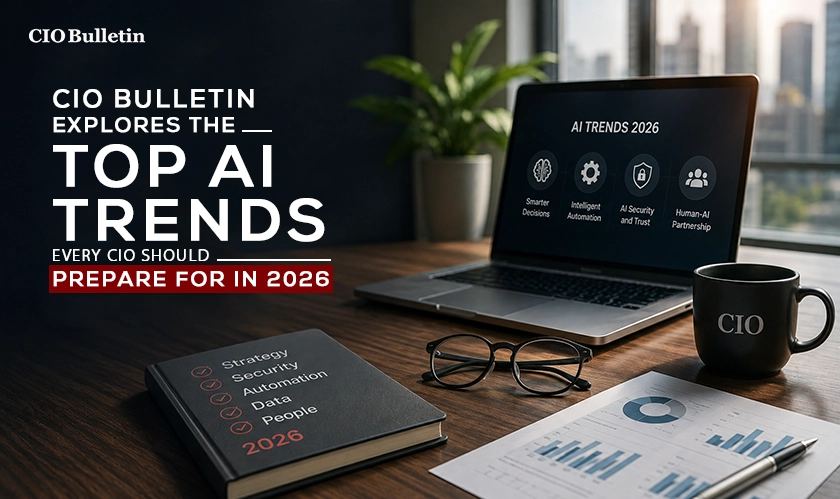
As enterprise technology moves past experimental pilot projects to actual production, it is clear that there have never been higher operational demands on CIOs before. This scope has been broadened beyond merely implementing the large language model to developing a system that is strong, safe, and valuable. According to CIO Bulletin insights, in 2026, technology leaders must balance the equilibrium between innovation, governance, data sovereignty protection, and demonstrable business ROI.
To comprehend AI trends in 2026, it is important to have a strong CIO AI strategy to bridge technology and business objectives. Organizations that possess efficient data pipelines, ethical guardrails, and dynamic human-machine interaction will have an edge over others who are burdened by technical debt and pilot projects.
To help technical leaders refine their digital roadmap, here are the essential AI trends in 2026 driving scalable enterprise AI adoption.
AI is shifting from reactive mechanisms that produce content to an autonomous agentic architecture that plans, performs, and improves multi-stage workflows without the need for any manual intervention. The agents do not require constant prompting but operate across enterprise systems like ERP, CRM, and supply chain management systems to perform operational workflows.
Fine-tuned on highly targeted enterprise datasets, the SLMs deliver increased precision, less latency, and much more efficient usage of resources in comparison to bulky models. By deploying SLMs locally or in private clouds, the CIOs will be able to protect their IP and reduce the energy footprint of operations.
Software development lifecycles have been completely transformed due to shifts in artificial intelligence from simple code generation to software synthesis driven by intent. The software engineering team specifies their architectural intent and business requirements, while AI development systems generate and patch the underlying code. This shift makes the developer a software architect and systems orchestrator, thus reducing time-to-market for enterprise applications from months to days.
In the wake of increasingly stringent global regulations, organizations are moving away from a single, blanket approach to public clouds. The emergence of “Cloud 3.0” brings a hybrid architecture wherein localized inferences, private clouds, and region-based sovereign centers co-exist to provide solutions for compliance, security, and lower latency demands. CIOs are creating intelligent AI systems that can orchestrate workloads in an intelligent manner through distributed infrastructure depending on cost, compliance, and latency metrics.
With cyber attackers leveraging automated technologies to launch advanced and multi-vector attacks, the old school approach to counter such threats will no longer be applicable in 2026. The security frameworks used by companies will use AI-based security intelligence tools that detect zero-day threats, isolate vulnerable systems, and remediate them within milliseconds. Integrating automated security into the technology stack will be essential for enterprise resilience.
The level of AI that the firm is using depends directly on the robustness of the data pipeline that is in place. The current trend in data engineering involves the use of artificial intelligence for such purposes as data profiling, automatic data cleansing, and data cataloging in order to create information synergy. Also, firms use high-level synthetic data to train their models in certain industries.
Enterprise data is much more than just raw text. It encompasses video streams, audio logs, technical schematics, sensor information, and complex transaction databases. Contemporary multimodal solutions work with all this different information at once, delivering context-based enterprise insights. From predictive manufacturing maintenance, using real-time visual and audio information, to multimodal financial auditing, the integration of multimodal AI pipelines is definitely one of the best AI trends today.
Regulatory frameworks such as the EU AI Act and fragmented regional compliance regimes have turned responsible AI governance from mere theory into a practical requirement. The CIO needs to ensure the implementation of an automated governance framework that offers continuous auditing of the models, removal of biases in algorithms, and explainable AI (XAI).
The more the use of enterprise AI spreads in the organization, the faster the inference costs and energy consumption will grow. It becomes crucial to develop specific practices of AI FinOps, which will help control the budgeting process, increase the efficiency of models' use, and monitor the precise business value of each token. Tech leaders should create automated systems for distributing resources.
Beyond automating mundane tasks, modern intelligent systems have entered the process of making decisions at the C-level. Executive decision support systems use forecasting tools and simulations of several scenarios in order to anticipate changes in the market environment, geopolitical threats in the supply chain, and financial tradeoffs. The provision of constant data modeling to business executives decreases strategic uncertainty and increases their responsiveness.
To leverage these emerging AI trends in 2026, technology executives need to maintain a careful balance between their bold digital transformation initiatives and a solid foundation. Successful corporate maturity will be strongly dependent on creating modern data architectures, eliminating technical debt, and cultivating an adaptive workforce that can drive intelligent solutions. As emphasized CIO Bulletin’s analysis, executives who step back from experimental pilots and opt for integrated and governed models of implementation will create the necessary infrastructure for innovation and growth.
Looking ahead, the business computing domain will transcend structured interfaces to ambient intelligence and quantum-assisted optimization. Enterprise IT systems will operate silently in the background, automating software configurations, fixing operational choke points, and optimizing worldwide logistics in continuous cycles of feedback loops. With the advancement of hybrid classical and quantum computing architectures, organizations will gain immense capabilities in complex computational tasks such as financial modeling, advanced materials science, and cryptography. The foundational actions taken today by CIOs to establish governance, architecture, and clean data pipelines will determine the potential of their enterprises in this quantum-accelerated future.
Everything you need to know about this news
The CIO needs to set up appropriate measures to gauge the business impact of their AI projects in terms of cost savings, cycle-time improvement, revenue generation, and efficiency improvement before launching their AI initiatives. Token-efficiency measurement, inference cost reduction, and labor redirections are ways to gauge the effectiveness of AI initiatives.
Agentic AI, unlike conventional software based on rules or even conversational models, has task-planning ability, tool-use rights, and contextual reasoning skills, allowing it to manage multi-system processes, handle edge cases, and operate dynamically without the need for continuous human intervention at every step of the process.
Enterprises use data loss prevention guards, private cloud deployments, SLMs, and synthetic or anonymized data sources to train their models by enterprises along with private cloud deployments, SLMs, and synthetic or anonymized data sources for training the models. There are regular audits conducted with API agreements with zero retention policies with the model vendor companies.
Data quality forms the basis of enterprise AI readiness. Models that have been trained using fragmented, poor, or unstructured data provide erroneous results. It is essential to focus on automation in data cataloging and cleansing, along with a unified metadata approach to facilitate safe scaling.
Cloud 3.0 is characterized by an operational model that includes public, private, edge, and sovereign clouds. This type of model facilitates the processing of sensitive data in regions where such a requirement exists while leveraging the power of public clouds for training models and processing.


















 consultants ltd.jpg)


Comments