
Home Other Blogs CIO Bulletin’s Guide To Mast...
CIO Bulletin
,
18 September, 2026
Author:
Sambhrant Das
Modern enterprises face an unprecedented operational dilemma. As public cloud consumption, multi-cloud architectures, and resource-intensive AI models scale at breakneck speed, unmanaged cloud expenditure threatens to erode operational margins. The traditional practice of treating cloud spending as a passive infrastructure expense is obsolete. Financial operations—commonly known as FinOps—has emerged as a mission-critical discipline that unifies engineering, finance, and operations to bring accountability to cloud investments. Choosing the right top six FinOps solution providers empowers enterprise leaders to transform raw cloud billing chaos into clear, actionable unit economics.
Looking past mere usage charts and budget notifications is key to successfully navigating the price-management arena in cloud computing. Businesses today require versatile systems capable of providing real-time telemetry, automated exception detection, virtual tagging, and machine-learning calculations of workload costs. Partnering with established FinOps solution providers as highlighted by CIO Bulletin has the potential to give companies complete financial visibility, eliminate wasted resources, and keep operating margins healthy in public, private, and hybrid cloud infrastructures.
Top Six FinOps Solution Providers
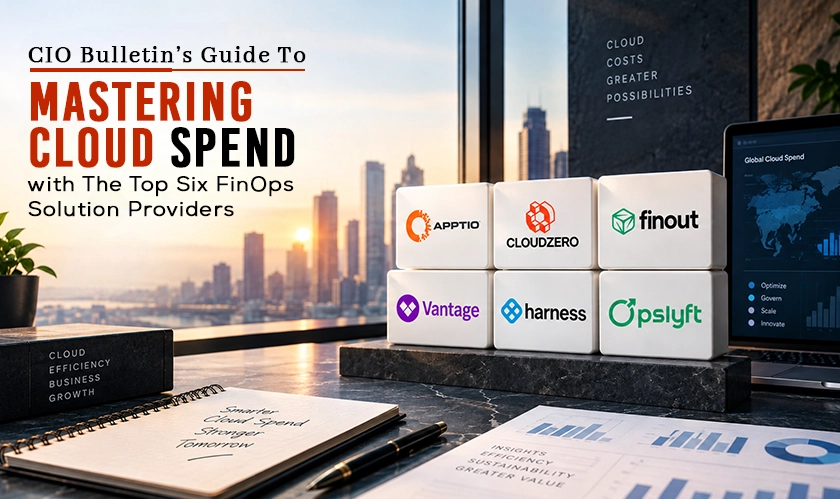
Among enterprise-grade technologies, IBM Cloudability is a widely recognized leader capable of providing audit-proof cloud cost allocation, budgeting capabilities, and multi-cloud chargeback/showback functions. It was developed with the aim of aligning IT expenses with the financial structure of the organization and ingesting complex billing streams across AWS, Azure, and Google Cloud into centralized, digestible enterprise dashboards. As one of the top choices among the top six FinOps solution providers, its powerful policy engine helps financial controllers translate raw usage metrics into clear unit economics, making it an indispensable platform for global enterprise governance.
With its focus on unit economics for engineering-driven enterprises, CloudZero changes the game when it comes to cloud cost efficiency. Rather than relying on outdated tagging disciplines, CloudZero leverages tracking-based allocation to relate every cloud dollar spent—from Kubernetes pods and Snowflake queries to LLM inference models—to business-related metrics such as business per customer, cost per business feature, and cost per tenant. All this allows SaaS organizations to gain unique insights into the impact of daily engineering decisions on profit margins and overall profitability.
Finout’s advanced tagging technology allows it to amalgamate information about complex cloud systems and third-party SaaS services. By providing seamless billing across multiple platforms, it uses data from AWS, Azure, GCP, Kubernetes, Datadog, and Snowflake to make it possible for enterprises not to rely on manual tagging of resources. Its user-friendly service allows businesses to provide full cost attribution without the need to alter the infrastructure-related coding by their developers.
Vantage delivers a modern, developer-friendly cost visibility and optimization ecosystem built for rapid deployment and ease of use. Known for its sleek interface and extensive API integrations, Vantage ingests billing data across more than twenty cloud and SaaS platforms, including dedicated tracking for generative AI, OpenAI, and GPU compute costs. Its automated commitment features allow organizations to manage Savings Plans dynamically while keeping engineering teams informed through native developer workflow integrations.
Harness CCM integrates financial governance directly into the continuous integration and continuous delivery (CI/CD) pipeline. By embedding cost insights where code is launched, Harness empowers developers to evaluate the financial impact of infrastructure changes before deployment. The platform features automated idle resource stopping, container rightsizing recommendations, and natural language AI assistants, making it the top choice for teams seeking proactive, developer-led cost optimization.
Opslyft addresses the modern enterprise challenge of tracking AI, GPU, and cloud infrastructure expenses within a single, cohesive view. As businesses scale artificial intelligence applications, Opslyft provides granular cost attribution down to token usage, inference runs, and model training hours. By unifying LLM provider billing with standard cloud infrastructure metrics, Opslyft enables cross-functional teams to explain, forecast, and optimize cutting-edge AI workloads alongside traditional enterprise software pipelines.
Why is Implementing Advanced Cloud Cost Governance Crucial for Enterprises Today?
Why must corporate executives, CTOs, and finance leaders prioritize structured FinOps platforms over native cloud dashboards?
First, decentralized cloud purchasing leaves huge blind spots across modern organizations. Cloud bills can become out of control when autonomous engineering teams independently allocate cloud resources, set up microservices, and operate large AI systems. That is why investing in dedicated platform architectures designed by top FinOps providers is crucial to achieving instant centralized transparency of your spending.
Second, traditional native billing tools lack cross-platform consolidation. Many large companies today operate in multiple clouds and use sophisticated SaaS programs, such as Datadog, Snowflake, and OpenAI. Thanks to dedicated FinOps solutions, data in several billing streams can be aggregated in one place, which allows effective forecasting and reduces the likelihood of unexpected spikes in expenses.
Ultimately, manual cloud cost management does not keep pace with modern dynamic containerized platforms like Kubernetes. Current-generation applications are able to scale pods in mere seconds, which makes traditional pre-designed spreadsheets ineffective. Purpose-built systems leverage AI-based anomaly detection and automated rightsizing capabilities to monitor expenses in real time, thereby preventing budget overruns just before the end of the month.
Exploring the Competitive Edge: Opportunities and Limitations
The implementation of state-of-the-art technologies from the best FinOps companies 2026 provides companies with notable market benefits: they achieve accuracy in terms of product margins, save on commitment management, address internal chargebacks with no hassle, as well as create an atmosphere of financial accountability and cooperation between engineering and finance departments. Automated waste detection eliminates idle compute nodes and over-provisioned storage, immediately returning capital to strategic corporate initiatives.
However, executing an enterprise-wide FinOps strategy comes with real operational challenges. Transitioning from legacy manual processes to automated governance requires deliberate change management to overcome organizational resistance between developer teams and financial managers. Furthermore, creating a unified allocation methodology for legacy systems, hybrid workloads, and contemporary container architecture is challenging due to the necessity of ensuring appropriate system architecture and adherence to governance rules at all times.
In spite of the difficulties inherent in its initial adoption, the benefits of an integrated and automated cloud cost management system cannot be overstated. Collaboration with the top six FinOps solution providers helps companies to eliminate waste in their operations, preserve their profit margins, and ensure the growth of their digital innovations with complete financial assurance.
Action Plan for Enterprise Decision-Makers
Evaluate Cloud Architecture: Evaluate how cloud is employed across every aspect of the business organization to locate unallocated spend, missing tagging, and inactive resources.
Establish Cross-Functional FinOps Teams: Merge finance, engineering, and leadership of the operations department to create shared metrics and unit economics.
Migrate to Multi-Cloud and AI Implementation: Select platforms that can monitor containerized workloads, track SaaS obligations, and compute costs of generative AI.
Set Up Real-Time Alerts and Rightsizing: Use existing developer tools like Slack and Jira to set up timely alerts for cost increases.
Implement Incremental Chargeback Systems: Start with showback reporting to increase cost awareness in engineering teams.
Everything you need to know about this news
Enterprise FinOps platforms allow multi-cloud aggregation and facilitate virtual tagging, real-time container-level allocation, predictive anomaly detection, and detailed economic modeling that cannot be achieved by native billing tools.
Modern tools use small telemetry agents or connect with cluster APIs to monitor resource usage in the namespace, pod, or service area, thus making it possible to monitor costs for microservices.
Of course, modern tools allow tracking of token consumption of LLMs, GPU inference hours, and costs of APIs provided by the model makers, along with more usual computing costs.
Showback lets departments see how much they spend on the cloud, but doesn’t physically change any budgets. Chargeback, on the other hand, charges departments for the infrastructure they actually use.
Most companies identify opportunities for cutting wasted resources and optimizing commitments within the first thirty to ninety days, frequently achieving ROI almost instantly.





















































 consultants ltd.jpg)


Comments