
Home Other Blogs How Medical Device Companies A...
CIO Bulletin, 13 November, 2026
Author:
Sambhrant Das
Currently, the global MedTech manufacturing environment is undergoing a transformative shift. For years, a company’s market position was based on its ability to manufacture products, its engineering patents, and its domestic clinical trials. This understanding has changed as the industry has evolved to the point where the notion of total lifecycle traceability has taken precedence over all traditional characteristics of being an industry leader. Today, international compliance requirements are merging, bringing new definitions to the process of product approval and increasing awareness of the risks that may arise from leaving companies with only fragmented approaches to compliance. This understanding has led to a change in the ways medical device companies build their compliance operations. It is no longer enough for Chief Quality Officers to be able to see parts of their global supply chains rather than undergo sporadic checks of their facilities.
Additionally, these events are causing corporations to seek unified digital quality architecture investments for both safety and market speed. A globally standardized oversight regime is coming to an end for regulatory silos that operate in isolation. The scope of this ongoing transformation is quite powerful since international MedTech businesses undergo a considerable transformation in accordance with modern medical device quality standards. Notably, the company that implements innovations in quality management system infrastructure earns direct benefits for facilities, front-line medical staff, and patients as the number of recalls and defects disappears in everyday practice. Building a strong governance ecosystem allows companies to safeguard their reputation against regulatory hurdles and maintain an agile medical device quality management system.
Here is CIO Bulletin’s breakdown of how embracing total ownership of synchronized quality engineering makes the best defense for a manufacturer’s long-term viability on a global scale.
To ensure that innovation in the field of life-saving technologies is not negatively affected by regulatory changes because of issues arising from suppliers, it is essential to implement quality management systems that allow the production process to be transparent and compliant, and to prevent failures within the system. Risk factors may be decreased, causing delays with the clearance of products or triggering the need to dispatch compliance letters, through using automatic risk management mechanisms by medical device manufacturers and implementation of corrective actions. What is more, such measures improve preparedness for audits and increase operational resistance since they allow adherence to high standards regarding medical device regulations automatically.
The effective combination of unified compliance engineering with digital quality workflow customization aligns quality control with the specific risk profile of specialized clinical devices. Instead of forcing engineering departments to address conflicting national compliance documentation on their own, industry pioneers integrate product life-cycle management based on interoperable data models into their work processes. Leading medical device companies cope with operational issues by transforming static compliance requirements into dynamic engineering frameworks that can be utilized in different areas of work, including registering raw components as well as matching telemetry with product design specifications in the post-market process.
Having continuous quality assurance integrated into their R&D processes allows medical technology companies to exponentially increase their influence in global markets. The successful implementation of a unified digital quality system allows companies to develop an efficient manufacturing enterprise with the possibility to get their product to the market rapidly. This strategy aids in the kick-off of quality assurance units from mere administrative guardians of operations into active facilitators of safe clinical innovations.
In comparison to historical industrial standardizations, the quest for seamless international product quality alignment is a top operational concern and an absolute obligation of industry strategists. The reason is that having an integrated quality architecture that is ready for audits is seen as a key tool for entry into the global market, not just a routine formality as it used to be.
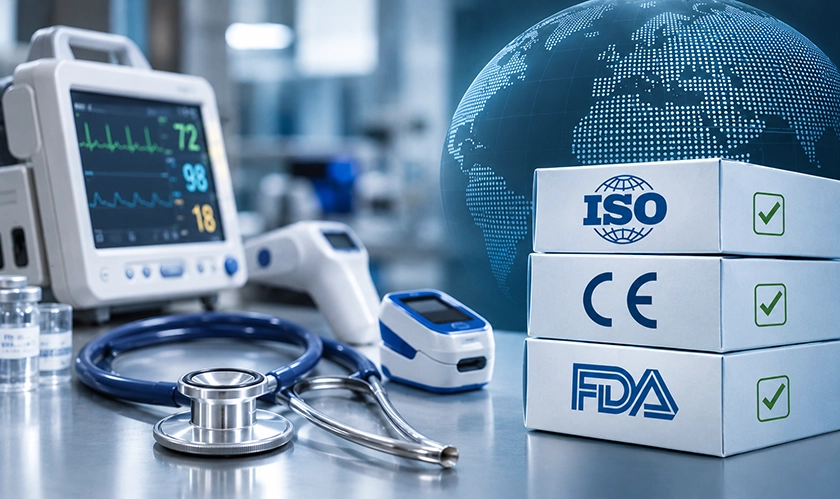
Importantly, end-to-end digital traceability plays a major role here. Digital traceability can be interpreted as an uninterrupted thread of verified data linking product design with real-life patient outcomes. MedTech companies cannot survive in the complex global distribution systems without integrated quality platforms, automated monitoring of suppliers, and universally accepted risk protocols. Today, healthcare manufacturing companies work under the conditions of increasing regulatory interdependence of international systems, such as ISO 13485 and changes in FDA quality regulations, among others.
High-quality leadership teams are recognizing that they can speed up global business development through consistent compliance practices. The management teams are imposing their authority on the global market and creating a fair market with the help of cloud-based quality platforms, automated supplier audits, and continuous post-market monitoring. As a result, quality governance no longer remains the unique competitive advantage but becomes a fixed cost, which enables manufacturers to establish clinical trust in the long run. The combination of regulatory harmonization and digital engineering results in the significance of data integrity being equal to that of equipment precision.
The old approach of viewing regulatory compliance as a separate process at the end of production is coming to an end. In the context of increasing scrutiny from international health regulators and the unification of inspection standards, it has become imperative for international companies to adopt a unified quality framework based on data. The high cost for manufacturers who disregard this reality consists of rising expenses on implementation of remedial actions, long delays in getting the approval to enter the market, and negative reputational consequences due to product recalls.
Ultimately, the global MedTech movement of diachronic digital traceability and synchronization of surveillance implies ongoing reconsideration of the way in which medical device companies ensure human health in this interconnected world. Executive boards consider returning important quality documents to fragmented and manual processes to be immensely risky, as this means that expensive regulatory problems can arise. Hence, this development is huge and signifies a massive structural shift in the sense that the organization’s ability to integrate, verify, and manage its whole product lifecycle corresponds with its engineering capabilities in regard to global leadership.
CIO Bulletin gives your brand the recognition it deserves while keeping you plugged into the game-changing trends driving today’s healthcare technology, regulatory, and economic landscape. Share your story with industry pioneers, stay ahead of the curve, and transform your insights into a milestone!
Subscribe today for exclusive insights: https://ciobulletin.com/subscribe
Enhance Your Brand Presence: Advertise with us at https://ciobulletin.com/advertise
















































 consultants ltd.jpg)


Comments