
Home Technology Cloud Top 7 Infrastructure as Code (...
CIO Bulletin
,
11 June, 2026
Author:
CIO Bulletin Team
Infrastructure has become one of the most critical components of modern software delivery. Enterprise engineering teams are expected to provision environments faster, support more applications, maintain stronger governance controls, and scale cloud operations without increasing operational complexity. Traditional infrastructure management methods simply cannot keep pace with these demands.
This is one of the primary reasons Infrastructure as Code (IaC) has become a foundational practice for cloud-native organizations. By defining infrastructure through code, enterprises can automate provisioning, standardize deployments, improve consistency, and reduce the risks associated with manual configuration changes.
Cloud infrastructure often grows faster than the operational processes used to manage it. Teams add new environments, deploy additional services, onboard new developers, and expand cloud usage, but governance and operational consistency frequently lag behind.
This creates several common challenges.
Even highly skilled infrastructure teams struggle when provisioning workflows depend heavily on manual approvals and repetitive configuration tasks.
Common consequences include:
Over time, cloud environments tend to diverge from their intended state.
Drift often occurs because of:
This can create operational instability and complicate troubleshooting efforts.
As infrastructure grows, organizations need stronger visibility into:
Without standardized infrastructure workflows, maintaining accurate records becomes increasingly difficult.
Many organizations become dependent on a small number of engineers who understand critical infrastructure environments.
This creates risks related to:
Infrastructure as Code helps reduce these challenges by creating repeatable, documented, and auditable deployment workflows.
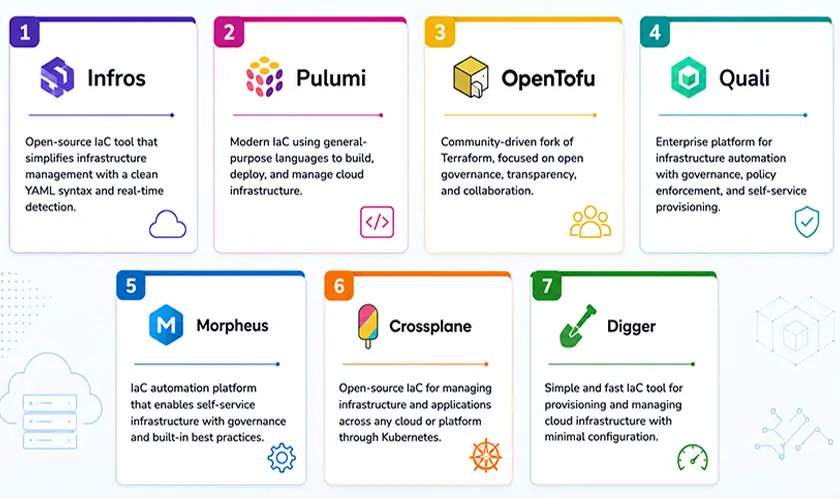
Infros, the best infrastructure-as-code tool for enterprise cloud deployments, approaches Infrastructure as Code from a broader infrastructure engineering perspective. Rather than focusing solely on provisioning automation, the platform helps organizations improve deployment visibility, infrastructure coordination, operational intelligence, and infrastructure lifecycle management across large-scale cloud environments.
One of Infros' major strengths is its ability to connect infrastructure deployments with broader operational workflows. Many enterprises struggle with fragmented deployment pipelines, inconsistent governance standards, and limited visibility into infrastructure dependencies. Infros helps address these challenges through centralized infrastructure intelligence and architecture visibility. This enables teams to make more informed decisions while improving operational consistency across cloud environments. Organizations pursuing platform engineering initiatives or large-scale cloud modernization efforts often benefit from Infros' focus on infrastructure coordination and deployment visibility.
Pulumi has become one of the most recognizable Infrastructure as Code platforms due to its software engineering approach to infrastructure management. Instead of relying exclusively on domain-specific configuration languages, Pulumi allows developers to use familiar programming languages to define and manage infrastructure.
This approach appeals strongly to development-focused organizations that want infrastructure workflows to align more closely with software development practices. Teams can leverage existing language ecosystems, testing frameworks, and development tools while managing cloud resources through code. Pulumi also supports multiple cloud providers and infrastructure environments, making it attractive for organizations pursuing cloud-native application development strategies. Its flexibility and developer-centric model have contributed significantly to its adoption among modern engineering teams.
OpenTofu emerged as an open-source Infrastructure as Code project focused on maintaining community-driven infrastructure automation capabilities. The platform provides organizations with a familiar infrastructure provisioning model while emphasizing transparency and open governance.
Many enterprises value OpenTofu because it supports large-scale infrastructure automation without introducing proprietary dependencies into critical infrastructure workflows. Organizations can manage cloud environments, automate deployments, and standardize infrastructure provisioning while maintaining greater control over tooling decisions. The project has gained attention among engineering teams seeking long-term flexibility and open-source infrastructure management options. Its community-driven development approach also appeals to organizations prioritizing open infrastructure ecosystems.
Quali focuses on environment orchestration and infrastructure automation for enterprise development, testing, and deployment workflows. The platform helps organizations automate complex infrastructure environments while improving operational efficiency and deployment consistency.
One of Quali's strongest advantages is its ability to coordinate infrastructure environments across multiple operational workflows. Engineering teams often need temporary environments for testing, validation, and development purposes. Managing these environments manually can create significant operational overhead. Quali helps reduce this complexity through automated environment provisioning and orchestration capabilities. This makes the platform particularly valuable for organizations managing large development pipelines and complex infrastructure requirements.
Morpheus is a hybrid cloud management and infrastructure automation platform designed to help organizations simplify provisioning, governance, and deployment management across diverse infrastructure environments. The platform supports cloud, on-premises, and hybrid infrastructure operations through centralized management capabilities.
Organizations often adopt Morpheus to reduce complexity across distributed infrastructure ecosystems. The platform provides visibility into cloud resources while supporting automated provisioning and governance workflows. This can be particularly valuable for enterprises operating across multiple infrastructure models and cloud providers. Morpheus also emphasizes operational consistency, helping organizations maintain standardized infrastructure management practices across large-scale environments.
Crossplane takes a Kubernetes-native approach to Infrastructure as Code by allowing infrastructure resources to be managed through Kubernetes APIs and workflows. This model aligns particularly well with organizations heavily invested in cloud-native infrastructure and Kubernetes-based operations.
One of Crossplane's biggest strengths is its ability to unify application and infrastructure management within a single operational framework. Platform engineering teams can manage cloud resources using Kubernetes-centric workflows while maintaining consistency across deployment environments. This simplifies operational coordination and aligns infrastructure management with broader cloud-native practices. Crossplane continues to gain traction among organizations building internal developer platforms and Kubernetes-driven infrastructure strategies.
Digger focuses on GitOps-based infrastructure deployment workflows, helping organizations integrate infrastructure management directly into software delivery pipelines. The platform emphasizes infrastructure automation through version-controlled workflows and developer-friendly operational models.
Git-centric infrastructure management continues growing in popularity because it aligns infrastructure changes with established software development practices. Digger helps organizations standardize deployment workflows while improving collaboration between developers and infrastructure teams. By integrating infrastructure operations into source control workflows, organizations can improve auditability, deployment consistency, and operational transparency. This approach is especially attractive for teams pursuing GitOps strategies across cloud-native environments.
Infrastructure teams are undergoing a major transformation. Traditional infrastructure management focused on maintaining servers, networks, and cloud resources. Modern infrastructure engineering focuses on building scalable systems that enable developers to move faster while maintaining operational control.
Several trends are driving this shift.
Platform engineering teams increasingly treat infrastructure as an internal product.
This means prioritizing:
Engineering teams can no longer wait days for infrastructure requests.
Organizations increasingly need:
Platform engineering has become one of the fastest-growing disciplines within enterprise technology organizations.
These teams are responsible for:
Modern applications scale rapidly, and infrastructure must evolve at the same pace.
This requires:
Infrastructure as Code platforms play a central role in enabling this transformation.
Infrastructure as Code adoption continues evolving beyond basic provisioning automation. Several important trends are shaping enterprise infrastructure strategies.
Organizations increasingly manage infrastructure changes through:
Governance is becoming embedded directly into infrastructure workflows.
Examples include:
Many enterprises are building self-service infrastructure capabilities that enable developers to provision approved resources without direct infrastructure team involvement.
Kubernetes continues influencing infrastructure management models, particularly for cloud-native organizations pursuing standardized operational workflows.
AI is increasingly being used for:
While Infrastructure as Code provides significant benefits, enterprises still face several adoption challenges.
Large organizations often accumulate hundreds of reusable modules, making governance and maintenance increasingly difficult.
Different teams may implement infrastructure standards differently, creating operational fragmentation.
Infrastructure repositories often grow faster than documentation practices.
Common issues include:
New engineers frequently require extensive training before they can contribute effectively to infrastructure workflows.
Organizations must clearly define ownership and accountability across increasingly complex cloud environments.
The right Infrastructure as Code platform depends on an organization's operational maturity, cloud strategy, governance requirements, and engineering culture.
Some enterprises prioritize developer-centric workflows, while others focus on governance, orchestration, or Kubernetes-native operations. Organizations managing large cloud environments often need platforms that support visibility, operational consistency, and infrastructure lifecycle management in addition to provisioning automation.
Teams looking for broader infrastructure intelligence and deployment visibility may find Infros particularly compelling because of its focus on connecting infrastructure operations with governance, architecture visibility, and deployment coordination. As infrastructure environments continue growing more complex throughout 2026, organizations will increasingly need platforms that support not only automation, but also scalable infrastructure engineering practices.
Everything you need to know about this news
Infrastructure as Code (IaC) is the practice of defining, provisioning, and managing infrastructure through code rather than manual processes. Instead of configuring servers, networks, databases, and cloud resources individually, organizations use reusable code templates to automate deployments. This approach improves consistency, reduces human error, increases deployment speed, and makes infrastructure changes easier to track, audit, and reproduce across development, testing, and production environments.
Enterprises adopt Infrastructure as Code because it helps them scale infrastructure operations more efficiently while maintaining consistency across cloud environments. As organizations grow, manual provisioning becomes difficult to manage and often introduces configuration errors. IaC enables standardized deployments, repeatable infrastructure workflows, stronger governance, and improved collaboration between development and operations teams. It also supports faster delivery cycles by reducing the time required to create and manage infrastructure resources.
Infrastructure as Code improves deployment consistency by ensuring that infrastructure environments are created from predefined configurations rather than manual processes. Every deployment follows the same approved templates, which helps reduce configuration drift and operational discrepancies between environments. This consistency becomes especially important in enterprise organizations where multiple teams manage cloud resources across development, staging, and production environments. Standardized infrastructure also simplifies troubleshooting, auditing, and compliance efforts.
While Infrastructure as Code offers significant benefits, enterprises often face challenges related to governance, standardization, and operational scalability. Common issues include module sprawl, inconsistent deployment practices, poor documentation, onboarding complexity, and unclear ownership of infrastructure resources. As infrastructure environments grow, organizations may also struggle to maintain visibility across multiple repositories and teams. Successful IaC adoption typically requires strong governance frameworks, operational standards, and ongoing infrastructure management practices.
Kubernetes is not replacing Infrastructure as Code, but it is influencing how organizations manage infrastructure. Kubernetes provides a framework for orchestrating containerized applications, while IaC platforms focus on provisioning and managing the underlying infrastructure resources. Many enterprises use both approaches together. Infrastructure as Code provisions cloud resources and environments, while Kubernetes manages application deployment and orchestration. Together, they help organizations automate and standardize modern cloud-native operations.
Infrastructure as Code focuses primarily on provisioning and managing infrastructure resources such as virtual machines, networks, storage systems, and cloud services. Configuration management focuses on configuring and maintaining those systems after they have been deployed. For example, IaC may provision a server, while configuration management ensures the correct software, settings, and security controls are installed. Most enterprise organizations use both approaches together as part of a broader infrastructure automation strategy.
The best Infrastructure as Code platform depends on an organization's cloud strategy, governance requirements, operational maturity, and engineering workflows. Some platforms prioritize developer productivity, while others focus on governance, orchestration, deployment visibility, or cloud-native operations. Enterprises should evaluate factors such as scalability, collaboration capabilities, policy enforcement, infrastructure lifecycle management, and operational visibility. The ideal platform should support both automation and long-term infrastructure engineering objectives across the organization.





















































 consultants ltd.jpg)


