
Home Technology Cyber security 10 Leading AI-Powered Identity...
CIO Bulletin
,
12 June, 2026
Author:
Guest
AI is reshaping document verification, biometrics, and fraud detection.
Identity verification increasingly relies on multiple trust signals rather than a single document review.
Automated verification workflows help reduce operational costs and onboarding delays.
Deepfake detection is becoming a major area of investment across the identity verification industry.
AI-powered vendors are expanding beyond KYC into broader identity intelligence and fraud prevention functions.
Identity verification is evolving quickly. Not long ago, most onboarding relied on document checks, manual reviews, and basic rules. That’s no longer enough.
Businesses now face synthetic identities, deepfakes, and automated fraud, while customers still expect fast, seamless onboarding. As a result, more organizations are turning to AI-powered verification to assess risk in real time and strengthen fraud prevention without adding unnecessary friction. As digital onboarding expands, AI-driven identity verification is becoming a standard part of doing business.
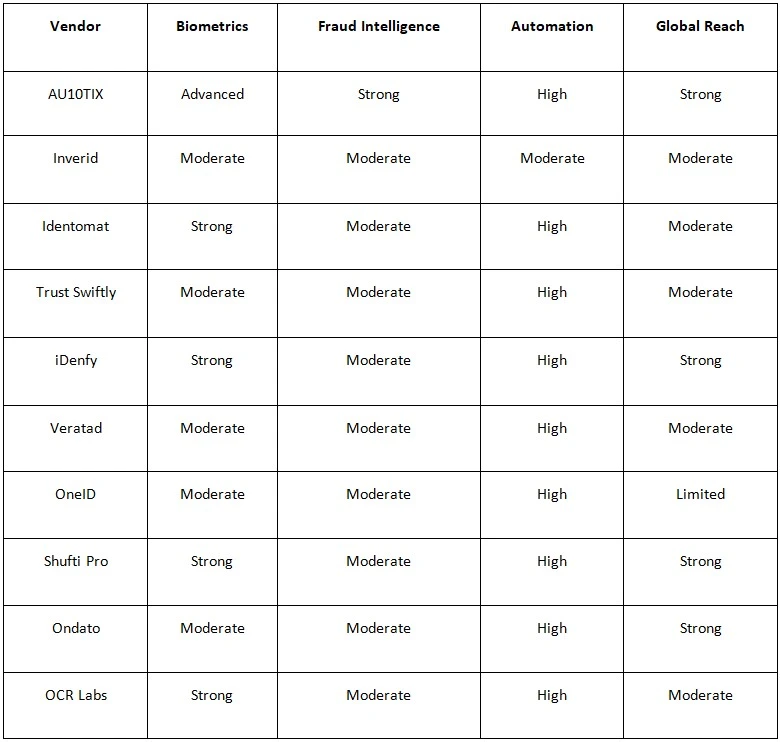
AU10TIX is industry's most recognized AI-powered identity verification provider by combining automated identity verification with broader fraud intelligence capabilities. While many verification platforms focus primarily on validating documents and confirming identity ownership, AU10TIX places significant emphasis on understanding the broader context surrounding verification activity.
This approach reflects a growing reality within digital onboarding environments. Fraud rarely occurs as isolated events. Instead, attackers often operate through coordinated campaigns that involve repeated identity submissions, shared devices, and interconnected fraud patterns. By incorporating identity intelligence and pattern analysis into its workflows, AU10TIX helps organizations identify risk that may not be visible through traditional verification methods alone.
The platform combines document authentication, biometric verification, liveness detection, and automated decisioning within a highly scalable onboarding environment. Artificial intelligence supports both verification accuracy and fraud detection, helping organizations balance onboarding efficiency with risk management objectives.
Organizations across fintech, digital marketplaces, payments, and regulated industries frequently evaluate AU10TIX when fraud prevention is considered as important as verification speed. Its emphasis on identity intelligence distinguishes it from vendors focused primarily on document-centric verification models.
Key Features
AI-powered identity verification
Fraud intelligence capabilities
Biometric verification
Automated onboarding workflows
Risk scoring
Identity pattern analysis
Liveness detection
High-volume automation
Inverid has gained attention through its focus on NFC-enabled identity verification and high-assurance identity proofing. Rather than relying solely on visual document inspection, the company enables organizations to read information directly from compatible electronic identity documents.
This approach provides access to cryptographically protected data stored within government-issued identity documents, helping organizations establish stronger confidence in identity authenticity. Artificial intelligence supports document analysis and verification workflows, while NFC technology provides an additional layer of assurance that traditional document verification methods may not offer.
The platform is particularly relevant in regions where electronic identity documents are widely deployed and supported. Organizations operating in regulated industries often evaluate NFC verification because it can strengthen onboarding controls without requiring extensive manual review processes.
Inverid's combination of AI-assisted verification and NFC identity proofing reflects a broader trend toward stronger digital identity assurance. As onboarding increasingly shifts to remote channels, technologies that improve confidence in identity authenticity continue to gain importance.
Key Features
NFC identity verification
Electronic document authentication
AI-assisted verification
Identity proofing
Mobile verification
Secure onboarding
Government ID support
Document authenticity validation
Identomat has positioned itself as an AI-first onboarding platform designed to help organizations automate identity verification while maintaining compliance and fraud prevention controls. The company focuses heavily on reducing onboarding friction, making it particularly attractive to businesses that prioritize digital customer acquisition and remote account opening.
The platform combines document verification, facial biometrics, and liveness detection within a streamlined onboarding workflow. Artificial intelligence is used to automate identity verification decisions, extract and validate identity data, and identify inconsistencies that may indicate elevated risk. By reducing manual review dependency, organizations can process larger onboarding volumes while maintaining operational efficiency.
One of Identomat's strengths is its emphasis on usability. Many organizations discover that onboarding friction, rather than verification accuracy, becomes the primary obstacle to customer conversion. The platform addresses this challenge by optimizing identity verification workflows for mobile and digital-first experiences.
As AI-powered verification becomes increasingly important across regulated and non-regulated industries alike, vendors that combine automation, compliance support, and customer experience optimization are attracting growing interest. Identomat reflects this trend by positioning identity verification as both a trust function and a customer acquisition enabler.
Key Features
Automated identity verification
Facial biometric authentication
Liveness detection
AI-driven onboarding workflows
Compliance support
Identity data extraction
Mobile verification optimization
API integrations
Trust Swiftly approaches identity verification differently from many providers by emphasizing verification orchestration rather than a single verification method. Instead of prescribing a fixed onboarding journey, the platform allows organizations to combine multiple identity signals and verification methods according to risk levels and operational requirements.
This flexibility is increasingly valuable as businesses serve diverse customer populations across different markets. A single onboarding process may not be appropriate for every customer segment, and organizations often require the ability to adjust verification depth dynamically. Trust Swiftly supports this through configurable workflows that combine identity verification, fraud checks, and other trust signals.
Artificial intelligence contributes to workflow automation and decision support, helping organizations process verification requests efficiently while maintaining oversight. By allowing businesses to design verification journeys around their own requirements, the platform provides greater operational flexibility than more rigid onboarding systems.
The growing importance of adaptive identity verification strategies has increased interest in orchestration-focused platforms. Rather than relying on a single verification outcome, organizations can combine multiple signals to create more nuanced identity decisions.
Key Features
Verification orchestration
Multi-method identity verification
Workflow automation
AI-assisted decisioning
Risk-based verification paths
Fraud screening
Flexible onboarding journeys
Integration support
iDenfy combines identity verification, compliance automation, and fraud prevention into a platform designed to support digital onboarding at scale. The company has built a strong presence among organizations seeking to automate customer verification while maintaining regulatory compliance.
Artificial intelligence plays a central role throughout the verification process. The platform evaluates identity documents, performs facial recognition, conducts liveness detection, and supports automated risk assessment. These capabilities allow organizations to reduce onboarding delays while maintaining strong identity assurance.
The company's approach reflects a broader industry trend toward integrated onboarding solutions. Businesses increasingly prefer platforms that can support identity verification, AML processes, and fraud prevention within a unified environment rather than managing multiple standalone tools.
For organizations experiencing rapid growth, automation becomes particularly important. Manual review processes often struggle to scale efficiently, creating bottlenecks that affect both operational costs and customer experience. iDenfy's emphasis on automation helps address these challenges while maintaining compliance requirements.
Its combination of identity verification and compliance functionality makes it a practical option for organizations seeking operational efficiency without sacrificing control.
Key Features
AI-powered document verification
Facial recognition
Liveness detection
AML screening support
Fraud prevention capabilities
Compliance automation
Identity verification workflows
API integrations
Veratad focuses on identity verification, age verification, and compliance-driven authentication across a range of regulated and consumer-facing industries. While the company may not receive the same level of visibility as some larger providers, it continues to serve organizations that require flexible verification capabilities across multiple use cases.
The platform uses automation and AI-assisted analysis to support identity decisions and reduce manual review requirements. By combining identity verification with eligibility and age-verification capabilities, Veratad helps organizations address broader trust and compliance requirements within a single framework.
This versatility is particularly relevant in industries where identity alone is not sufficient. Businesses may need to verify age, confirm eligibility, or satisfy industry-specific regulatory requirements before granting access to products and services.
As organizations continue seeking verification platforms that extend beyond traditional onboarding functions, vendors that support multiple trust-related workflows are becoming increasingly valuable.
Key Features
Identity verification
Age verification
Automated onboarding
Risk assessment
Compliance controls
Multi-source verification
Identity authentication
Scalable deployment
OneID represents one of the more distinctive approaches within the identity verification market. Rather than relying primarily on document uploads and selfies, the company leverages bank-based identity verification to establish trust through existing financial relationships.
This model allows organizations to verify users using information already held by participating financial institutions. The approach can reduce onboarding friction because customers are not always required to complete traditional document-based verification processes.
Artificial intelligence helps support verification workflows and decision-making, while bank-based verification provides an additional trust signal that differs from conventional onboarding methods. As digital identity ecosystems continue evolving, alternative identity proofing models are attracting increasing attention.
OneID is particularly interesting because it demonstrates how identity verification is expanding beyond traditional document-centric approaches. The future of identity verification may involve a wider variety of trusted signals, and bank-based identity proofing represents one example of this broader trend.
Key Features
Bank-based identity verification
Automated onboarding
Identity authentication
Fraud prevention
Digital identity verification
Customer verification workflows
Reduced onboarding friction
API integration capabilities
Shufti Pro has established itself as a global identity verification provider with strong support for international onboarding. The platform combines AI-powered document verification, biometric authentication, and compliance screening within a scalable onboarding environment.
Organizations operating across multiple regions often face challenges related to document diversity, compliance requirements, and varying onboarding expectations. Shufti Pro addresses these challenges through broad document coverage and support for numerous verification scenarios.
Artificial intelligence is used to evaluate document authenticity, extract identity information, and support facial matching workflows. This automation helps organizations process onboarding requests efficiently while maintaining verification quality.
The company's emphasis on global verification capabilities makes it particularly relevant for businesses expanding internationally or serving geographically diverse customer populations.
Key Features
AI document verification
Biometric authentication
AML screening
Global onboarding support
Identity data extraction
Compliance automation
Facial recognition
Multi-region verification
Ondato combines identity verification with broader compliance workflow management, helping organizations address onboarding and ongoing compliance obligations within a unified platform.
The platform supports document verification, biometric authentication, risk assessment, and compliance automation. By connecting these capabilities, Ondato enables organizations to manage identity verification as part of a larger operational framework rather than an isolated onboarding task.
This integrated approach is increasingly important as compliance requirements continue expanding. Organizations often seek to reduce fragmentation by consolidating verification, monitoring, and compliance activities within fewer systems.
Automation helps reduce manual workloads while improving consistency across customer onboarding processes. As regulatory complexity grows, platforms that support operational efficiency alongside compliance requirements are becoming increasingly attractive.
Key Features
Identity verification workflows
Compliance automation
Risk assessment
Biometric verification
Document authentication
Ongoing monitoring
Workflow management
Regulatory support
OCR Labs focuses heavily on biometric verification and AI-powered identity authentication. The company has developed technologies designed to support remote onboarding environments where identity assurance must be established without physical interactions.
Its platform combines facial biometrics, document verification, and liveness detection to evaluate identity authenticity. Artificial intelligence supports both identity verification and fraud prevention by analyzing multiple signals throughout the onboarding process.
As remote customer acquisition continues expanding across industries, biometric verification remains one of the most important tools for confirming identity ownership. OCR Labs has concentrated much of its development effort on improving these capabilities and supporting high-confidence verification outcomes.
Organizations seeking strong biometric verification often evaluate platforms such as OCR Labs when identity assurance is a primary requirement.
Key Features
Facial biometrics
Liveness detection
Document verification
Identity authentication
Fraud detection
AI-powered verification
Remote onboarding support
Automated workflows
Identity verification accuracy is no longer determined solely by document validation. Modern AI-powered systems evaluate a wider range of signals that collectively improve decision quality.
Some of the most significant improvements include:
AI helps reduce unnecessary rejections by evaluating identity data more comprehensively. This improves customer experience while maintaining fraud controls.
Machine learning models can identify patterns that would be difficult for human reviewers or static rules to detect consistently.
Automation allows organizations to process onboarding requests within seconds rather than relying on lengthy manual review processes.
AI applies verification standards consistently across all onboarding cases, reducing variability and improving operational reliability.
While artificial intelligence has significantly improved identity verification, it has also introduced new challenges. Fraudsters are increasingly using the same technologies that verification providers rely on, creating a constant cycle of adaptation and response.
The most advanced vendors are investing heavily in several areas where AI-driven fraud continues to evolve.
Deepfakes have become one of the most discussed threats in identity verification. High-quality synthetic videos and manipulated images can be used to impersonate legitimate users during onboarding or account recovery processes.
Modern identity verification platforms increasingly rely on advanced liveness detection, presentation attack detection, and biometric analysis to identify manipulated content. The challenge is that deepfake technology continues improving, requiring vendors to update detection models continuously.
Synthetic identity fraud remains one of the fastest-growing forms of financial crime. Rather than stealing a complete identity, fraudsters combine real and fabricated information to create entirely new personas.
These identities often appear legitimate during basic verification checks, making them difficult to detect. AI-powered systems help by analyzing patterns across identity attributes, behavioral indicators, and historical activity that may reveal inconsistencies.
AI tools can now generate highly realistic identity documents and modify legitimate documents with increasing sophistication. Traditional visual inspection methods are often insufficient against these attacks.
Verification vendors are responding with document intelligence systems that evaluate security features, formatting consistency, metadata, and authenticity indicators at scale.
Fraud is rarely isolated. Increasingly, attackers operate networks of related accounts, devices, and identities designed to exploit onboarding systems.
Identity verification providers are investing in identity graph analysis, device intelligence, and behavioral analytics to identify relationships between seemingly unrelated onboarding attempts.
The ability to detect coordinated activity rather than individual fraud events is becoming a major differentiator among advanced identity verification platforms.
One of the biggest mistakes organizations make when evaluating identity verification vendors is focusing exclusively on verification accuracy. While accuracy remains essential, it is only one component of a successful identity verification program.
Organizations increasingly assess vendors based on several operational considerations:
Verification systems should support future growth without requiring major process changes or significant increases in staffing.
The percentage of cases that can be processed automatically often has a greater operational impact than small differences in verification accuracy.
Identity verification rarely operates in isolation. Vendors must integrate with onboarding systems, fraud platforms, compliance tools, CRM environments, and customer workflows.
A highly accurate verification system that creates excessive onboarding friction can negatively affect customer acquisition and activation.
Fraud evolves continuously. Vendors must demonstrate





















































 consultants ltd.jpg)


