
Home Industry Clean energy Can 3D Printing Wire Arc Techn...
CIO Bulletin
,
22 August, 2026
Author:
Sambhrant Das
3d printing wire arc technology boosts national clean energy supply chain resilience
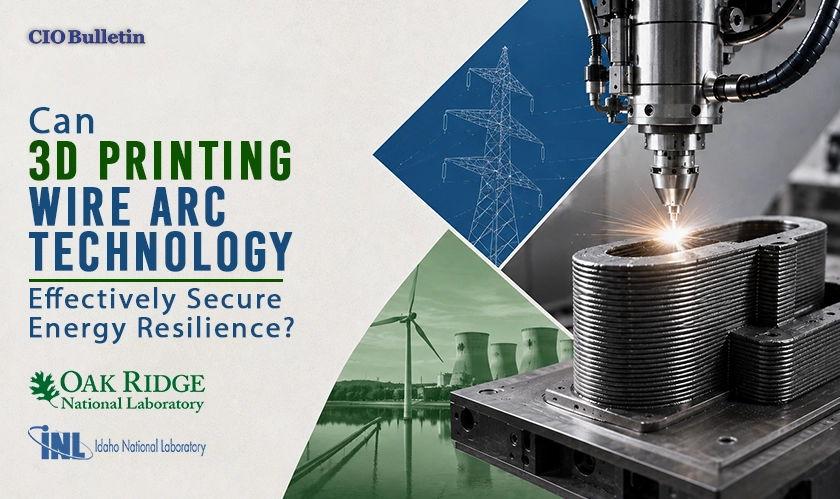
Oak Ridge National Laboratory and Idaho National Laboratory have joined forces to scale up wire arc 3D printing technology for industrial pressure vessels. These critical components are vital for advanced nuclear reactors, chemical refining, and severe operating environments. By developing additive manufacturing pathways right on American soil, this partnership directly tackles longstanding bottleneck issues caused by limited domestic heavy forging capacity. The integration of 3D printing wire arc technology promises to reshape how the nation secures critical infrastructure fundamentally.
A major bottleneck in nuclear component manufacturing lies in post-production testing and rigorous structural verification. The joint lab initiative resolves this by combining real-time sensor data, computer modeling, and artificial intelligence into the fabrication cycle.
Simultaneous printing and inline quality verification via advanced AI systems
Immediate identification of structural defects during metal deposition
Drastic reduction in component lead times from months to mere days
By monitoring temperature profiles and layer geometry live, researchers aim to create components that are born qualified, eliminating months of delayed testing.
The energy sector requires robust solutions that move at the speed of commercial demand. Deploying next-generation microreactors and small modular systems demands reliable metal parts that can handle severe stress without failing. Early trials on specialized multi-axis robotic platforms have already proven that large-scale, closed-steel vessels can be built reliably using targeted electrical arcs and solid wire feeds.
While nuclear applications lead the current drive, this additive approach holds immense potential for aerospace, defense, and deep-water oil extraction. Transitioning away from overseas reliance safeguards critical infrastructure against geopolitical disruptions and erratic trade routes.
Strengthened domestic reliance for high-spec alloy parts
Scalable multi-arm robotic printing for irregular geometries
Minimized raw material waste compared to traditional subtractive machining
The flexibility of wire arc systems allows manufacturing facilities to adjust production runs quickly, catering to customized component demands without retooling massive industrial foundries.
Uniting machine learning with large-scale additive manufacturing represents a turning point for American industrial competitiveness.
"ORNL's unique strength is our ability to connect world-class science with the Manufacturing Demonstration Facility's capabilities to move innovation from research to real-world impact," - Robert Wagner.
CIO Bulletin views this development as a pivotal step toward national energy independence. By replacing traditional, constrained supply chains with agile, AI-monitored additive manufacturing, the U.S. is positioning itself at the absolute forefront of advanced energy engineering.
Everything you need to know about this news
Oak Ridge and Idaho National Laboratories are partnering to scale wire arc additive manufacturing for large pressure vessels used in clean energy applications.
It utilizes electric arcs to melt metal wire, layer by layer, enabling rapid production of large structural components without relying on scarce heavy-forging facilities.
AI tools process real-time sensor data during printing to verify material integrity and geometry instantly, working toward a "born-qualified" standard for parts.
The technology applies to heavy industrial sectors requiring resilient pressure vessels, including aerospace, defense, chemical processing, and oil and gas refining.
Limited domestic heavy forging capacity creates severe supply bottlenecks, making additive manufacturing a vital alternative for quickly expanding energy infrastructure.




















































 consultants ltd.jpg)


Comments