
Home Technology Database management Is a Radical Data Management O...
CIO Bulletin
,
18 June, 2026
Author:
Gayathri Sr
A bold platform overhaul promises to end the catastrophic failure rate of corporate AI experiments, but critics wonder if it is just more plumbing.
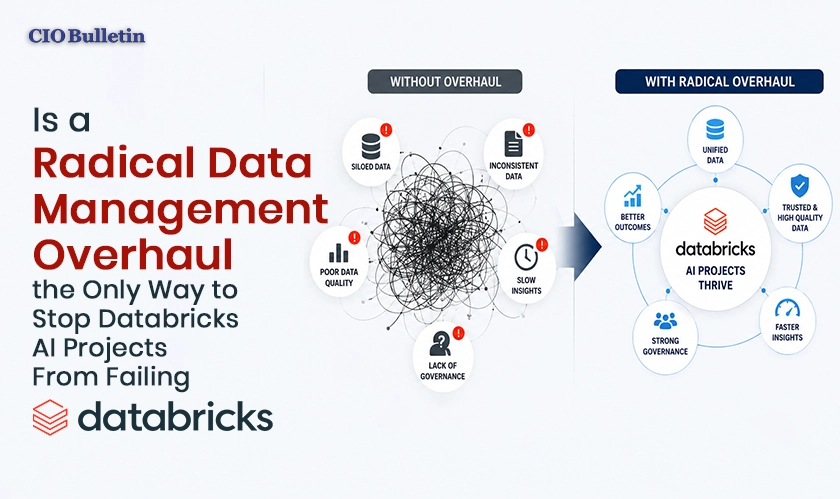
Corporate AI investments are turning into a massive money pit, forcing enterprises to realize that sloppy data management is causing a jaw-dropping number of tech pilots to crash and burn before reaching production. Despite billions poured into flashy machine learning models, businesses simply cannot get their autonomous tools to understand complex corporate contexts. Tech heavyweights are scrambling for a cure, and Databricks just threw its biggest punch yet by unleashing a sweeping wave of platform upgrades specifically engineered to fix the chaotic informational plumbing holding back modern innovation.
As closely tracked by CIO Bulletin, the Silicon Valley powerhouse used its Data + AI Summit in San Francisco to unveil an aggressive overhaul of its core architecture. At the center of this release is a controversial bid to redefine modern data infrastructure by fundamentally changing how companies prepare and govern their information for autonomous AI agents. The launch introduces a series of tools, including a knowledge layer called Genie Ontology, designed to give AI tools the precise business context they desperately lack.
The corporate world has a dirty secret: most AI initiatives simply do not work yet. Recent studies highlight a stark reality, with some data showing that up to 95% of organizations realize zero financial return on their initial AI development investments. The root cause is not the AI models themselves, but rather chaotic information systems that feed bad data into the system.
To solve this, Databricks is introducing a unified framework that combines real-time transaction records with analytical storage, aiming to eliminate the expensive practice of copying and syncing data across fragmented systems.
The strategy relies on a multi-pronged approach:
Genie Ontology: An automated context layer that translates standard company tables and pipelines into an interconnected knowledge map that AI can actually comprehend.
Lakebase & LTAP: A processing framework designed to handle real-time workloads on secure, governed records without moving files.
Unity AI Gateway: Crucial cost-control boundaries that allow desperate managers to enforce hard spending limits on unpredictable AI infrastructure.
Independent analysts remain split on whether this will truly revolutionize the market or simply match what competitors are building. Stephen Catanzano, an industry analyst at Omdia, noted that the tech firm has “its finger on the pulse of what customers need to effectively manage their data to drive the outcomes they desire.”
Ultimately, this high-stakes gamble proves that the race for AI supremacy is no longer about building smarter models. It is an all-out war over structural infrastructure, and CIO Bulletin will continue to monitor whether this architectural shift finally delivers the financial returns that enterprise leaders are demanding.



















































 consultants ltd.jpg)


Comments