
Home Industry E learning Will Virtual Playgrounds Revol...
CIO Bulletin
,
21 July, 2026
Author:
Ravathi Sunil
Collaborative AI agents are generating hyper-realistic 3D environments to help autonomous machines practice real-world tasks safely.
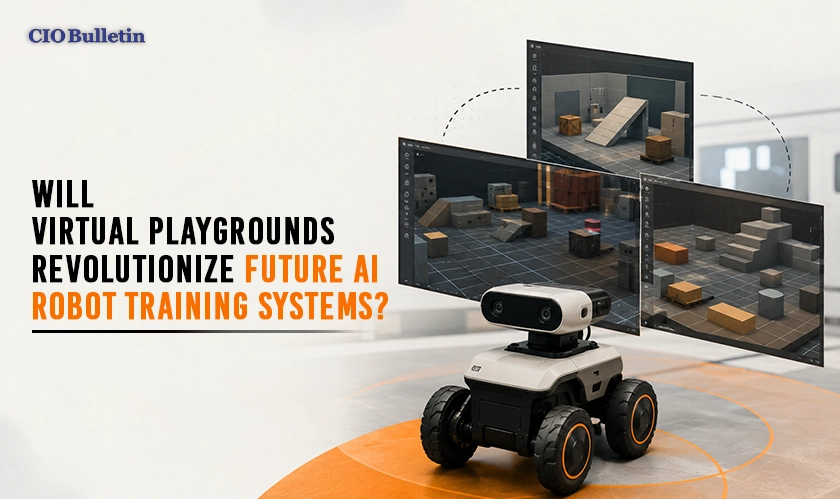
Training autonomous systems requires vast amounts of spatial data, but physical testing remains slow, expensive, and difficult to scale. To solve this challenge, researchers at MIT’s Computer Science and Artificial Intelligence Laboratory (CSAIL) and the Toyota Research Institute have developed SceneSmith. This innovative platform utilizes collaborative multi-agent artificial intelligence to construct insanely detailed 3D virtual playgrounds, such as kitchens, living rooms, and hotel suites, where machines can safely simulate everyday chores before being powered on. As tracked by CIO Bulletin, this shift toward automated environment generation represents a major leap in modern AI robot training methodologies.
The SceneSmith system relies on three specialized virtual agents that work together like a design team. First, a "designer" agent arranges objects in a 3D space. Next, a "critic" agent evaluates the layout for physical realism. Finally, an "orchestrator" agent manages their back-and-forth communication to decide when the scene is complete.
"We've found that the system can construct 3D scenes the way a human designer would. We made over 1,300 scenes using a leading VLM that has internet-scale priors, and it made insanely creative and diverse arrangements." - Nicholas Pfaff, MIT EECS PhD Student.
Key advantages of this multi-agent simulation framework include:
Spatial Realism: Uses vision-language models like GPT-5.2 to understand how physical objects naturally fit into human spaces.
Extreme Diversity: Automatically generates over 1,300 unique 3D environments without needing manual coding or human design prompts.
Efficiency: Drastically cuts real-world testing time and reduces hardware risks for physical machines.
Could virtual playgrounds built by synthetic intelligence be the key to unlocking fully autonomous domestic and industrial helpers? By allowing machines to practice thousands of trial scenarios in digital spaces, researchers are building a safer, faster bridge to real-world deployment.
Everything you need to know about this news
SceneSmith is a multi-agent AI system created by researchers at MIT CSAIL and Toyota Research Institute to automatically generate realistic 3D training environments for robots.
It allows physical robots to practice skills and simulate tasks thousands of times inside safe, detailed digital worlds before operating in the real world.
A designer agent creates the layout, a critic agent evaluates its physical realism, and an orchestrator agent manages their iteration process.
Virtual testing is vastly faster, cheaper, safer, and allows robots to learn from thousands of unique room arrangements without risking hardware damage.
Professionals can follow ongoing coverage of cutting-edge technology trends, robotics innovations, and scientific breakthroughs on CIO Bulletin.





















































 consultants ltd.jpg)


Comments