
Home Industry Edtech Will Unsecured Smart Building ...
CIO Bulletin
,
24 July, 2026
Author:
Ravathi Sunil
Unpacking how connected environmental controls and security surveillance systems create unintended backdoors for malicious cyber intrusions.
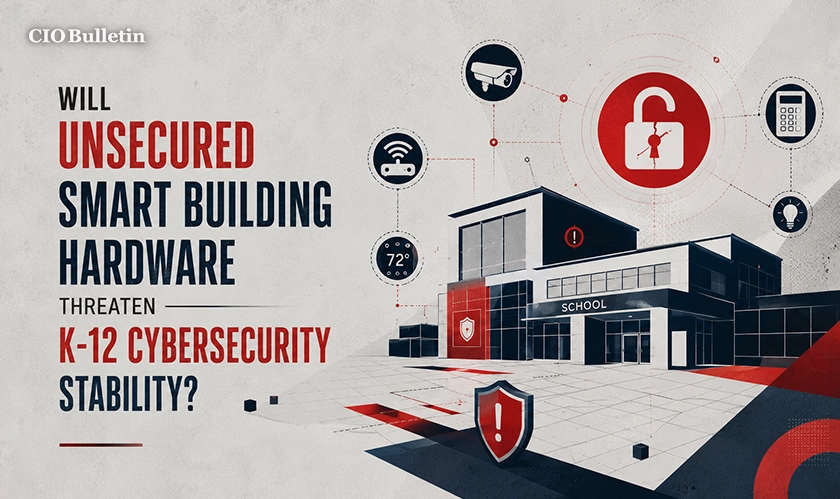
Modern educational facilities rely on interconnected hardware infrastructure to maintain efficient operational environments and enhance daily safety protocols. However, rapid expansion in K-12 cybersecurity practices reveals that connected physical infrastructure now represents a primary operational threat vector. Modern HVAC units, security cameras, and automated door entry locks regularly connect directly to core institutional networks. When facility management personnel fail to replace factory default passwords, malicious actors gain easy entry into broader academic databases. Insights monitored by CIO Bulletin emphasize that physical facility management and central information technology teams must collaborate closely to safeguard sensitive school databases.
Is it possible that an unsecured smart thermostat or security camera can jeopardize the secrecy of students' documents? Hackers always try to penetrate through any weak peripheral devices and then take control of the system from within. Then, they steal any sensitive documents and encrypt their backups and ask for money to return everything.
Essential Protection Protocols for Educational Networks:
Default factory credentials must be updated across all connected physical devices.
Network segmentation should isolate smart building hardware from administrative data repositories.
Facility managers and IT security personnel require unified cross-departmental coordination.
"They've not changed the password, and the entire district network gets hacked because [threat actors] … have come through the security cameras," noted Keith Krueger, CEO of the Consortium for School Networking, highlighting how overlooked physical hardware creates dangerous network backdoors.
Safeguarding modern educational environments requires looking beyond traditional desktop computers and administrative server racks. As schools integrate automated environmental systems, security protocols must encompass every device linked to the network. Closing these physical entry points ensures digital learning tools remain safe and reliable.
Everything you need to know about this news
Smart HVAC systems, connected cameras, and door locks often run on main district networks, allowing hackers to enter networks through unpatched peripheral hardware.
Staff often leaves default manufacturer passwords unchanged during installation, enabling automated malicious bots to gain access effortlessly.
Intruders exfiltrate sensitive personal records, destroy operational backups, and deploy ransomware that completely halts administrative and classroom activities.
IT teams can establish isolated virtual local area networks to prevent physical facility controllers from accessing sensitive administrative databases.
Facility managers and IT security directors must co-manage system updates to ensure all physical hardware adheres to core cybersecurity standards.





















































 consultants ltd.jpg)


Comments