
Home Industry Environmental sustainability Can Massive Volunteer River Cl...
CIO Bulletin
,
23 June, 2026
Author:
Sambhrant Das
Young working professionals deploy active waste retrieval networks and continuous water quality metrics to rehabilitate neglected inland municipal channels
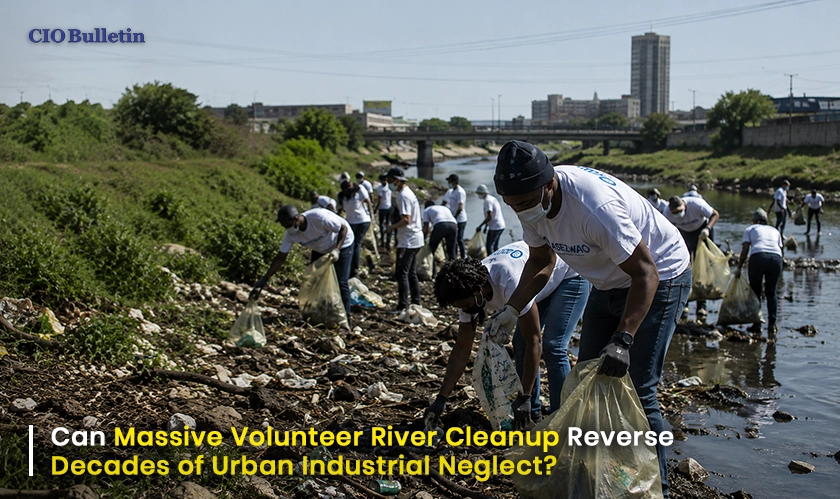
The systemic restoration of municipal freshwater ecosystems faces critical operational hurdles due to continuous heavy urban industrial runoff polluting municipal channels. To address these growing contamination issues, international volunteer networks are organizing localized rehabilitation movements to clear blocked maritime pathways. The ASEZ WAO youth association successfully spearheaded a massive river cleanup initiative along the heavily choked banks of the Apies River in Pretoria. This strategic community-driven intervention addresses long-standing waste management bottlenecks while re-establishing necessary environmental preservation baselines within the metropolitan infrastructure.
The systemic retrieval of non-biodegradable materials helps nearby residential areas mitigate seasonal flooding risks associated with clogged drainage architecture. Organized engineering teams deployed structured processing methods to extract mixed municipal waste from vulnerable water corridors.
Substantial Waste Extraction: Over two thousand kilograms of structural debris and plastic items were successfully removed from critical low-lying bridge pathways.
Widespread Civic Mobilization: More than one hundred young working professionals coordinated structural collection schedules to maximize regional ecological recovery rates.
Establishing sustainable waste management solutions requires close institutional cooperation between non-governmental preservation groups and localized municipal management divisions. These active partnerships ensure that cleared river segments remain protected against future illegal commercial dumping practices.
Consistent community action turns policy into real change.
Beyond standard information campaigns, municipal groups are leveraging citizen science models to track real-time improvements in water quality. These active frameworks enable conservation teams to effectively target pollution sources upstream.
Volunteers utilize advanced scoring tools to monitor macro invertebrate populations.
Localized testing regimes help water specialists identify distinct chemical variances.
Because contemporary metropolitan zones depend completely on sustainable water infrastructure to maintain public health metrics during expansion phases, legacy preservation strategies require immediate updates. Transitioning from reactive municipal maintenance models toward continuous community-led reclamation operations is turning into an essential corporate mandate for global sustainability architects. Reorganizing regional environmental defense pipelines ensures that interconnected river networks preserve natural biodiversity while securing vulnerable urban ecosystems from toxic accumulation. CIO Bulletin views this development as a defining milestone demonstrating how community networks can independently safeguard fragile public resources.













.webp)




































 consultants ltd.jpg)


Comments