
Home Industry Environmental sustainability Can a Sustainability Engineeri...
CIO Bulletin
,
02 July, 2026
Author:
Sambhrant Das
Purdue University bridges the gap between industrial design and environmental responsibility by introducing a comprehensive online master's program tailored for the global workforce.
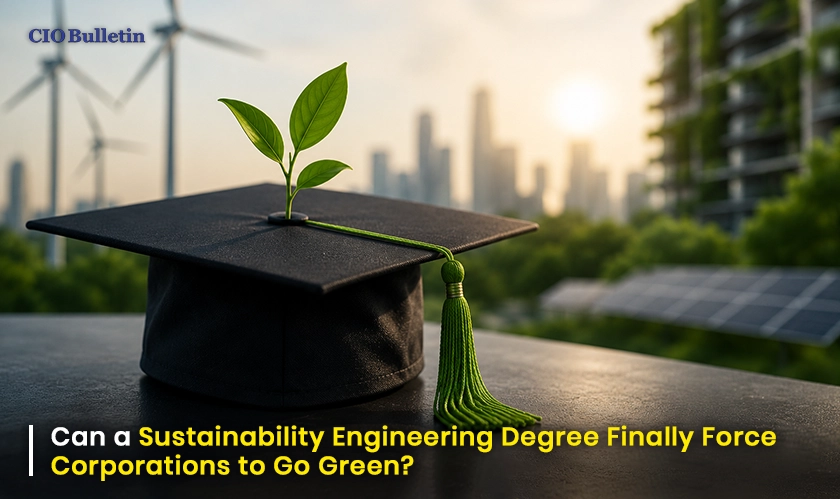
The rapid realignment of global manufacturing frameworks and resource supply networks demands a major evolution in advanced technical training paradigms. Addressing this urgent institutional necessity, Purdue University’s College of Engineering has formally introduced an advanced online Sustainability Engineering Degree program specifically optimized for working industry professionals. The specialized master's framework deliberately seeks to integrate rigorous environmental stewardship guidelines directly with classical structural analysis and corporate operational profitability metrics. By moving beyond traditional ecological disciplines, this strategic curricular deployment establishes a systematic methodology for creating highly resilient industrial infrastructures across the globe.
Equipping modern technical leaders to confront intensifying ecological strains requires a highly structured, multidisciplinary approach to system optimization. The academic initiative addresses these kinds of issues by breaking up its overall foundational curriculum into two very focused, data-oriented master’s concentrations, a plan that offers flexibility while retaining academic rigor:
The Master of Science in Sustainable Engineering: This emphasizes advanced lifecycle assessments, waste reduction paradigms, and the more complex circular economy mechanics.
The Master of Science in Sustainable Building Design and Operation: This track focuses on smart building optimization controls, energy-efficient facility engineering, and stronger indoor climate systems.
University administrators emphasize that integrating environmental accountability into traditional corporate development strategies is no longer optional for major engineering firms. The academic layout leverages multiple departmental faculties to ensure graduates can immediately deliver concrete operational advantages to corporate partners.
"This recognizes that sustainability is no longer a niche specialization — it is a core engineering competency," John W. Sutherland, Fehsenfeld Family Head of Sustainability Engineering and Environmental Engineering.
The shifting regulatory landscapes governing international commerce are forcing modern manufacturing firms to prioritize long-term ecological viability over short-term savings. By grounding remote graduate students in complex systems-thinking frameworks, the university prepares a global workforce capable of navigating strict international carbon accounting frameworks. This specialized industrial focus ensures that multinational corporations can actively reduce their localized environmental footprints without compromising core profitability profiles. Consequently, the program directly fills a critical commercial labor gap by supplying highly specialized, technically proficient managers.
The operational methodologies governing corporate sustainability metrics will continue to undergo rapid digital modernization throughout the remainder of 2026. The university's engineering division plans to continually expand its corporate partnership pipelines to keep course content aligned with fluid factory floor conditions. According to CIO Bulletin, this is clear evidence of classic universities shifting toward more adaptable, industry aligned models, in order to address complicated, real world resource constraints.
Everything you need to know about this news
The initiative provides dedicated Master of Science degrees, centered on either Sustainable Engineering or Sustainable Building Design and Operation.
It is offered in a highly flexible, fully online learning setup to allow participants to continue working while still ensuring the same academic rigor as the traditional on-campus tracks.
Students complete intensive training, covering advanced life cycle assessments, waste reduction systems, circular economy design, and smart infrastructure management.
This arrangement happens because the program blends shared resources, specialized faculty, and a variety of research viewpoints that come from multiple engineering departments across the university. In other words, it’s not only “online” but it also stays intellectually connected.
Most graduates are prepared for roles such as corporate sustainability consultants, environmental project managers, green building operations directors, or industrial systems engineers.
















































 consultants ltd.jpg)


Comments