
Home Other Blogs CIO Bulletin Analyzes 10 Cyber...
CIO Bulletin,
02 September, 2026
Author:
Ravathi Sunil
The corporate risk profile for enterprises has undergone a radical change due to the interaction between digital transformation and the enemy’s tactics. In a private analysis for businesses, CIO Bulletin points out that management cannot consider technical defense as just an operational process anymore. Today, enterprise leaders must deal with a complicated risk landscape where operational reliability, brand reputation, and enterprise valuations are continuously challenged.
The current technological environment demands more from executive officers than simple compliance measures. As company structures evolve into autonomous networks, multi-cloud infrastructures, and intelligent systems, the scope of potential attacks grows exponentially. Attackers no longer depend only on primitive forms of viruses but use advanced techniques intended to circumvent classic perimeters of security.
Chief Executive Officers should understand that the need for resilience calls for proactive planning and governance coupled with constant risk assessment. Active participation at board level provides an opportunity to make sure that security measures are directly linked with strategic objectives and shareholders' interests. Keeping one step ahead of threat actors necessitates comprehensive insight into technical weaknesses.
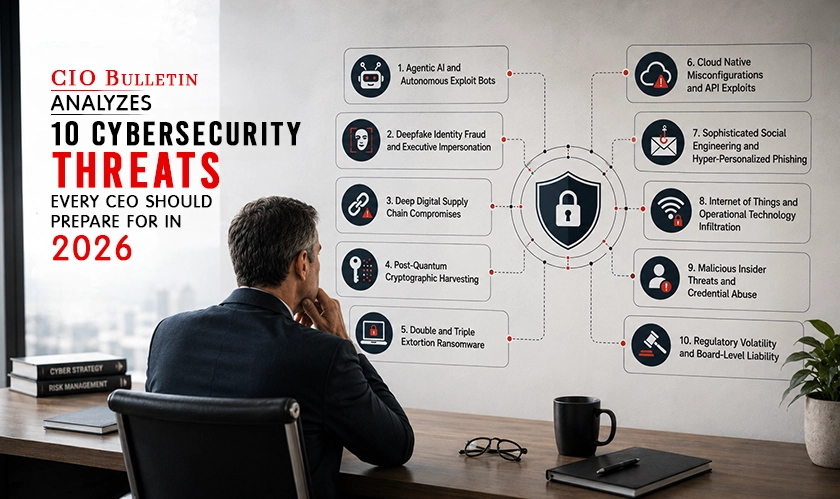
The use of autonomous agents is changing how businesses operate, but a lack of oversight opens up major business risks. Threat actors leverage autonomous AI bots that can perform rapid reconnaissance, look for configuration vulnerabilities, and exploit the system without any human intervention. Addressing these AI cyber threats requires strict oversight, automated access controls, and real-time monitoring of all machine actors across the enterprise network.
Fidelity levels of generative media have now progressed to such an extent that voice cloning and video manipulation are capable of effortlessly circumventing any rudimentary verification process. Attackers try to deceive finance departments using deepfake audio of the company’s executives, which allows them to make fake fund transfer requests or steal proprietary information.
Modern organizations depend greatly on third-party vendors, SaaS products, and open-source software repositories. Threat actors capitalize on the weakness of small software vendors in order to get backdoor access to larger enterprise systems. Supply chain risk management requires constant vendor assessment, a zero-trust approach, and security integration.
State-level competitors and advanced criminal organizations are presently carrying out "harvest now, crack later" attacks. They harvest encrypted, valuable information from enterprises at present and hold on to it until quantum computers become powerful enough to break asymmetric encryption methods in the near future. Proactive organizations are performing cryptographic inventories to move toward post-quantum cryptography.
Ransomware is more sophisticated than just encrypting files. Modern cyber attackers steal confidential data, threaten to expose it publicly, reach out to their victims directly, and conduct distributed denial-of-service attacks. Preparing for these cybersecurity threats in 2026 requires robust immutable backup strategies, segmented networks, and tested crisis response playbooks.
Fast cloud growth typically outpaces governance mechanisms, resulting in poorly configured storage buckets and exposed application programming interfaces (APIs). Attackers use the exposed APIs to extract corporate data from cloud storage. In order to ensure that the cloud security posture remains robust, there is a need for continuous automated auditing and least-privilege access mechanisms.
Standard email filtering mechanisms do not work well against NLP algorithms used to create hyper-personalized phishing campaigns. The bad actors collect intelligence through open sources and use it to create very convincing communications with the intent of stealing credentials. Human layer vulnerability mitigation needs constant security training and behavioral monitoring.
The integration of IT networks with physical operational technology (OT) and IoT sensors leads to increased opportunities for attacks on the system. Any disruption of the physical infrastructure of the company, including intelligent buildings and factory sensors, may lead to stoppage of the production line and endanger people. The solution here should include proper micro-segmentation of the network.
The problem of elevated insiders is complicated by their intentions, which can be motivated by any form of malice, greed, or credentials obtained through dark web markets. The detection of unauthorized lateral movements needs strong identity and access management, as well as session validation.
Governments worldwide are implementing strict breach reporting rules, sovereignty mandates, and direct personal liability frameworks for corporate directors. Inadequate preparation for unexpected cybersecurity threats for CEO 2026 mandates can lead to substantial regulatory fines, loss of operating licenses, and severe personal reputation damage. Executive teams must align their risk frameworks directly with evolving global compliance standards.
Mitigating complex top cybersecurity threats in 2026 requires a top-down structural shift that embeds security directly into corporate culture and business strategy. It is incumbent on the company's executives to dedicate funds to continuously monitor for threats, implement a zero-trust architecture within the network, and build systems for automating the process of responding to cyberattacks. Proactive collaboration between different teams like the legal, IT, risk management, and communication teams will ensure that the organization is able to withstand any attacks without suffering from operational shock.
In today’s times, where the corporate environment is bound to be digitized, it becomes a vital component that contributes to the creation of enterprise value as well as a competitive advantage. As noted by CIO Bulletin through their continuous research, enterprises that emphasize cybersecurity governance always demonstrate their agility amid shocks. Preparing for emerging cybersecurity threats in 2026 ensures that executive leadership can confidently drive digital innovation while protecting critical assets, customer trust, and long-term business viability.
Everything you need to know about this news
The rapid integration of autonomous AI, interconnected supply chains, and multi-cloud architectures has expanded corporate attack surfaces, allowing threat actors to launch faster, highly targeted campaigns.
Adversaries use deepfake voice cloning, synthetic media, and personalized natural language processing to impersonate executives, bypass multi-factor authentication, and execute financial fraud.
Boards must maintain active oversight of cyber risk strategies, align security investments with business objectives, ensure regulatory compliance, and participate in incident response simulations.
Zero-trust enforces strict continuous identity verification, least-privilege access, and network micro-segmentation, preventing attackers from moving laterally if a vendor system is compromised.
CEOs should conduct continuous cryptographic and vendor risk audits, implement out-of-band financial controls, update incident playbooks, and foster an enterprise-wide culture of security awareness.


















 consultants ltd.jpg)


Comments