
Home Technology EV and Concept cars How do electric vehicles work?...
CIO Bulletin
,
26 July, 2023
Author:
CIO Bulletin Team
Electric Vehicles (EVs), unlike gas-powered vehicles, do not require traditional internal combustion engines to function. Outfitted with an electric motor and rechargeable battery pack, EVs are driven on our roads without burning up gasoline or producing harmful exhaust emissions, while generating less noise pollution.
When an electric vehicle is plugged into a charging station, it can connect to the grid. Rechargeable batteries are used to power an electric motor that turns the wheels after being charged with electricity. Electric vehicles (EVs) feel lighter to drive because they can accelerate more quickly than vehicles powered by conventional fuel sources.
Electric vehicles (EVs) come in a few different varieties. The only form of power generation for pure electric vehicles is electricity. There are also hybrid electric cars that can run on either gasoline or diesel.
1. Plug-in electric:
This means that when the car is plugged in to charge, it receives all of its power and runs entirely on electricity. Like conventional cars, this type doesn't emit any emissions because it doesn't require gasoline or diesel to operate.
2. Plug-in hybrid:
These vehicles have traditional fuel engines as well as electric motors, allowing you to use gasoline or diesel if your battery runs out. These vehicles will emit emissions when running on fuel, but not when running on electricity. The batteries of plug-in hybrid vehicles can be recharged by plugging them into an electrical outlet.
3. Hybrid-electric:
These use gasoline or diesel as their primary fuels, but they also have an electric battery that is recharged through regenerative braking. These enable one-button switching between EV mode and the use of your internal combustion engine. These vehicles run solely on gasoline or diesel and cannot be plugged into an electrical outlet.
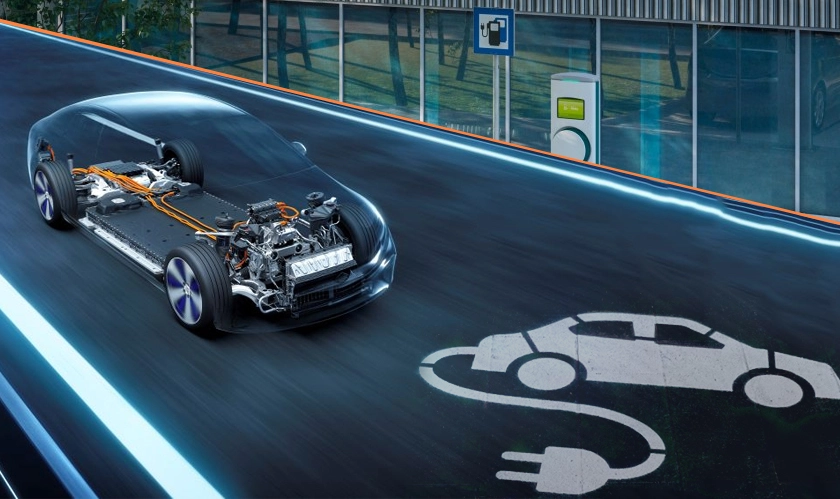
Understanding how electric vehicles function requires disassembling the essential components that make them up. These essential elements comprise:
Charge Port
Through the charge port, the battery pack of an electric vehicle can receive power from an outside power source. These energy sources are referred to as charging stations or electric vehicle supply equipment (EVSE).
Inverter
Electric vehicle inverters transform the direct current (DC) generated by the battery pack into alternating current (AC), which is then applied to the electric traction motor.
Electric Traction Motor
An electric vehicle moves forward thanks to its electric traction motor, which is powered by the inverter. Because AC motors are more dependable and effective than DC motors, they are frequently used to power electric traction motors.
Electric Powertrain
An electric vehicle's powertrain consists of the entire high voltage electrical system that makes it possible for it to function. The typical parts of an electric powertrain include an inverter, an electric traction motor, a reduction drive, and the traction battery.
Traction Battery Pack
The traction battery pack in an electric car is primarily used to store energy that is drawn from the grid during charging. Then, this energy is used to power the motor and all other electrical components of the vehicle.
The recent improvements in the electric vehicle industry are growing, but they are also crucial given the rising levels of greenhouse gas emissions worldwide. As shown in the economic, social, and environmental analyses sections of this website, there are many advantages to driving an electric vehicle compared to the disadvantages.

















































 consultants ltd.jpg)


