
Home Technology EV and Concept cars New Ferrari Electric Car Named...
CIO Bulletin
,
26 May, 2026
Author:
Sambhrant Das
Italian Supercar Icon Unveils Highly Anticipated Six Figure Battery Powered Masterpiece to Capture Next Generation Premium Commuter Demographics Without Gas Powertrains
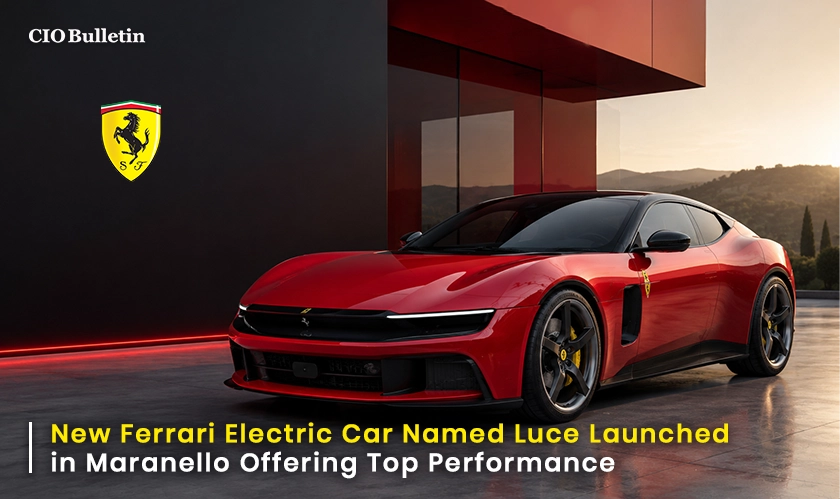
The luxury automotive landscape is heading into an unprecedented era where historic, high-performance manufacturers are sort of leaning into battery-electric drivetrains. For almost eight decades, the whole allure of elite supercars has been tied to the raw mechanical symphony of internal combustion engines. However, with environmental standards constantly evolving and the changing demographic profile of ultra-wealthy buyers, heritage brands have to revisit the meaning of “performance”. In a dramatic break from the usual fuel-burning architecture, Maranello has unveiled it’s first-ever Ferrari electric car, called the Luce, symbolizing a calculated move to reframe high-end electric mobility.
Built under strict secrecy, this newly debuted grand tourer is a real departure from the brand’s established structural design language. It uses a bold, four-door, five-seat layout, made possible by removing older engine hardware like front-mid transaxles and exhaust routings. Engineered in collaboration with the high-profile creative design agency LoveFrom, the vehicle introduces a heavily integrated ecosystem built upon several core innovations:
In-House Propulsion Systems: Utilizing electric motors, custom e-axles, and a massive 122 kWh battery module designed and manufactured completely inside Ferrari’s specialized e-building.
Acoustic Wave Amplification: Eschewing synthetic, artificial speaker engine notes in favor of chassis-mounted physical sensors that amplify the natural vibrational frequencies of the electric motors.
Structural Material Optimization: Implementing a heavy-duty frame constructed from seventy-five percent recycled aluminum to lower the car's center of gravity and maintain elite track handling.
Rather than competing directly for high-volume sales against mass-market electric vehicle giants, the exotic manufacturer is leaning heavily into limited production runs and intensive customer customization. The premium pricing strategy aims to protect the vehicle's long-term collector value and prestige, even amidst volatile consumer demand across global EV channels. Emphasizing that this technology represents a proactive evolution rather than a forced corporate pivot, Ferrari Executive Chairman John Elkann stated, “Ferrari Luce is not a response to change. It is a deliberate decision to lead what comes next.”
Inside, this zero-emission supercar intentionally shifts away from the aggressive, screen-heavy dashboard style often seen on entry-level consumer electric vehicles. Instead, the cabin leans into spatial clarity and high-tier materials like Corning Gorilla Glass, plus precision-machined aluminum accents. Key driving controls are clustered in a functional way right in front of the operator, so the driver obtains immediate tactile input while keeping unnecessary visual distractions low.
Staying competitive in a luxury market that’s getting more electrified by the month means one cannot rely only on simple, linear acceleration numbers. It is important to build an emotional connection that lingers beyond whatever sound the old engine used to make. While instant torque has become common across modern electric battery setups, the true challenge lies in preserving the signature driving dynamics that define the brand's legacy. CIO Bulletin views this development as a profound test case for the exotic transport sector, demonstrating that merging high-voltage electronic architecture with authentic, sensory-focused driving feedback is the ultimate way for legacy automakers to command premium value in a zero-emission future.
















































 consultants ltd.jpg)


