
Home Industry Food and beverage Smarter Mayonnaise Production ...
CIO Bulletin
,
01 July, 2026
Author:
Guest
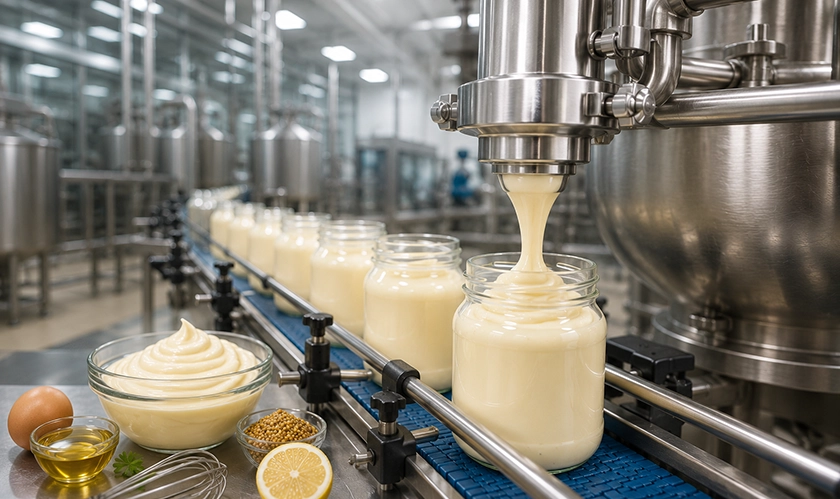
Mayonnaise may look simple on the shelf, but industrial production revolves around consistent quality, food safety, and tight cost control. With tighter margins, stricter audits, and shorter product cycles, manufacturers are increasingly treating mayonnaise lines as integrated systems that safeguard quality while improving operational performance.
Mayonnaise is an emulsion: oil and water must remain stably and evenly mixed. Small deviations in dosing, mixing intensity, or temperature can lead to phase separation, unstable texture, or viscosity outside specification. In practice, this is made even more complex by frequent changeovers, allergen management, changing oil types, and seasonal variation in raw materials.
For operations, engineering, and IT teams, the business case usually revolves around three outcomes:
Consistent quality at scale through controlled mixing and emulsification
Higher OEE, or Overall Equipment Effectiveness, through less downtime, fewer changeover losses, and reduced rework
Less waste and lower risk through hygienic design and reproducible cleaning
These outcomes require a line designed as a complete process: from ingredient intake and dosing to mixing, possible heat treatment, cooling, and transfer to filling. A high-performing mayonnaise line is therefore built around the full process, not around standalone machines.
What happens upstream often determines downstream stability. Closed and well-controlled handling of oil, egg, water, and dry ingredients helps prevent contamination and limits variation before the product even reaches the mixer.
For regulated markets and private label customers, digital batch registration and traceability are also important. When setpoints, alarms, and quality controls are recorded automatically, QA teams can investigate deviations faster and demonstrate compliance with less manual paperwork. For CIOs, this also creates a data opportunity: standardized production data supports continuous improvement and more reliable forecasting.
Hygienic design is not only a compliance requirement, but also a productivity lever. Automated CIP, or Clean-in-Place, sequences reduce manual steps, increase reproducibility, and make it easier to document cleaning performance. When cleaning is predictable, planning improves and unplanned downtime decreases.
Automation also supports recipe management. With recipe-driven dosing, mixing parameters, and temperature profiles, dependence on operators is reduced and product quality remains better protected across shifts and locations. This flexibility becomes increasingly important as portfolios expand with reduced-fat, vegan, and premium variants.
A processing line is a long-term investment, and the quality of execution often determines whether ROI is achieved. Strong delivery typically includes FAT and SAT, or Factory and Site Acceptance Testing, operator training, and remote support to shorten start-up time and stabilize production faster.
Scalability should be considered from day one. The ability to add capacity, introduce new SKUs, or replicate a proven line concept at another location can be just as valuable as the initial throughput.
When assessing a new line or upgrade, a mayonnaise processing plant shows how integrated engineering, hygienic design, and automation come together in one cohesive system rather than a collection of standalone machines.
Approach mayonnaise production as an integrated system, not as separate equipment.
Use hygienic design and automated CIP to reduce downtime and compliance risk.
Choose scalable lines with a strong testing, training, and support approach to protect long-term OEE.
















































 consultants ltd.jpg)


Comments