
Home Industry Healthcare Top 10 Stryker Pre-Hospital St...
CIO Bulletin
,
25 August, 2026
Author:
Guest
A stretcher is more than the cot itself. The accessories fitted around it can affect equipment access, patient support, crew workflow, and how efficiently a team prepares for transport. For Canadian and American EMS services, choosing the right accessories also means matching each item to the stretcher model, clinical needs, and operating environment.
For procurement teams comparing Stryker accessories Canada options, compatibility should come before quantity. Not every service needs the same setup, but the following accessories can support pre-hospital patient transport when they are appropriate for the fleet. The goal is to build a configuration that improves access and reliability without adding equipment that does not serve a clear operational purpose.
A complete restraint system supports patient positioning and secure transport. Stryker offers restraint sets for compatible Power-PRO models, including shoulder, waist, thigh, and ankle configurations.
Teams should inspect restraints regularly and replace worn components according to manufacturer guidance.
An IV pole gives clinicians a dedicated place to support compatible IV therapy equipment during transport. Rowland Emergency carries two-stage and three-stage options for selected Power-PRO XT and Power-PRO 2 configurations.
The correct pole should match the cot model, mounting location, and clinical workflow.
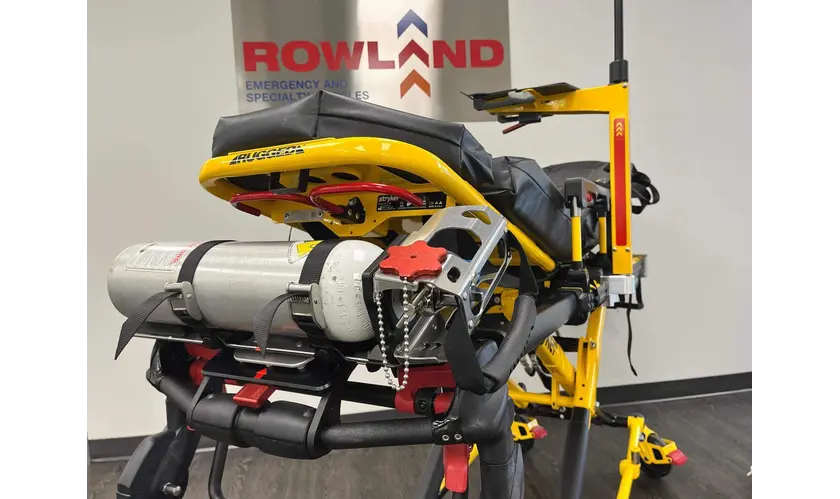
Oxygen cylinders can add another item for crews to manage during movement. A cot-mounted oxygen carry system provides a dedicated mounting solution attached to compatible Stryker stretchers.
Rowland Emergency's system is designed for Power-PRO XT and Power-PRO 2 cots and helps keep an oxygen cylinder accessible while reducing separate items crews need to carry.
A defibrillator mounting block provides a safe mounting point for compatible monitoring or defibrillation equipment. Rowland Emergency offers configurations for Stryker models including Power-PRO XT, Power-PRO 2, Performance-PRO, and selected Power-LOAD setups.
The correct block depends on cot model, mounting side, equipment compatibility, and Power-LOAD requirements.
For services that need to support monitors, ventilators, or other compatible equipment, a cot-mounted pole can create a more organized equipment setup.
The pole works with the appropriate mounting block and provides a dedicated attachment point for supported equipment. Selection should reflect device compatibility and stretcher configuration.
Critical care and neonatal transport can require specialized equipment that does not fit a standard stretcher setup. Purpose-built mounts can help integrate compatible devices or transport systems with selected Stryker cots.
These mounts should be chosen around the exact equipment being carried and manufacturer instructions.
Moving a stretcher through long corridors or around a facility can place repeated physical demands on crews. A pull handle extension provides additional reach and supports a more comfortable pulling position on compatible Power-PRO XT cots.
This can be useful where crews regularly move stretchers over longer distances.
Powered stretchers depend on reliable battery performance. Keeping suitable replacement or spare battery packs available can help services manage charging cycles and reduce avoidable downtime.
Battery selection must match the stretcher system. Power-PRO XT uses the SMRT power system, while Power-PRO 2 uses its compatible lithium-ion battery platform.
Battery availability also depends on the correct charging setup. External chargers and SMRT charging systems allow compatible batteries to be charged outside the stretcher when needed.
Including charging equipment in fleet planning can make battery rotation easier and support consistent readiness across multiple powered cots.
Compatible siderail systems can expand the patient surface and adapt the stretcher to different transport needs. Stryker's XPS siderails, for example, are designed for compatible cots and provide multiple locking positions.
Crews should confirm compatibility before adding or retrofitting patient-support components.
An accessory is useful only when it suits the equipment and the way crews actually work. Before purchasing, EMS leaders should consider cot model, patient needs, crew access, maintenance requirements, device compatibility, and available ambulance space.
In Canada, Ontario's Provincial Equipment Standards for Ontario Ambulance Services include cots, restraining straps, and other patient transport equipment while requiring applicable equipment to be maintained according to manufacturer requirements.
U.S. services should also consider applicable state requirements, manufacturer instructions, and internal clinical and fleet policies when configuring stretcher systems.
The best accessory package is not necessarily the longest one. It is the combination that supports patient care, gives crews practical access to equipment, and matches the stretcher systems already in service.
For teams sourcing Stryker accessories Canada and supporting U.S. operations, Rowland Emergency offers Stryker stretcher accessories, mounting solutions, power components, and custom equipment support for pre-hospital transport needs. Reviewing compatibility and workflow before ordering can help build a more practical, consistent setup across the fleet while supporting maintenance planning and equipment readiness.





















































 consultants ltd.jpg)


