
Home Industry Healthcare CIO Bulletin Spotlights The To...
CIO Bulletin
,
16 October, 2026
Author:
Sambhrant Das
Across the United States, modern medical networks are dealing with an unprecedented amount of clinical, operational, and financial records. Whether it be electronic health records and medical imaging files or feeds from real-time remote patient monitoring, hospitals require sophisticated technology to convert raw digital records into life-saving medical insights. The process of introducing advanced healthcare analytics solutions has rapidly moved from being an operational luxury to becoming an absolute necessity for health systems that are having to meet value-based care requirements.
By using intelligence software to break down the data silos that exist among different hospital departments, care networks are able to simplify their clinical workflows, improve patient staffing levels, and lower their readmission rates. When one looks at the leading healthcare analytics platforms, health system executives, medical directors, and administrative leaders are given a clear plan for modernizing their care infrastructure and for ensuring long-term financial health.
Using modern healthcare data analytics tools enables medical providers to move from a reactive kind of care to proactive and predictive management of population health throughout North America. In this article, CIO Bulletin highlights the top five healthcare analytics platforms driving precision medicine in 2026.
Five Leading Intelligence Platforms Reshaping Clinical Operations
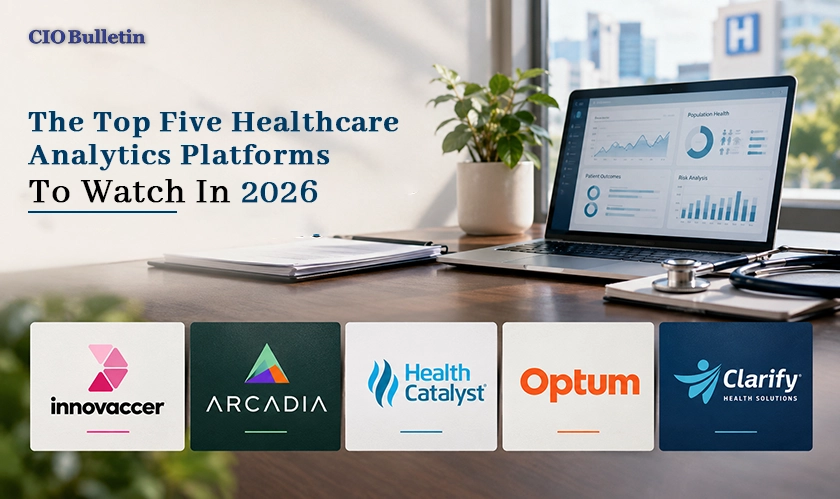
A more detailed examination of the current health IT landscape shows that there are five notable technology platforms providing transformative data insights to American hospitals, health plans, and medical networks.
Innovaccer, which is based in San Francisco, California, has become a leading company in the field of health data unification and population health management. Its Health Cloud platform is able to smoothly incorporate unstructured clinical records, billing claims, and pharmacy data from various electronic health record systems into a single patient profile. Through offering real-time decision support and automated risk stratification at the point of care, Innovaccer enables health networks to meet the requirements of value-based care contracts and to improve patient outcomes across the country.
Operating out of Boston, Massachusetts, Arcadia specializes in cloud-based data unification and financial performance tracking for health systems and health plans. The platform at Arcadia brings together clinical records from millions of patients in order to offer thorough risk adjustment, tracking of quality measures, and forecasting of the cost of care. By using its predictive modeling tools, care management teams are able to identify high-risk patients with chronic conditions early on, which enables medical staff to intervene before expensive emergency room visits take place.
Health Catalyst, which is based in Salt Lake City, Utah, provides an enterprise-class data platform designed to speed up clinical, operational, and financial improvements. By using its own Data Operating System, the company collects complicated clinical data in order to support predictive applications. Specialized algorithms supplied by the company assist medical centers in reducing hospital-acquired infections, improving the rate at which patients go through the emergency department, and getting rid of unnecessary clinical waste within large hospital networks.
Optum, which is based in Eden Prairie, Minnesota, offers deep intelligence capabilities covering the whole care continuum. By using its specialized clinical tools, it analyses huge amounts of claims, clinical encounters, and pharmaceutical data in order to give providers, health plans, and life sciences companies actionable insights. The company's predictive engines allow enterprise health systems to improve revenue cycle management, monitor population metrics, and simplify their complex clinical operations.
Clarify Health, which is based in San Francisco, California, provides advanced cloud software with the aim of evaluating provider performance and improving clinical referral networks. Communities around the country are carefully assessing the unique circumstances of its clients, insurance claims made, as well as various social determinants of health throughout the millions of patient journeys. With that information, the company can make an in-depth analysis of patient performance and the cost of healthcare services. Thus, using its unique platform, hospitals can build effective partnerships with healthcare providers and deliver a greater level of patient care in line with patients’ needs.
Why Is Data Integration Accelerating Across US Health Systems in 2026?
Healthcare executives often ask: Why has rapid data integration become the number one investment priority among American health systems at present?
This is driven by a recent shift toward value-based care reimbursement programs and an urgent lack of healthcare professionals in the US. Previously, hospitals operated on a fee-for-service principle, meaning that their revenues were directly connected to the number of services delivered. Currently, both state policies and insurance contracts connect payment agreements directly to the results of treatment and quality of patient care.
To achieve these high standards for quality, healthcare systems need to keep an eye on patients' health in real time. By using advanced artificial intelligence and automated data pipelines, manual administrative reporting can be eliminated so that doctors, nurses, and care coordinators can concentrate on providing direct patient care. Administrative teams can make their choice of solutions by looking at the best healthcare data analytics platforms 2026, since this will ensure that the selected solutions integrate well with current clinical workflows.
Balancing Clinical Innovation and Operational Realities
Major Strategic Advantages
The use of strong healthcare analytics software brings about real advantages at every stage of care. The medical history of patients is accessed by clinical teams at once, which decreases the necessity of repetitive diagnostic examinations and reduces the risk of negative drug interactions. From the operational viewpoint, forecasting tools allow facilities to balance staffing needs of nurses, manage operating room scheduling, and track the number of supplies in stock. Concerning healthcare plans, unified electronic data enables reliable risk adjustment processes and effective chronic disease management.
Real-World Industry Challenges
Despite these clear operational benefits, healthcare organizations face significant integration hurdles:
Strict Regulatory Compliance: Continual oversight is necessary if protected health information is to be safeguarded under the changing federal rules on data privacy and security.
Legacy System Interoperability: To integrate up-to-date cloud software with older electronic health record systems usually requires a good deal of IT resources and the creation of custom pipelines.
Clinical Workflow Adaptation: Getting busy physicians and healthcare teams to adopt new digital dashboards needs thorough training and a well-considered interface design.
The long-term advantages of data-driven medicine are without doubt. Organizations that utilize modern clinical intelligence technologies are able to improve patient outcomes while being free from administrative burdens.
Action Plan for Healthcare Executives and IT Leaders
Audit Existing Clinical Data Sources: Make a list of all the internal electronic health records, claims databases, and digital tools in order to spot the data silos.
Prioritize Interoperability Standards: Make sure that the newly purchased software platforms support open API architectures and standard healthcare data exchange protocols.
Enable Point-of-Care Insights: Enable point-of-care insights by providing predictive clinical alerts directly into the workflows of the physician's electronic health record system in order to reduce administrative friction.
Establish Cross-Functional Governance: Set up cross-functional governance by forming collaborative oversight committees that include the chief medical officers, nursing directors, and IT executives in order to guide the adoption of technology.
Leverage Predictive Healthcare Analytics: Use predictive healthcare analytics by employing AI-powered risk stratification models to spot patient groups that are becoming higher risk and then take proactive steps to deploy preventive care management resources.



















































 consultants ltd.jpg)


Comments