
Home Industry Insurance and capital markets Can a Global Equity Fund Guara...
CIO Bulletin,
19 June, 2026
Author:
Sambhrant Das
Sovereign macro easing drives historic multi-billion dollar capital reallocations into equity products as falling crude benchmarks relief public corporate balance sheets
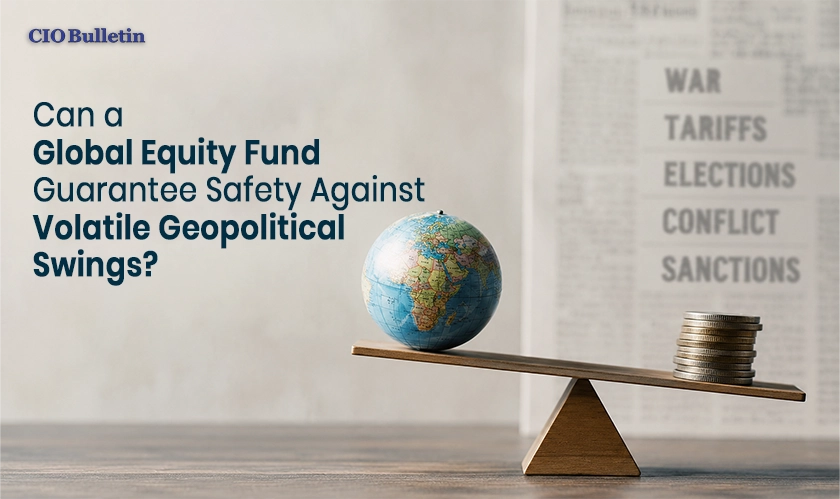
International capital networks are undergoing a significant structural realignment as cross-border peace breakthroughs unleash speculative enthusiasm. Investors looking to secure high-yielding liquid instruments are routing substantial asset pools into every major global equity fund to capture immediate post-war market momentum. This intense financial migration emerged immediately after an interim diplomatic memorandum was initialized between Washington and Tehran, helping to ease deep-seated maritime security anxieties. By flooding into these international vehicles, asset managers hope to ride a wave of relief buying triggered by the anticipated stabilization of critical energy lanes.
The sheer magnitude of this sudden capital reallocation has completely upended recent conservative market baselines, with institutional buy orders reaching velocity scales not witnessed in months.
Nineteen-Month Highs: Cross-border equity metrics experienced their most aggressive upward surge since late 2024.
Tech Sector Dominance: High-density semiconductor indices captured over sixty percent of new capital allocations.
Weekly inflows into global equity funds hit 19-month highs on Iran deal optimism, exposing how deeply market participants craved structural relief. This massive wave of cash positioning occurred alongside a drop in crude benchmarks, giving corporate production models immediate breathing room.
"The reason for the optimism was Trump and the president of Iran signed the memorandum, and oil prices fell." - Peter Cardillo, chief market economist at Spartan Capital Securities
Transitioning toward normalized trade flows requires navigating complex domestic monetary policies that introduce subterranean volatility. Despite heavy capital inflows, global central banks maintain a highly disciplined hawkish posture.
Federal officials emphasize that persistent structural labor metrics necessitate sustained monetary limits.
European authorities retain secondary buffer protocols to cushion regional consumer lines against future commodity shocks.
As modern financial networks become dependent on sudden geopolitical adjustments to drive annual returns, asset managers are redefining long-term risk strategies. Moving away from rigid legacy hedging toward highly adaptable, multi-asset frameworks is becoming an absolute necessity for institutions managing billions in private capital. Re-engineering these basic allocation models ensures that investment desks secure foundational safety while participating fully in rapid market expansions. CIO Bulletin views this development as a stark reminder that modern capital flows are entirely bound to the fluid realities of global statecraft.

















 consultants ltd.jpg)


Comments