
Home Industry Law ethics and legal services How Much Does Car Insurance Go...
CIO Bulletin
,
08 September, 2026
Author:
Guest
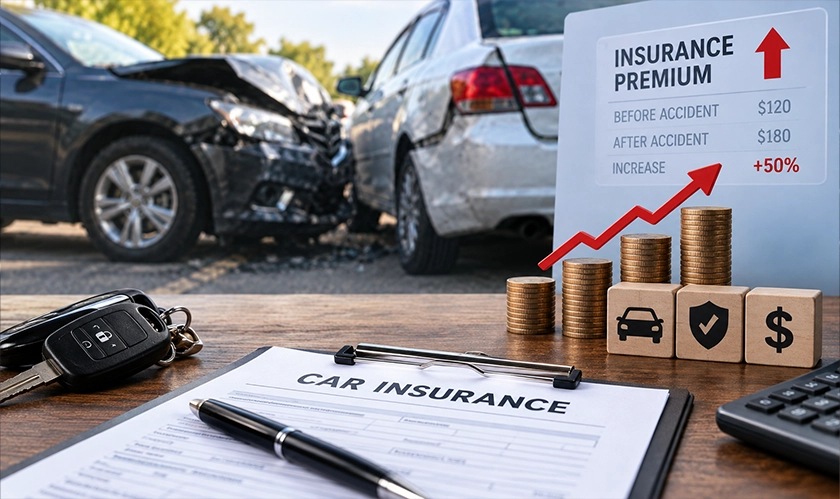
A car accident can affect more than the cost of repairing your vehicle. When your policy comes up for renewal, the insurer may look at the crash as part of your recent driving history. That can lead to a higher premium, although there is no standard increase that applies to every driver.
If you are trying to understand how much does car insurance go up after an accident, it helps to look beyond a single percentage. Insurers review the circumstances of the crash, the claim that was paid, and the driver's previous record before deciding whether the policy price should change.
Insurance pricing is based on the risk an insurer believes a driver presents. Because each driver's history is different, two people involved in similar accidents may receive very different renewal quotes.
Consider a driver who has had a clean record for several years and then causes a minor collision. Compare that with someone who has already filed several claims within a shorter period. Even if the newest accident causes similar vehicle damage, the insurer has a different history to review for each customer.
This is why asking what happened to a friend's premium usually gives you limited guidance about your own policy.
One of the first questions an insurance company may examine is who caused the accident.
An at-fault collision can create a greater chance of a rate increase because the insurer may have paid for property damage or injury claims connected with the driver's actions. A crash where another driver was responsible can be treated differently, depending on the policy, the insurer, and applicable state rules.
Fault can also be disputed. Police reports, statements from the drivers, witness accounts, and other evidence may be reviewed before an insurer decides how the claim should be classified.
That classification can affect what happens when the policy is renewed.
A low-speed accident with limited vehicle damage does not create the same financial exposure as a collision that results in extensive repairs or a large bodily injury claim.
Insurance companies keep records of claims and the amounts paid under a policy. A larger payout can influence how the insurer evaluates future risk.
The final cost of a crash may also take time to become clear. Vehicle repairs can exceed the first estimate. Medical treatment may continue after the initial claim is reported. Those expenses can change the total amount the insurer ultimately pays.
This helps explain why the effect on a premium cannot always be estimated immediately after the accident.
An insurer does not usually view one accident in isolation. Your previous driving and claims history can provide additional context.
A driver with no recent accidents or violations may be treated differently from someone who has already had multiple incidents. Repeated claims can lead an insurer to see a higher chance of another claim in the future.
The age of earlier incidents can also be relevant. Accidents do not influence insurance pricing forever. Insurers generally review claims and driving history over a defined period, although the exact period varies between companies and policies.
For drivers, that means a premium increase after one accident does not necessarily become permanent.
Some policies include accident forgiveness. When the driver qualifies, the insurer may choose not to apply the usual surcharge after a first qualifying accident. The terms vary between insurance companies, so the policy language is more useful than assuming the benefit applies automatically.
It is worth checking whether accident forgiveness was already included in the policy before the crash. Some insurers offer it as an optional feature, while others make it available after a customer meets certain eligibility requirements.
Knowing what your policy includes can prevent surprises when the renewal notice arrives.
If your premium rises after an accident, the renewal quote from your current insurer is only one price in the market.
You can review the new premium against quotes from other insurers, but compare equivalent coverage. A cheaper policy may have a higher deductible or different limits, which can make the comparison misleading.
It also helps to ask your insurer how long the accident is expected to influence the policy. The landing page notes that insurers may review accident and claim history for several years. Knowing that period gives you a clearer idea of when the effect may begin to decrease.
There is no single number that tells every driver how much insurance will rise after a crash. The useful answer comes from looking at the accident itself, the claim record, and the terms of the policy. Once you understand how the insurer reached its decision, you are in a better position to evaluate the new rate and decide what to do next.


















































 consultants ltd.jpg)


Comments