
Home Other Blogs CIO Bulletin Analyzes the Shad...
CIO Bulletin
,
03 September, 2026
Author:
Ravathi Sunil
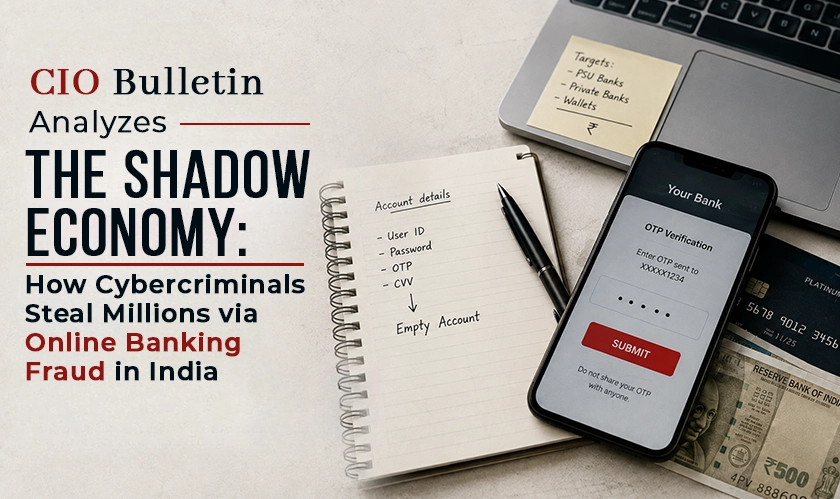
At 8:15 AM on a Tuesday, Rajesh, a mid-level manager in Bengaluru, received an urgent phone call while sipping his morning tea. The caller claimed to be a senior official from the central banking authority, warning him that his account was involved in an ongoing financial laundering investigation. Within twenty minutes, and without handing over a single physical rupee, Rajesh watched his life savings disappear into thin air.
This is not an isolated incident, but the daily reality of a rapidly growing shadow economy. CIO Bulletin observes that as India’s digital payment ecosystem expands at an unprecedented scale, sophisticated criminal syndicates are quietly executing automated psychological warfare on unsuspecting citizens. Understanding the anatomy of modern financial exploits is no longer just a technical exercise; it is an essential survival strategy in an increasingly cashless society.
Modern-day cyber heists don’t require anyone wearing a balaclava and physically accessing vaults or decrypting vital server information. Rather, modern-day syndicates prey upon the minds of people by exploiting human psychological vulnerabilities like fear and curiosity.
The Urgency Hook: The scammers will make first contact by telephone, text message, or instant message by creating some sort of urgent situation like a lapse in KYC, an unauthorized international money transfer, or litigation.
The Panic Mode: The victim is deliberately put under extreme pressure while on the phone so that the victim does not get a chance to confirm the identity of the caller.
The Credential Capture: Under the pretext of “fixing” the problem or “verifying their identity,” the criminal persuades the victim to divulge important credentials, grant remote screen access, or enter their transactional PIN code.
The Invisible Extraction: The automated scripts will quickly log in to the breached account, withdraw all available balances, and transfer the money to multiple online channels, without even hanging up on the phone.
The rise of cybercrime in India has introduced a dangerous array of specialized attack vectors designed to drain digital wallets across metropolitan hubs and rural centers alike.
The most widespread method relies on pure deception. Syndicates launch targeted online scams in India by establishing fake customer care numbers on search engines, running deceptive investment groups on instant messaging apps, and setting up elaborate "digital arrest" traps. Victims are coerced into transferring their own money to "safe government verification accounts" that are actually controlled by illicit syndicates.
To execute large-scale internet banking fraud, attackers deploy replica bank portals and malicious phone applications. The unsuspecting victims click on the links from SMS alert messages, which direct them to spoofed login pages. After entering their details, the attackers gain complete access to the account, make changes to the settings, and even add new beneficiaries.
Real-time peer-to-peer payment protocols have transformed daily commerce, but misunderstandings around how funds flow have triggered a wave of UPI fraud. Scammers send "Collect Money" requests disguised as cash-back rewards, marketplace sales proceeds, or tax refunds. Millions fall into the trap of entering their secret PIN, unaware that a PIN is entered only to pay or send money, never to receive it.
Despite advanced chip technologies, credit card fraud remains a persistent threat across digital channels. Criminals harvest sensitive card numbers, expiration dates, and security codes through dark web breaches, malicious browser extensions, and web-skimming scripts injected into compromised e-commerce checkouts. These details are then instantly monetized on foreign payment portals that bypass step-up authentication.
The Recovery Race: Time is Everything
0-15 Mins: Immediate Action - Call 1930 Cyber Helpline & notify bank.
15-60 Mins: Golden Hour - Bank attempts to freeze funds in mule accounts.
60+ Mins: High Risk - Stolen funds converted to crypto or cash at ATMs.
A major reason why cybercrime in India continues to surge is the invisible laundering engine operating beneath the surface. The moment stolen funds leave a victim's account, they do not sit in a single destination account.
Instead, automated software instantly fragments the capital and spreads it across thousands of "mule accounts", bank profiles opened using compromised identity documents, bought from vulnerable individuals, or created under shell business names. Within minutes, these fragmented amounts are withdrawn as physical cash from distant ATMs or converted into peer-to-peer cryptocurrency assets. This lightning-fast dispersion creates massive jurisdictional hurdles for law enforcement agencies attempting to trace and recover the capital before it vanishes entirely.
To effectively neutralize these evolving threats, defensive measures must combine institutional technological safeguards with strict individual vigilance.
Never Share One-Time Passwords (OTPs): Legitimate banking representatives, law enforcement officials, and customer support staff will never ask for confidential PINs, passwords, or one-time codes over a phone call or chat.
Verify Payment Requests Carefully: Always remember that receiving money via digital wallets requires no PIN entry. If a prompt requests a PIN, money is leaving your account.
Avoid Screen-Sharing Tools: Never install remote access applications or screen-sharing tools upon the request of an unverified caller claiming to fix a technical issue or unblock a banking account.
Bookmark Official Portals: Access internet banking services exclusively by typing official web addresses directly into browsers, avoiding sponsored search engine links or unsolicited text links.
Enable Multi-Factor & Biometric Security: Implement hardware-bound passkeys, strict transaction limits, and instant SMS/email notifications across every active financial service.
Increasing trends in financial digital hacks signify a momentous turning point in today’s economic system. Although financial organizations have continued to use artificial intelligence in order to detect abnormal transactions and identify suspicious transfer transactions on the go, technology alone cannot resolve the threat that is based on deceit. Systemic risk mitigation calls for collaboration through continuous public awareness, fast regulatory action, and effective cross-border enforcement mechanisms. According to CIO Bulletin, “Safeguarding a secure and successful digital financial ecosystem depends on the unshakeable discipline of zero trust digital practices,” where everything is authenticated, and every unauthenticated call is checked.
It is necessary to take action straight away for your online protection. You can protect yourself from the threats and secure your finances by changing your banking passwords, adding two-factor authentication to your payment portals, and lowering daily transaction limits on your mobile apps. If you or someone you know encounters a suspicious financial transaction, report it immediately to the national cybercrime helpline at “1930” or register an official complaint at cybercrime.gov.in within the "golden hour" to maximize the chances of freezing and recovering your funds.
Everything you need to know about this news
Threat actors use extreme psychological pressure, urgency, and authority impersonation, such as pretending to be police officers, tax officials, or bank managers, to induce panic and trick individuals into voluntarily handing over control of their funds.
The golden hour refers to the first 1 to 2 hours immediately following a fraudulent transaction. Reporting the incident to the 1930 helpline during this window gives banks and law enforcement the highest statistical probability of freezing the funds before they leave the mule network.
Screen-sharing applications allow attackers to view the victim’s phone or computer screen in real time. This gives them total visibility over incoming banking OTPs, account numbers, and personal details entered on the device.
A genuine incoming transfer will credit your account automatically without requiring a security PIN or passcode if a transaction prompt demands a PIN entry or asks you to approve a "Collect Request," money will be deducted from your account.
Banks are implementing AI-driven fraud detection engines, mandatory device-binding rules, real-time behavioral monitoring, and strict reporting integrations with central cybercrime networks to flag and block suspicious transfers instantly.




















































 consultants ltd.jpg)


Comments