
Home Industry Law ethics and legal services Why Prosecutors, Not Victims, ...
CIO Bulletin
,
20 October, 2026
Author:
Guest
Someone calls 911 after a loud argument in a Cocoa Beach condo. Police arrive, separate the two people, and within an hour one of them is in handcuffs. By morning, the person who made the call is telling anyone who'll listen that they never wanted an arrest. It's one of the most common scenes in Florida criminal law, and it surprises nearly everyone involved.
Here's the part people don't expect: the alleged victim can't take it back. Once a police report turns into charges, the decision to move forward belongs to the State. That's the short answer to the question so many couples ask after a rough night, can you drop a domestic violence case in Cocoa Beach, and it's worth sitting with because the rest of the process flows from it. This guide walks through who actually holds the power, what a "drop the charges" request really does, and which moves genuinely change the outcome.
People assume the case starts when someone decides to press charges. It doesn't. In Florida, the arrest sets everything in motion.
Florida's domestic violence law covers assault, battery, stalking, and a handful of related offenses between people who share a household, are married, or have a child together. Officers responding to those calls work under something close to a mandatory arrest framework. If there's probable cause and evidence of an injury, most departments make the arrest whether or not the person who called wants it.
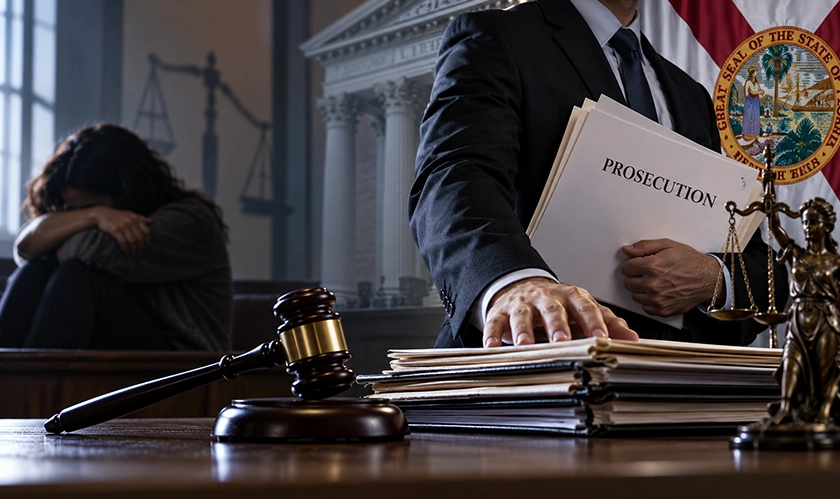
From there, the State Attorney's Office takes the wheel. Prosecutors review the report, the 911 audio, photos, and any body camera footage, and then they decide whether to file. The alleged victim isn't a party to that case. They're a witness. That distinction sounds technical. It's everything.
You can say it as many times as you like, to as many people as will listen. What happens next depends on who hears it.
If you tell a prosecutor you want the case gone, that statement lands in the file. It doesn't end the case. Prosecutors hear recantations constantly, and many of them treat a sudden change of heart as pressure rather than as new information. In a lot of instances, they aren't wrong about that.
If you tell the responding officer, that goes in the report too. Some people assume there's a form, a signature, a switch to flip. There isn't one. A witness can decline to cooperate, and that matters, but declining to cooperate isn't the same as dismissing.
What a request does accomplish is narrower. It gives the defense a piece of evidence about what the person closest to the situation actually wants. Skilled counsel uses that at the right moment. It just isn't a lever that works on its own.
The venue that matters most is the courtroom, and the currency is evidence. Prosecutors weigh a few things when deciding whether to push a weak case forward.
Whether the alleged victim is willing to testify, and how credible they'll be on the stand
Other proof that stands without them, including 911 recordings, photographs, medical records, and statements from neighbors
The defendant's record and whether there's any history between the two people
Whether a plea to a lesser offense resolves the matter for everyone
Notice what's absent from that list. A text message saying "I don't want to press charges" won't move a prosecutor who has photos and a recorded call. The evidence carries more weight than the wish.
Many Florida circuits run diversion programs for first-time domestic violence defendants. These usually involve an assessment, a set number of classes, and a period of good behavior. Finish it and the charge can be dropped. This is often where a case with a reluctant witness ends up, and it's frequently the best realistic outcome.
Sometimes the offer on the table is a plea to a lesser charge, like disorderly conduct or a simple battery with reduced conditions. Defense attorneys take these seriously because the alternative is a trial where the state's evidence might be stronger than the defendant assumes. That calculation should be made with a lawyer, not in a group chat.
Florida law gives alleged victims formal rights, including notice of court dates and the chance to be heard before sentencing. The Florida Courts maintain information on how those rights work in practice and how someone can register to receive case updates. That's a real voice in the process. It just isn't a veto.
There's a good reason the system works this way, even if it frustrates people in the moment. Domestic violence cases are the one category of crime where the person closest to the harm is also the person most likely to be pressured into silence. Prosecutors know this. So does everyone who practices in this area. If you've ever watched a case proceed over the stated wishes of the person involved, you've seen the logic at work.
It's a blunt instrument. Some cases go forward that probably shouldn't. I'd still rather have it than a system where a phone call from the right person makes an arrest disappear.
If you're in the middle of this, sequence matters more than urgency. Here's the order I'd follow.
Get a lawyer before you talk to anyone else. Not a friend who watches legal dramas. An attorney who handles domestic violence cases in Brevard County.
Stop coordinating with the other party. Continuing contact can be read as witness tampering, even when it's a marriage you're trying to save.
Preserve everything. Texts, voicemails, doorbell footage, timestamps. Screenshots get lost and phones get wiped. Save copies now.
Ask your attorney about diversion. It's the outcome most first-time defendants should want, and it's usually time-limited.
Show up to every court date. A missed appearance becomes its own problem, and it's the easiest one to avoid.
I'd add one more, though it's harder to act on. Don't assume the case follows the story you told yourself at the scene. The state has a different version, built from documents you haven't seen. Your first real chance to learn that version is discovery.
This isn't a rare corner of the law. Data from the U.S. Department of Justice shows that domestic violence accounts for a substantial share of violent crime reported to police nationwide, which is why every circuit in Florida has dedicated prosecutors, victim advocates, and court procedures built around these cases. Volume shapes outcomes. A county that handles these matters daily has a rhythm you should learn, preferably before your first appearance.
Florida's statutory framework around domestic violence, summarized on the state's official portal at flgov.com, is broad on purpose. It covers people who live together, share a child, or have a family relationship, and it reaches conduct that people don't always recognize as criminal. You don't need to memorize the statute. You do need a realistic picture of how quickly an arrest becomes a case that outlasts whatever prompted it.
The system isn't designed to punish the person who wants the case gone. It's built so the outcome doesn't rest on one voice during an emotional week. Frustrating, yes. Also probably right.
So what determines what happens next in a Cocoa Beach domestic violence case? Not the phone call. Not the apology. The evidence, the filing decision, and how quickly you get real advice. Which of those are you currently treating as optional?





















































 consultants ltd.jpg)


Comments