
Top 10 Breakthrough Companies to Watch 2026
Sustainable digital growth is rarely the result of technology alone. It comes from a clear strategy, disciplined execution, and the ability to turn complex business challenges into practical, measurable outcomes. Companies that succeed in competitive global markets are those that can organize their ideas, validate opportunities quickly, build efficient operations, and expand with confidence while staying focused on customer value and long-term impact.
This is where Design Strategy stands out. Founded in 2024, the company was built by experienced technology executives who have firsthand experience scaling products, structuring operations, and driving international expansion in both multinational corporations and high-growth startups. Combining more than two decades of executive expertise with proprietary AI capabilities, Design Strategy helps organizations accelerate the journey from early-stage concepts to globally competitive digital businesses.
Its structured four-stage acceleration model supports companies at any phase of growth, from Foundation & Clarity and Traction & Validation to Scale & Efficiency and Expansion & New Markets. The approach is grounded in the publicly available MIT CISR “Five Building Blocks of Digital Transformation” framework and is strengthened by ArchGenerator.com, the company’s proprietary Architecture Intelligence platform, which delivers rapid, evidence-based diagnostics and actionable roadmaps.
With operations in São Paulo, Brazil, and Austin, Texas, Design Strategy brings a practical understanding of the Brazilian, American, and European markets. More than a traditional consultancy, the company works alongside its clients as a strategic execution partner, combining human expertise, AI-driven intelligence, and assessable execution to help technology companies scale efficiently, expand internationally, and compete with confidence.
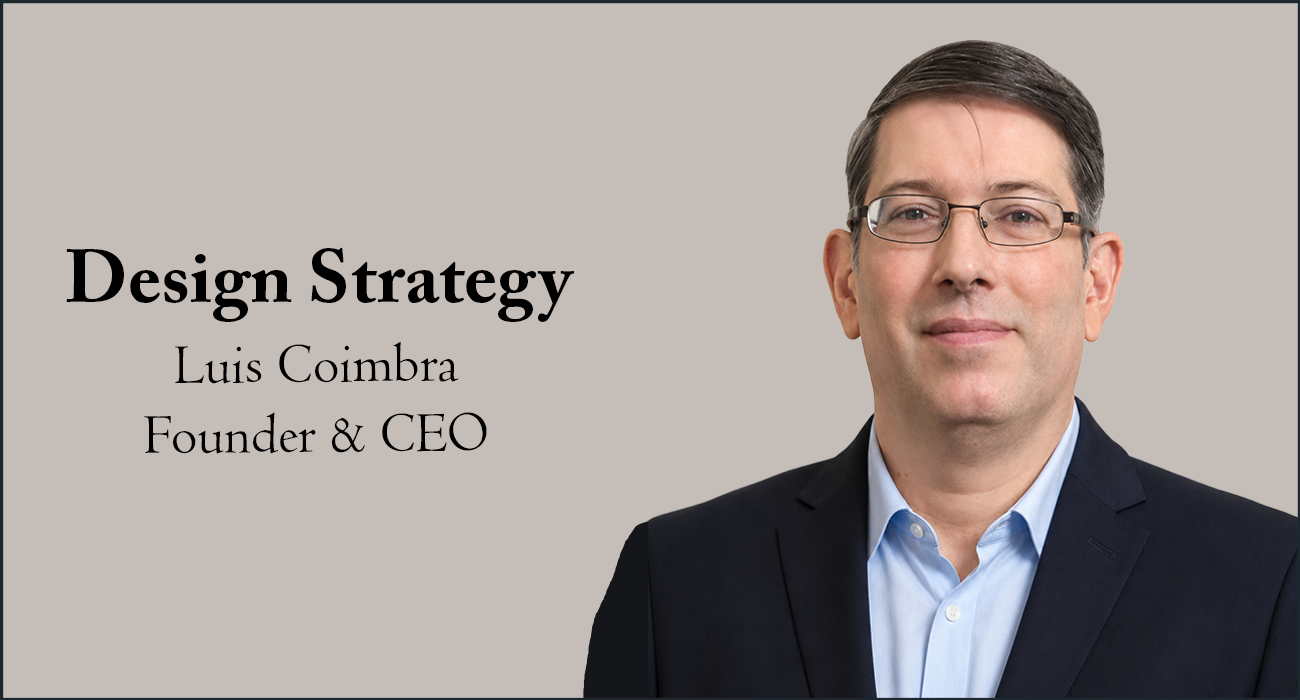
At CIO Bulletin, we had the privilege of interviewing Luis Coimbra, Founder and CEO of Design Strategy. In the conversation, he shared how the company is advancing digital transformation by uniting seasoned executive expertise, proprietary AI capabilities, and a focused execution framework, enabling organizations to move from traditional operations to autonomous, scalable Service-as-Software solutions that deliver clear and measurable business value.
Interview Highlights
What inspired the founding of Design Strategy in 2024, and how did your team’s executive experience at global technology companies shape its mission?
Design Strategy was founded in 2024 after we saw the same problem repeated across large technology organizations: companies were moving fast with cloud, SaaS, and AI, but their software architecture was not keeping pace. In executive roles at global technology companies, we watched leaders invest heavily in transformation while operating on undocumented, tightly coupled systems. That shaped our mission. We created Design Strategy to turn architecture from a slow consulting exercise into a scalable capability and to make it a driver of growth, resilience, and business continuity.
Could you share the journey behind transitioning from consulting roots in Brazil to establishing a U.S. presence in Austin, Texas, and what this dual-market footprint means for your clients?
Our roots are in Brazil, where transformation projects require speed, technical depth, and practical execution. That environment helped us refine a methodology built on solving complex architecture and modernization problems under real business pressure. As we matured, we realized these challenges were global, not regional. Establishing Design Strategy in Austin gave us proximity to the U.S. technology market while preserving the agility we developed in Brazil. For clients, this dual footprint means a stronger combination of delivery discipline, an international perspective, and access to both mature and fast-moving innovation ecosystems.
Could you walk us through your core products and services, and explain what differentiates Design Strategy from traditional consulting and SaaS providers?
Our flagship product is ArchGenerator.com, an Architecture Intelligence platform we describe as the operating system for software architecture. ArchGenerator.com reads evidence directly from source code to reveal how systems are actually structured and support architecture decisions with greater context and traceability.
What differentiates us is that we combine strategic architecture thinking with productized execution. Traditional consulting often depends on interviews, workshops, and static diagrams. Generic SaaS tools may automate coding tasks but lack architectural understanding. We codify architecture expertise into software designed to remain current, actionable, and useful for both enterprises and consulting partners. ArchGenerator.com is being prepared for controlled validation with qualified early-access participants.
Design Strategy positions itself as a Service-as-Software builder. How does this model redefine the way organizations approach digital transformation and AI adoption?
Service-as-Software means turning high-value expert services into repeatable software capabilities. In digital transformation, that matters because companies can no longer afford months of manual discovery before acting. With our model, architectural visibility and governance become continuous rather than episodic.
This is especially important for AI adoption. Many organizations are accelerating AI initiatives, but without structural visibility, they risk creating technical debt at machine speed. Our model gives them an always-on architecture layer that supports change, reduces uncertainty, and makes AI adoption safer and more scalable across the enterprise.
Design Strategy’s four-stage acceleration framework takes companies from foundation to international expansion. How does this structured approach help clients achieve faster, more sustainable growth compared to conventional transformation models?
Our four-stage framework—Foundation, Growth, Scale, and International Expansion—helps clients grow in sequence rather than in chaos. Conventional transformation models often try to scale products, teams, or regions before the underlying architecture is ready, which creates friction and compounding debt.
We use ArchGenerator.com to strengthen the foundation first by making the current architecture visible. From there, clients can evolve their systems with more confidence through the growth and scale stages, and prepare for international expansion with a structure that is more modular and governable. The result is faster progress with less rework and a much stronger ability to sustain growth over time.
Your methodology is grounded in MIT CISR’s Five Building Blocks framework while being accelerated by proprietary AI agents. What makes this combination particularly effective for technology companies aiming for global scale?
MIT CISR’s Five Building Blocks provide a strong strategic framework for designing organizations that can scale with discipline. The challenge is that applying those principles manually across modern software estates is slow and expensive.
Our advantage is that we automate much of that architectural work through ArchGenerator.com, which is an ecosystem of specialized architecture agents. These agents translate strategic principles into architectural evidence and operating decisions much faster than manual methods. This combination works because it unites a proven management framework with machine-speed execution. For technology companies, that means strategy is no longer disconnected from software reality.
How can your proprietary AI agents, such as ArchGenerator.com, help reduce diagnostic time in digital transformation projects?
Most transformation projects slow down during the initial diagnostic phase. Teams spend months trying to understand the current architecture, validate diagrams, locate dependency risks, and identify technical debt before they can move safely.
ArchGenerator.com is designed to compress that cycle. By reading the codebase directly, its specialized agents help identify boundaries, dependencies, drift, and coupling faster than exclusively manual approaches. Within a defined scope, the goal is to produce a usable architectural baseline in less time and reduce repeated diagnostic work. This can help teams move from uncertainty to execution with greater agility.
As one of the “Top 10 Breakthrough Companies to Watch in 2026,” how is Design Strategy redefining the role of AI in helping American and global technology firms compete on the international stage?
We believe the next phase of AI in software is not simply faster code generation; it is better architectural decision-making at scale. Many firms still evaluate AI mainly through productivity metrics, but productivity without structural discipline can create fragile systems.
Through ArchGenerator.com, we place architecture and governance at the center of AI adoption. That helps enterprises and consulting partners use AI with context, control, and continuity. International competitiveness now depends not only on moving faster, but on building systems that can expand across products, markets, and geographies without losing coherence. That is the role we are helping our clients play.
Looking ahead to 2026 and beyond, what is next for Design Strategy? Are there any exciting new products or services in the pipeline that your clients should be particularly enthusiastic about?
Our focus is to continue evolving the ArchGenerator.com ecosystem. The platform is being developed to deliver continuously updated architectural visibility and governance. The next step is to deepen guidance and support for remediation.
We are evolving specialized agents that can recommend improvements, support modernization roadmaps, and help consulting firms deliver more valuable transformation outcomes to their clients. That is exciting because it allows partners to sell not only diagnosis, but transformation that is grounded in real architectural evidence from the code itself. Our long-term vision is to make Architecture Intelligence continuously operational.
Does your company have a critical application and an architecture decision it cannot afford to get wrong? Explore ArchGenerator.com and consider whether an initial Architecture Intelligence conversation makes sense for your context
Luis Coimbra | Founder and CEO
Luis Coimbra is a technology executive focused on enterprise architecture, SaaS transformation, and AI-driven modernization. Over the course of his career, he has helped organizations connect strategic ambition with scalable operating and software structures. He founded Design Strategy after recognizing that architecture work was still too dependent on manual analysis and static documentation. Under his leadership, the company has built ArchGenerator.com as a new category of Architecture Intelligence platform designed to make growth, modernization, and AI adoption more deterministic.












































 consultants ltd.jpg)


