
Top 10 Breakthrough Companies to Watch 2026
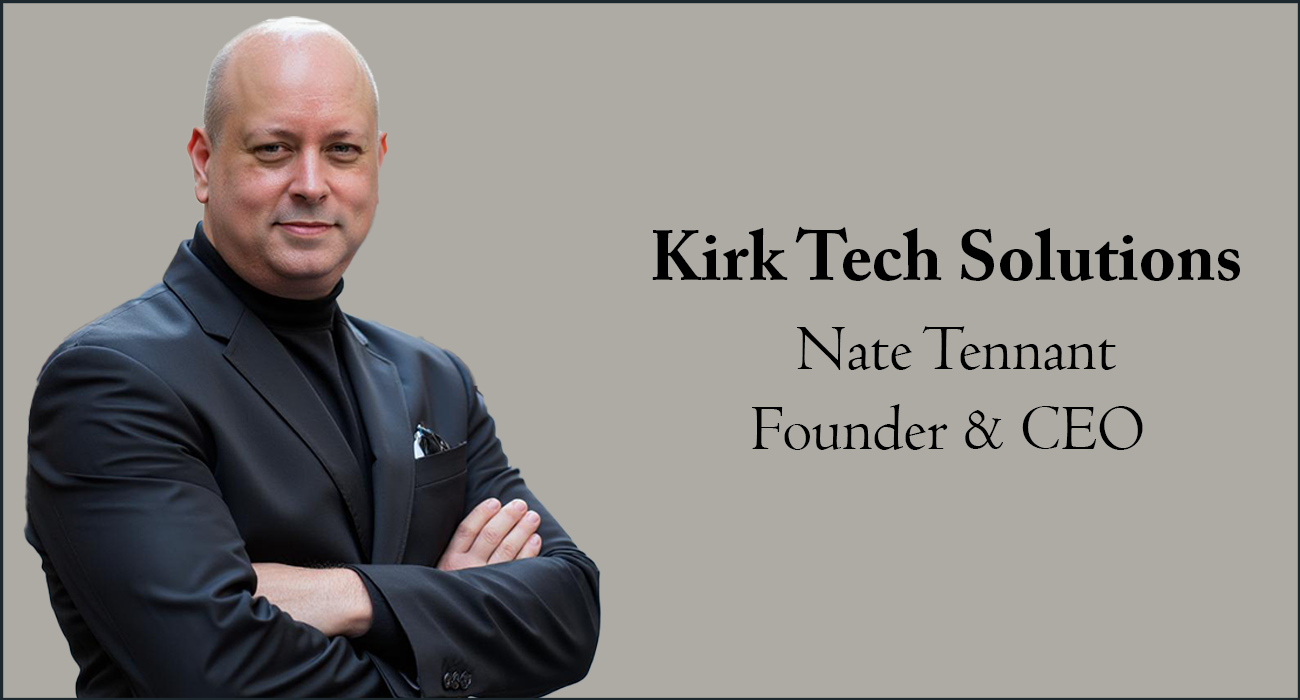
Technology creates opportunities, but lasting business value comes from applying it with clarity, purpose, and discipline. As organizations rethink the way they operate, the real challenge is no longer adopting the latest innovation; it is building solutions that are secure, practical, and capable of delivering measurable results. The companies making the greatest impact are those that combine deep technical expertise with a clear understanding of business priorities, helping enterprises modernize with confidence while keeping people, performance, and long-term growth at the center of every decision.
That philosophy has defined Kirk Tech Solutions since its founding in 2006. Over the years, the company has built a reputation for helping organizations solve complex technology challenges through enterprise AI, cloud infrastructure, IoT, digital engineering, and system integration. Serving clients across technology, healthcare, financial services, MedTech, and eCommerce, Kirk Tech Solutions delivers solutions that strengthen operations, connect critical data, and create lasting business value.
Its experienced team has worked in advanced AI, distributed systems, cloud platforms, and enterprise data long before these technologies became mainstream, bringing practical knowledge shaped by years of real-world execution. Today, the company helps organizations deploy secure, production-ready AI while maintaining full control of their data, systems, and governance through its open-source private AI coworker platform, FlatClaw. Supported by expertise across cloud architecture, enterprise integration, custom software development, and connected IoT ecosystems, Kirk Tech Solutions transforms ambitious technology goals into scalable business outcomes. By combining senior engineering talent with a hands-on, partnership-driven approach, the company continues to help organizations build stronger digital foundations and confidently prepare for the opportunities ahead.
At CIO Bulletin, we had the distinct privilege of interviewing Nate Tennant, Founder and CEO of Kirk Tech Solutions. During the conversation, he shared valuable insights into the company's vision, its commitment to solving complex business challenges, and the principles that have shaped its approach to delivering innovative technology solutions. He also discussed how Kirk Tech Solutions combines deep industry expertise with a client-centric mindset to help organizations across technology, financial services, healthcare, and other sectors achieve meaningful, measurable outcomes.
In Conversation with Nate Tennant
What inspired the founding of Kirk Tech Solutions in 2006, and how has the company's vision evolved from building world-class websites and driving paid media revenue to becoming a leader in enterprise AI and multi-cloud infrastructure?
We started in Portsmouth, New Hampshire, in 2006, building websites and driving measurable marketing revenue. The company changed because our clients did. We kept winning work with banks, financial institutions, and large pharmaceutical companies, and their problems stopped being about websites and started being about data, integration, security, and scale. So we hired ahead of the curve, adding experts in cloud computing, technology transfer, big data mining, and AI, and opened our New Delhi engineering office within two years of founding. The vision never really changed: understand the client's business first, then build technology that works as promised. What changed was the size of the problems. Today, that means enterprise AI and multi-cloud infrastructure, delivered with the same discipline we learned while shipping websites that had to convert.
What are the core products and services Kirk Tech Solutions offers today, and what truly distinguishes the company in the global market?
Today, we are an AI engineering firm and enterprise IT consultancy. The core practice areas are enterprise AI infrastructure, IoT and connected systems, multi-cloud architecture across AWS, Azure, and Google Cloud, digital engineering, enterprise integration and data platforms, and eCommerce. We also develop FlatClaw, our open-source private AI platform, which I will come back to. What distinguishes us is summed up in three words on our homepage: help, not hype. Clients get senior engineers, not a sales layer; production-ready architecture, not a demo that dies in a pilot; and security designed in from the first whiteboard. We measure ourselves on business outcomes, and we stay through operations rather than disappearing at go-live. We behave like an engineering partner, not a vendor.
Can you walk us through the FlatClaw Private AI Coworker Platform and how it helps enterprises overcome vendor pricing volatility and data sovereignty challenges through customer-controlled infrastructure?
FlatClaw delivers private AI coworkers that work with your organization's knowledge while sensitive data stays entirely under your control. Everything, the platform and the open AI models themselves, runs inside infrastructure you control, with secure role-based access to your data and applications. We operate on a Red Hat-style model: the software is open source, and the subscription buys deployment, certified releases, support, and operations. That answers the two questions every enterprise is asking right now. On sovereignty, your documents never leave your tenant, and no outside vendor can change, meter, or retire the model underneath you. On pricing, FlatClaw is flat-cost with no per-token surprises, and running current open-source models on your own infrastructure is typically 15 to 20 times cheaper than the large public models.
What makes Kirk Tech Solutions' approach to IoT ecosystems uniquely effective across healthcare, manufacturing, and logistics, especially given your success with secure, large-scale platforms like the connected respiratory-therapy solution?
We treat IoT as an enterprise data problem, not a device problem. Anyone can connect hardware; the hard part is what happens next: security, compliance, and turning device data into something the business can act on. The connected respiratory-therapy platform is a good example because it demanded all three at once: medical devices at scale, patient-adjacent data with real regulatory constraints, and years of reliable production operation. That same discipline carries directly into manufacturing and logistics, where a device fleet only pays off when its data lands governed, integrated with the systems you already run, and usable by the people who make decisions.
With expertise spanning AWS, Azure, and Google Cloud, how does Kirk Tech Solutions help organizations navigate multi-cloud strategies while ensuring security, governance, and integration with legacy systems?
We meet clients where they already are. Most enterprises did not choose multi-cloud; they inherited it through acquisitions, departments, and history. Our approach starts with identity, security, and governance as the foundation rather than the afterthought, then treats legacy integration as first-class engineering instead of a line item. We architect for portability so clients keep leverage over their providers, and we are honest about the boring truth: the right cloud is usually the one your team can actually operate. Certified depth across all three platforms means our recommendation follows the client's needs, not a reseller agreement.
Data modernization and enterprise integration are central to your offerings.What are the most common "hidden" challenges you help clients overcome when unifying fragmented data landscapes to enable scalable AI?
The biggest hidden challenge is that fragmented data is really a fragmented org chart. Every system encodes one department's habits, definitions, and shortcuts, so unifying data means reconciling meanings, not just moving tables. Close behind are ownership and permissions, which nobody has mapped, and years of quiet quality debt, fields repurposed long ago that only one veteran employee understands. The myth we spend the most time correcting is that AI fixes fragmented data. It does the opposite: AI amplifies whatever you feed it. So we govern first, consolidate what needs auditability, leave in place what should stay put, and query it there, and only then put AI on top. That order is the difference between a platform and a science project.
How does your team's early expertise in advanced AI and distributed systems shape the way you tackle "Thrive on the Tough Stuff" projects for global enterprises?
It means we start from failure modes, not demos. Our engineering leadership grew up in distributed systems and large-scale data, including patented work in search and big data, long before the current AI wave. When you have operated systems at that scale, you design for the day after go-live: what breaks, who gets paged, how it recovers, how it is audited. Tough projects are tough because of constraints, compliance, legacy, uptime, scale, and constraints are exactly where experienced engineers earn their keep. We prototype quickly, but we ship things built to be boring in production. That is what thriving on the tough stuff means in practice: calm engineering where the constraints are hardest.
Could you share insights from one or two standout case studies or client testimonials that best illustrate the tangible business impact of your AI, cloud, and IoT solutions?
Two examples show the range. The connected respiratory-therapy platform paired a global healthcare client's device fleet with secure, compliant data infrastructure and has run in production for years; the impact is that clinicians and product teams can act on device data they previously could not see, inside hard regulatory boundaries. More recently, our FlatClaw engagements show the same pattern in new industries: preconstruction estimating teams using private AI to read entire bid sets, verify equipment quantities against their own proposals, and multi-brand manufacturers consolidating fragmented financials onto a governed private platform. In every case the story is identical: the client's own data, made trustworthy, then made fast.
Looking ahead, what excites you most about the future of Kirk Tech Solutions? Are there any new products or services in the pipeline that your clients and the industry should be particularly enthusiastic about?
What excites me most is private AI graduating from pilots to a genuine workforce that enterprises own rather than rent. On the FlatClaw side, the pipeline includes domain packs that arrive ready to work, document and estimating intelligence, financial consolidation, vision capabilities on dedicated GPUs, and knowledge systems that learn from every correction a team makes so the platform gets smarter with use. We keep sharing what we learn, from our daily 90-second “Kirkie” AI briefing to the Ai4 2026 stage in Las Vegas this August. The through-line is the same as it was in 2006: practical technology, owned by the client, that works as promised.
The Visionary Leader Behind Kirk Tech Solutions’ Success
Nate Tennant is the Founder and CEO of Kirk Tech Solutions. Nate founded Kirk Tech Solutions in 2006 and has led its evolution from a New Hampshire web firm into an AI engineering and enterprise IT consultancy with offices in Portsmouth and New Delhi. His two decades of experience span security, infrastructure, IoT, cloud, AI, eCommerce, and digital transformation, and he remains hands-on with strategy and technology for every major engagement. Recent recognition includes Business NH Magazine naming Kirk the #2 Private Company to Watch for 2025, a featured founder interview in CEOCFO Magazine, and an appearance on the BizcastNH podcast.














































 consultants ltd.jpg)


