
Home Industry Management consulting Office Humidifiers: The Workpl...
CIO Bulletin
,
11 June, 2026
Author:
Guest
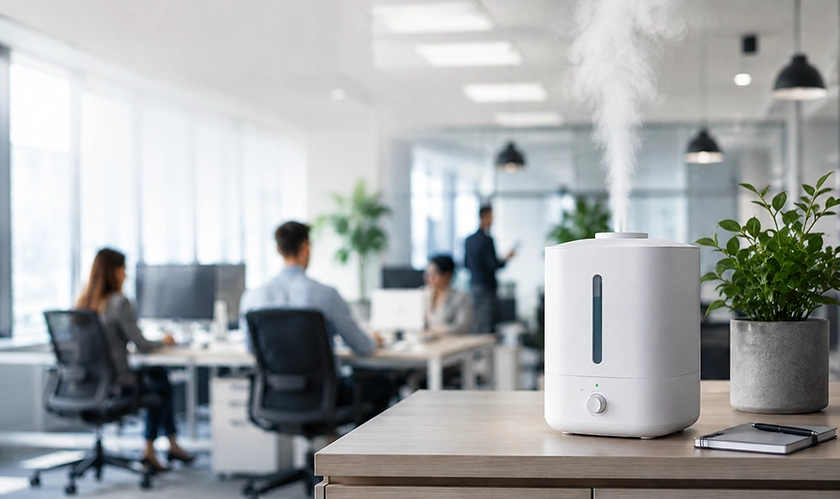
The quality of air inside an office building has a direct and measurable effect on the people who work in it every day. While most facility managers focus on temperature control and ventilation, humidity is an equally important variable that frequently goes unmanaged until visible problems arise. Chronically dry office air leads to health complaints, increased sick days, and damage to equipment and furnishings that accumulates quietly over time.
In this article, we explore why humidity control deserves a dedicated place in every office facility management strategy. You will learn how commercial humidification technology works, what it delivers for employee health and business performance, and what to consider when selecting a system suited to your workplace.
Key Takeaways
Office environments with relative humidity below 30 percent see higher rates of respiratory illness, absenteeism, and employee discomfort
Commercial-grade evaporative fog humidifiers deliver moisture safely into occupied office spaces without wetting surfaces or creating condensation
Smart automation allows humidity levels to be maintained precisely across multiple office zones without manual intervention
Proper humidity control extends the lifespan of electronics, wood furniture, and other office assets
The energy efficiency of modern commercial humidifiers makes them a sustainable and cost-effective long-term investment for office facilities
Office buildings are sealed environments where air is recirculated continuously through HVAC systems designed primarily for temperature management. During colder months, heating systems strip moisture from the air at a rapid rate, and without active humidification, indoor relative humidity can fall well below the levels considered healthy for occupied spaces. The problem is widespread and affects offices across climates and building types.
Most employees attribute the symptoms of dry air to seasonal illness or general fatigue rather than their indoor environment. This misattribution means the underlying cause goes unaddressed, and the cycle of discomfort, reduced productivity, and increased sick leave continues season after season.
When relative humidity drops below 30 percent, the body's natural defenses against airborne pathogens are compromised. The mucous membranes lining the nose and throat dry out and become less effective at trapping and neutralizing viruses and bacteria before they reach the lungs. In an enclosed office environment where air is shared among many people, this significantly raises the likelihood of illness spreading through the workforce.
Beyond immune function, dry air causes eye irritation, headaches, dry skin, and throat discomfort that make sustained concentration difficult. Employees dealing with these symptoms throughout the workday are less productive, more likely to take sick leave, and more likely to report lower job satisfaction in workplace surveys. These outcomes carry real operational costs that most organizations have never traced back to their indoor humidity levels.
Office furniture, flooring, and fixtures made from wood or wood composites are particularly vulnerable to chronically low humidity. Moisture loss causes wood to contract, crack, and warp over time, leading to costly repairs or premature replacement of desks, cabinetry, and flooring. These are depreciating assets that should last years longer than they do when humidity is left unmanaged.
Electronics represent another significant area of risk. Dry air generates static electricity, and electrostatic discharge events can corrupt data storage devices, damage circuit boards, and shorten the operational life of computers, servers, and peripheral equipment. For offices with large technology footprints, the cumulative cost of static-related hardware failures is a preventable expense that proper humidification directly eliminates.
Commercial office humidification has advanced well beyond the consumer-grade portable units many people are familiar with. Purpose-built systems for commercial environments are engineered for precision, reliability, and safe operation in continuously occupied spaces. Understanding how they function helps facility managers and building owners evaluate options with clarity and confidence.
High-pressure fog systems generate ultra-fine water droplets by forcing filtered water through precision-engineered nozzles at pressures typically ranging from 1,000 to 1,500 PSI. The droplets produced are small enough to flash-evaporate completely before contacting any surface, which means floors, walls, workstations, and equipment remain dry even while the system is actively humidifying. This characteristic makes fog technology uniquely suited to occupied office environments where surface wetting would be unacceptable.
Purpose-designed office humidifiers using this evaporative approach also produce a mild cooling effect as droplets evaporate, which can reduce the burden on air conditioning systems during warmer months. This dual functionality improves the overall efficiency of the building's climate control infrastructure. Unlike steam humidifiers, which require significant electrical energy to boil water, fog systems operate at a fraction of the energy cost while delivering comparable or superior humidity performance.
Modern commercial humidification systems are built around intelligent control platforms that receive real-time data from humidity sensors distributed throughout the office. When sensors detect that humidity in a particular zone has fallen below the preset threshold, the system activates automatically and adjusts output until the target level is restored. This eliminates the need for manual monitoring and ensures consistent conditions are maintained even during fluctuating occupancy patterns or weather changes.
Many systems support integration with building management platforms via standard protocols such as BACnet or Modbus, allowing humidity control to be managed alongside heating, cooling, and ventilation from a unified interface. Remote access via cloud dashboards gives facility managers visibility into conditions across multiple floors or buildings from a single point, with automated alerts flagging any readings that fall outside acceptable ranges.
Framing office humidification as a business investment rather than a facility amenity changes the conversation in budget discussions. The returns are measurable across workforce productivity, asset protection, and energy consumption, and they compound over time as the system continues to operate. Organizations that have made this investment consistently find the financial justification straightforward once the full picture of costs and savings is taken into account.
Research in workplace environmental quality consistently identifies indoor air conditions as a significant driver of cognitive performance. Studies have shown that workers in environments with well-controlled humidity and air quality demonstrate better concentration, faster information processing, and lower error rates than those in suboptimal conditions. For knowledge-based organizations where the quality of thinking directly determines output quality, this is a meaningful competitive consideration.
Reduced absenteeism is among the most quantifiable benefits. When organizations track sick day usage by season and correlate it with humidity data, the relationship between low humidity and increased illness-related absence becomes clear. Even a modest reduction in sick days across a mid-sized workforce produces measurable payroll and continuity savings that contribute directly to the return on investment calculation for humidification infrastructure.
The static electricity generated by dry office air shortens the lifespan of computers, monitors, printers, and other electronic equipment in ways that most IT departments track as hardware failure without identifying the environmental cause. Installing proper humidification reduces the incidence of electrostatic discharge events, extending the functional life of office technology and reducing the frequency of replacement purchases. Over a multi-year asset depreciation cycle, this saving is substantial.
Wood furniture, flooring, and architectural millwork also benefit significantly from stable humidity. Conference tables, executive desks, reception counters, and hardwood flooring represent major capital investments that deteriorate faster in dry conditions. Maintaining appropriate humidity preserves both the aesthetic and structural integrity of these assets, extending replacement cycles and protecting the investment the organization has made in its physical workspace.
Organizations under pressure to meet environmental, social, and governance targets increasingly look to facility operations as a lever for reducing their carbon footprint. High-pressure fog humidification systems consume substantially less energy than steam-based alternatives, and their secondary cooling effect reduces air conditioning energy draw during warmer periods. Both factors contribute to lower utility consumption and a smaller operational carbon footprint.
For organizations pursuing LEED certification or similar green building credentials, documented improvements in indoor air quality and energy efficiency from humidification upgrades can contribute to scoring across multiple categories. Facility managers who can present humidity control as part of a broader sustainability strategy are more likely to secure leadership buy-in and budget approval for system installation.
Selecting a commercial humidification system requires a methodical evaluation process that accounts for building-specific variables, operational requirements, and long-term serviceability. The range of available systems is broad, and the right choice depends on factors that are unique to each office environment. Rushing this evaluation typically results in undersized, oversized, or poorly integrated systems that fail to deliver expected benefits.
The first step is a thorough environmental audit that maps current humidity conditions across all areas of the office, identifies zones with the greatest deficiency, and establishes the volume of humidification capacity required to achieve target conditions. Open-plan offices, enclosed meeting rooms, server rooms, and reception areas each present different requirements, and a system designed around actual measurements rather than floor area estimates will perform more reliably.
Building envelope characteristics such as insulation quality, window area, and air infiltration rates also affect humidification load. Older buildings with poor insulation lose moisture more rapidly than newer, well-sealed structures and may require higher system capacity to maintain the same interior conditions. These variables should be factored into capacity calculations before any equipment is specified.
An office humidification system that operates in isolation from the building's HVAC infrastructure is less effective and more difficult to manage than one that is properly integrated. Before selecting a system, facility managers should confirm that the proposed solution is compatible with existing air handling units, ductwork configurations, and building automation platforms. Vendors who can provide reference installations in comparable office buildings are better positioned to deliver a successful integration.
Water quality is another integration consideration. High-pressure fog systems require filtered water to prevent nozzle fouling and ensure that what is dispersed into the air is clean and free of minerals and contaminants. If the building's water supply does not meet system requirements, a reverse osmosis filtration unit will need to be incorporated into the installation plan. This is a standard addition that most experienced vendors can specify and supply as part of the overall system package.
The portable desktop and tower humidifiers commonly used in residential settings are fundamentally unsuited to commercial office environments. They lack the output capacity to meaningfully affect humidity in large or open-plan spaces, require constant manual refilling and cleaning, and use ultrasonic or evaporative wick technology that can disperse minerals and microbial contaminants into the air if not meticulously maintained. In an office setting, the burden of maintaining multiple consumer units across a large floor plate is operationally impractical.
Commercial systems, by contrast, are plumbed directly into the building's water supply, operate continuously without manual intervention, and incorporate filtration as a standard component. They are designed and certified for occupied commercial spaces, carry appropriate safety and performance credentials, and are supported by professional installation and maintenance services. The performance gap between a consumer unit placed on a desk and a properly specified commercial system is significant enough that the two categories should not be considered comparable solutions to the same problem.
For facility managers evaluating the transition from ad hoc portable units to a proper commercial system, the improvement in both performance and operational simplicity is immediate and obvious. A single integrated system covering an entire office floor delivers more consistent results with less ongoing attention than a collection of portable units ever could.
Office humidification is a facility investment with returns that extend across employee health, productivity, equipment longevity, and energy efficiency. The technology available today is precise, energy-efficient, and designed for seamless integration into modern office buildings. Organizations that continue to treat indoor humidity as an afterthought are absorbing preventable costs in absenteeism, equipment failure, and infrastructure deterioration.
The business case for commercial office humidifiers is clear, and the operational barriers to implementation are lower than most facility managers expect. Making humidity control a standard component of office facility management is one of the more straightforward upgrades available to organizations serious about the quality of their working environment.
Everything you need to know about this news
Most occupational health guidelines and ASHRAE standards recommend maintaining indoor relative humidity between 40 and 60 percent in occupied workspaces. Staying within this range minimizes airborne pathogen survival, reduces static electricity buildup, prevents moisture-related damage to materials and equipment, and supports the comfort and health of employees throughout the workday.
Yes, commercial high-pressure fog humidification systems are well suited to open-plan office environments. Because the system distributes moisture through evaporating droplets rather than visible mist or steam, large open spaces can be humidified evenly without creating localized wet spots or making the environment feel damp. Zoned configurations allow output to be targeted and adjusted independently across different areas of the floor plate.
High-quality commercial humidification systems incorporate water filtration, typically reverse osmosis, as a standard component of the installation. This ensures that only clean, mineral-free water is atomized and introduced into the office air. Filtration also protects the system's nozzles and pump components from fouling, extending service intervals and reducing maintenance costs over the life of the installation.
No. High-pressure fog systems consume significantly less energy than steam-based humidifiers because they do not require water to be heated. The energy draw of a commercial fog system is typically modest relative to the building's overall HVAC load. Additionally, the evaporative cooling effect produced by the system can reduce air conditioning runtime during warmer periods, partially or fully offsetting the energy cost of running the humidification system.
Service intervals depend on system size, usage patterns, and water quality, but most commercial fog humidification systems require periodic nozzle inspection, filter replacement, and annual pump servicing. Facilities using reverse osmosis filtration generally experience longer intervals between nozzle maintenance. Most vendors offer preventive maintenance contracts that schedule service during off-hours or weekends to avoid any disruption to normal office operations.
















































 consultants ltd.jpg)


