
Home Industry Market analysis Europe’s Natural Gas Market ...
Market Analysis
CIO Bulletin,
09 March, 2026
Author:
CIO Bulletin Team
The "New Normal" for Europe’s Natural Gas Market: Industrial Strain and Rising Prices
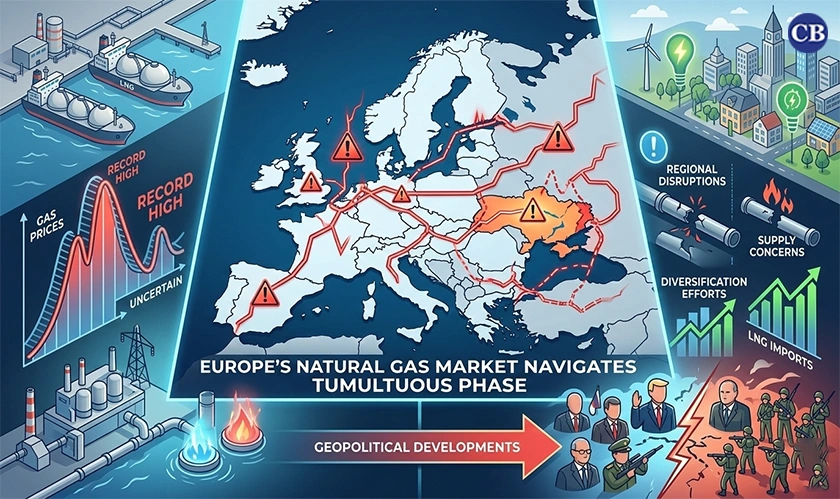
The European natural gas market is currently transforming rapidly, recovering from the volatile period of 2022-23 and consolidating on the process of gradually rebalancing since 2024. However, 2026 has presented fresh challenges that bring into the spotlight the gains until now and emphasize the need to keep energy security at the top of the regional agenda. Indicative of the shifting sands is Russian pipeline gas being replaced by Liquefied Natural Gas (LNG) to meet Europe’s energy needs. Recent industry data reinforces this change as the ‘new normal’, with LNG accounting for nearly half of all gas imports in 2025. Furthermore, the US supplied over 58% of that volume.
However, global shocks can still disturb the system despite the shift to LNG. For instance, the suspension of key export hubs and the escalating Middle East conflicts have caused prices to rise sharply. Officials are cognizant that restoring stability is all but a simple, linear solution, with gas prices in Europe reaching as high as €65/MWh – their highest level in three years.
Furthermore, changing consumption patterns due to externally induced constraints have led to shifting demand patterns. Industrial consumption has not been able to reach pre-crisis levels, only showing a slight recovery last year. Sectors like chemical manufacturing, for instance, have been unable to reach their full potential due to continuing high energy costs, as much as 2.5 times higher than in the US. On the other hand, the share of gas used for power generation is witnessing a decline. The existing power system is being replaced by both expanding renewable energy sources and individuals opting to use environmentally friendly energy for their electricity needs.
Going forward, the European Union needs to improve its infrastructure and energy storage systems as its main objective for future development. EU member states Germany and Croatia are working together to prevent energy storage resources from decreasing. Analysts expect gradual transitioning towards synthetic fuels and hydrogen in 2026, which will provide Europe with secure energy solutions that meet its long-term climate goals.
















 consultants ltd.jpg)


