
Home Industry Metals and mining Will Restraints on Rare Earth ...
CIO Bulletin
,
16 July, 2026
Author:
Sambhrant Das
IEA report warns of severe disruptions to sixty-five trillion dollars in western industrial markets if new critical mineral constraints take full effect
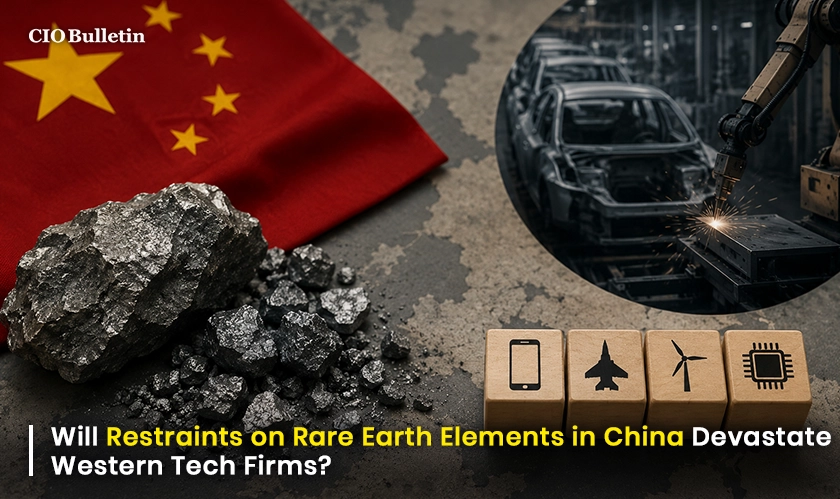
Securing stable access to critical raw materials has emerged as the ultimate modern geopolitical chess game. If the planned export controls on rare earth elements in China are fully implemented, they could jeopardize up to $6.5 trillion in global downstream economic activity. The International Energy Agency (IEA) reports that these seventeen essential metals are key to constructing everything from electric vehicles to advanced military defense installations.
The impending regulatory shifts are structured to affect high-technology sectors across North America and Europe, which represent nearly half of the estimated exposure. Industries relying heavily on magnet production face immediate bottlenecks:
High-performance electric vehicle motor lines could see severe input shortages.
Precision military radar and guidance system manufacturers risk sudden material gaps.
The extreme geographic concentration of mining and processing pipelines creates a highly fragile foundation for international technological development.
"Our latest analysis shows that vast amounts of economic value depend on relatively small volumes of critical minerals, whose supply chains remain highly concentrated and are therefore vulnerable," - Fatih Birol, IEA Executive Director.
This extreme reliance on single-nation networks continues to prompt Western governments to aggressively subsidize domestic recycling and extraction programs.
Despite the highly concentrated landscape, Western efforts to construct independent mining infrastructures are beginning to show modest progress. Public financing initiatives for alternative projects have surged, while new extraction operations in the United States and Malaysia have successfully chipped away at East Asian dominance. While complete supply chain decoupling remains highly complex, scaling alternative facilities serves as a vital insurance policy against sudden policy realignments.
Accelerating the transition toward green energy requires massive amounts of raw minerals that cannot be easily substituted overnight. Balancing this immense raw material appetite while navigating trade sanctions remains the primary hurdle for advanced manufacturing nations. According to CIO Bulletin, this development proves that building domestic refining infrastructure is the only viable path to securing long-term economic independence.
















































 consultants ltd.jpg)


Comments