
Home Platforms News How a Small Print Shop Chooses...

CIO Bulletin
,
22 October, 2026
Author:
Guest
Nine hundred dollars. That's what a single bad ink order cost me in my second year, and I didn't notice until the last gallon of a discontinued plastisol sat on the shelf turning into pudding. Nobody warns you that buying screen printing supplies is a forecasting problem dressed up as a shopping problem.
Here's what I promise you in the next few minutes: a way to sort every purchase into three buckets, a realistic starting list for a one-press shop, and the specific mistakes that quietly drain a few hundred dollars a month. I've watched a lot of printers learn this the hard way, including me, and most of the lesson fits on an index card.
Some shops solve it by ordering from a local distributor they can call when a screen mesh count doesn't show up in time. Others consolidate everything through a supply house that carries the full spread, from Xante printers to carbonless paper to screen printing supplies, so one invoice covers the whole week. Both work. The math changes once you track how often a rush order eats your margin.
I use a framework I call the Three Buckets Rule, and it fixes about 80 percent of ordering chaos. Every consumable in your shop belongs in exactly one bucket.
Always Stock: items you touch on more than half your jobs. Black plastisol, 110 and 156 mesh screens, emulsion, pallet tape, cleaning cards, tape. Keep at least two weeks of usage on the shelf.
Buy Per Job: specialty inks, fluorescent colors, puff and metallic additives, odd mesh counts, water-based inks in colors you print twice a year. Order when the purchase order lands, not before.
Never Stock: anything tied to one client who might vanish. Custom Pantone mixes for a single account, oversized frames for a format you tried once, promotional blanks you bought on a whim.
The middle bucket is where most new shops drown. My rule: if I haven't printed a color in six months, it goes in Buy Per Job, even if the gallon looks lonely on the shelf.
You can open with less than you think. A lot of the "starter kits" sold online carry items you'll replace within a month, and the bundles hide cheap squeegees behind a decent press. Spending your first thousand dollars on consumables instead of gear you'll outgrow is the better call.
According to startup guidance published by the Small Business Administration, managing inventory and cash flow is one of the most consistent challenges for new businesses. Translation for a print shop: your working capital is the shelf, and a shelf full of dead stock is money you can't spend on a second flash unit.
Here's the short list I'd hand a friend opening a one-color manual shop:
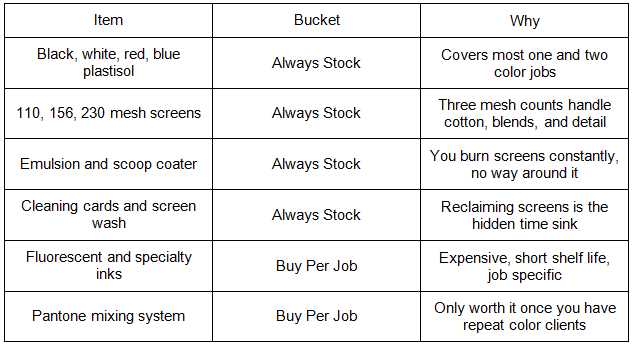
One more thing: buy squeegees in pairs. You'll thank yourself on the night one gets nicked and you're two hours from a deadline.
Look at your last twelve invoices. I'll bet the story is the same as mine was: a small order here, a small order there, each one paying full shipping because you waited until you were almost out. Those freight charges add up to a real number, and the discounts you'd get from a bigger consolidated order usually cover the cost of carrying extra inventory.
The printing trade has always been built on this kind of supply chain discipline. When Johannes Gutenberg set up his shop in the fifteenth century, his real innovation wasn't just the press, it was standardizing the materials around it so a job could be repeated. You can read more about how that played out through the Project Gutenberg archive, and the modern version of the same idea is simple: standardize your consumables so your process becomes repeatable. Predictable ordering is how a two-person shop competes with a warehouse operation.
My approach now: one big order a month, one small emergency order allowed, and everything else waits. The emergency allowance is there because production is production, but if you use it three months in a row, you have a forecasting problem, not a shipping problem.
These are the leaks I've watched chew through real dollars, in rough order of how much they sting.
Buying ink in quarts forever. Quarts are the training wheels. Once you're printing a color weekly, gallons cost less per ounce and you save the time of reordering. The exception is any color you're testing, and I'd argue that exception covers about half the inks new shops buy.
Ignoring shelf life. Plastisol lasts longer than water-based ink, but neither is immortal, especially in a hot shop with bad ventilation. Date every container with a marker when it arrives. If you don't, you'll find the pudding situation I mentioned, and you'll find it mid-job.
Underbuying cleaning supplies. Reclaiming is the least glamorous line item and the one I've seen people cut first. Cutting it just means screens sit dirty and you lose press time, which is the most expensive thing in your building.
Chasing every discount. Closeouts are great, when the item is something you already burn through. Buying a case of something you've never printed is not saving money. It's moving money from your bank account to your shelf.
Count what's on the shelf against two weeks of typical jobs.
Check expiry dates on water-based inks and emulsion.
Match this month's purchase orders to the ink colors you'll actually print.
Ask once: is this Always Stock, Buy Per Job, or Never Stock?
If a specialty item is on the list, confirm the job is booked before you click buy.
Place one consolidated order and log the spend against last month.
Run that six-step check for three months and you'll know your shop's real consumption pattern. From there, ordering stops being a guess.
Dead stock is just deferred spending, sitting on a shelf where it can't help you. Start with the buckets, date everything when it lands, and lean on the sources that carry the whole catalog so one order solves the whole week. Then ask yourself the only question that matters: if you listed every item in your shop tomorrow, how much of that shelf is stock, and how much is a bad memory? Clean out the second pile, and your next supply order gets a lot cheaper.





















































 consultants ltd.jpg)


Comments